
Skin and scar camouflage in Birmingham
Colour-matched skin camouflage for scars, pigmentation, redness and birthmarks
At Midland Skin we offer skin camouflage for scars and for visible skin conditions such as vitiligo, pigmentation, persistent redness and birthmarks, for patients in Birmingham, Solihull, Coventry, Wolverhampton, Worcester and the Midlands. You can book directly with our scar therapist; no referral or prior consultation is needed.


Quick Facts about scar camouflage

Best for
Scars, pigmentation, redness

Appointment
Initial skin camouflage

Treatment
Colour-matched camouflage

Downtime
None
Provider
Scar therapist

Price
See below
What is skin camouflage?
Skin camouflage, also called medical or cosmetic camouflage, uses specialist, highly pigmented creams that are matched to your skin tone and set with a fixing powder. Once set, the cream is water-resistant and designed to stay in place through the day. The aim is to reduce the colour contrast between a scar or skin condition and the surrounding skin, so the concern is less noticeable.
It is not a tattoo and it does not change the skin itself. It washes off with a cleanser and can be used as often or as rarely as you choose: every day, for a particular occasion, or only in summer when a scar is more visible.
It is used for scars and for a range of skin conditions that change the colour of the skin, whether darker, paler or redder. Camouflage can be used on the face or body and products are available for all skin tones. At Midland Skin it is one part of our scar service, which also includes scar therapy and treatments that aim to improve the scar itself.
Who is scar camouflage suitable for?
Camouflage can help when a fully healed, peferably flat scar is noticeably redder, darker or paler than the surrounding skin. It may be worth considering if you have:
- Surgical scars – including scars after skin cancer surgery or other operations
- Scars from injury, accidents or burns
- Acne or chickenpox scars – where discolouration, rather than indentation, is the main concern
- Self-harm scars
- Scars that are red, dark or pale against the surrounding skin – in any skin tone
- Scars in visible areas – face, neck, hands, arms or legs
- A particular occasion or season in mind – a wedding, a holiday or summer clothing
Camouflage is only applied to intact, fully healed skin. It is not suitable for wounds that are still healing, for broken, inflamed or infected skin, or for any mole or mark that has not been diagnosed. Your scar therapist checks this at your appointment and will suggest a consultant assessment if anything needs a doctor’s opinion first.
Skin conditions that can also be camouflaged
The same colour-matching approach works for skin conditions that change the colour of the skin. Camouflage may be worth considering for:
- Vitiligo – pale patches of lost pigment, which stand out most against darker skin tones
- Melasma and other hyperpigmentation – including post-inflammatory hyperpigmentation after acne, eczema or injury, lichen planus pigmentosus and sun-related pigmentation such as age spots
- Birthmarks – port-wine stains and other vascular birthmarks, café-au-lait patches and flat pigmented birthmarks
- Persistent redness – from rosacea or poikiloderma on the neck and chest
- Pale patches – post-inflammatory hypopigmentation or pale areas left after injury or treatment
- Stretch marks – established silver or white stretch marks on the body
- Tattoos – temporary cover for an occasion or for work
Camouflage is used on skin that is intact and settled. It is not applied to active or flaring conditions such as weeping eczema, scaly psoriasis or inflamed acne, and it is never used to cover a pigmented patch, mole or mark that has not been diagnosed, because some changes in skin colour need a dermatologist’s assessment first. If your mark has not been diagnosed, a consultant dermatology assessment is arranged before camouflage.
What camouflage can and cannot do
It works on colour. A well-matched product can make a red, brown or pale scar blend closely with the surrounding skin, and for many people this makes the scar far less noticeable. How much coverage is achievable varies with skin type, the site and the nature of the mark, so your scar therapist will give you a realistic picture at your appointment, before you buy any products.
It does not change texture. A raised, pitted or shiny scar will still catch the light, and some texture remains visible close up. Mattifying powders reduce shine but do not remove it. For small indented marks such as chickenpox or acne scars, a topical silicone filler can be used to level the dip before camouflage is applied. It takes practice, so your scar therapist colour-matches it and teaches you to use it.
It is temporary. Once set, camouflage is designed to last through the day on the face and can last longer on the body. Sweating, rubbing from clothing or towels, and oily skincare shorten wear time. It is removed with a cleanser, oil-based for some products.
It does not treat the condition. For vitiligo, melasma or rosacea, camouflage covers the colour change but does not stop it changing or spreading, so the colour match may need adjusting over time.
It is a skill. Results depend on a good colour match and on how it is applied, which is why the session is built around teaching you to apply it yourself. Most people find it becomes quick with practice.
What the evidence shows. Studies consistently report improvements in dermatology quality-of-life scores after a camouflage consultation.
Camouflage alongside treatment
You do not need to see a consultant before booking camouflage. If your scar therapist thinks treatment could improve the scar or skin condition itself, for example laser for redness, treatment for pigmentation, injections for raised or keloid scars, or surgical revision, a consultant assessment can be arranged and camouflage planned around it rather than instead of it. Camouflage can be worn while treatment takes effect and for areas that do not respond, and it can be combined with scar therapy such as silicone, taping or massage within one plan.
What happens at your camouflage appointment?
Your camouflage session is with Midland Skin’s scar therapist. Before anything is applied, your scar therapist explains what the session involves and asks for your consent. During the appointment:
- your scar and the surrounding skin are assessed, including whether the skin has fully healed and how your colour changes with the seasons or fake tan. Matching is done to your skin tone on the day
- products are trialled on your skin until the closest match is found. A single shade is used wherever possible so it is easy to repeat at home
- you are shown how to apply, set and remove the camouflage step by step, and practise doing it yourself
- you leave with a written list of the products, shades and ordering details, so you can buy exactly what was used
- you can purchase a small starter sample pack at the clinic, to get you going (subject to availability)
Treatment pathway for scar camouflage
Book directly
You can book a camouflage session with our scar therapist without a referral or a prior consultation. If your condition has not been diagnosed, or you are unsure whether it is ready for camouflage, contact us before booking as you may need a dermatology assessment first.
Skin camouflage session
Your scar therapist assesses the scar or skin condition, confirms it is suitable, colour-matches your skin, trials the products and teaches you to apply, set and remove the camouflage yourself. You leave with a written product plan.
Follow-up where needed
A further session can be arranged if you need help with technique, a colour adjustment (for example with a summer tan) or want to combine camouflage with other scar therapy. If treatment could improve the scar or skin condition itself, a consultant scar assessment can be arranged.
Your camouflage appointment: FAQs
Do I need a referral, and who will I see?
No referral or prior consultation is needed; you can book directly. Your appointment is with Midland Skin’s scar therapist, who provides the clinic’s supportive scar care service. The scar therapist is not a doctor: if your scar has not fully healed, if a mark has not been diagnosed, or if treatment could improve the scar or skin condition itself, a consultant assessment is requiredd.
How should I prepare for the camouflage session?
Moisturise the area for a few days beforehand if the skin is dry, including on the morning of your appointment, as well-hydrated skin takes the product more evenly. Arrive with no make-up or skincare on the area; you can bring your usual make-up to put on before you leave. Colour is matched to your skin on the day, so if you use fake tan routinely, apply it as normal, and if you only use it occasionally, leave it off for a few weeks beforehand. If your skin tone changes a lot between summer and winter, book at the time of year you most want to use camouflage. Wear or bring clothing that leaves the area easy to reach, tie long hair back if the area is on the face or neck, and choose lighter clothing, as setting powders can mark dark fabric. If you are unsure about anything, contact us before you come.
Can someone come with me?
Yes. A companion can give an honest view of how the camouflage looks and can learn the technique with you, which is useful for areas you cannot easily reach yourself.
Can children and young people have skin camouflage?
Yes, provided they want it themselves. For anyone under 16 we need a parent or guardian’s consent, and we also need the young person’s own agreement: the process is explained in language they understand, and their comfort comes first. Camouflage is offered as a choice, never something a child is talked into, and anyone of any age can pause or stop the session at any point.
Where do I get the products, and do I need to buy them?
Products are ordered directly from the manufacturers or their suppliers; the clinic does not sell them. You leave with the exact brands and shade codes. Some camouflage creams and powders are listed in the NHS Drug Tariff and a GP may prescribe them at their discretion; primers, brushes and fixing sprays are not available on prescription.
Can I wear sunscreen and ordinary make-up with camouflage?
Yes. Apply a broad-spectrum, oil-free sunscreen first and let it absorb before the camouflage. The SPF in camouflage products is limited, and scars need sun protection, particularly in their first year. Ordinary make-up can be applied over camouflage once it has been set with powder.
Can I use camouflage while my scar or skin condition is still being treated?
Only on skin that has fully healed and is not inflamed. After laser, injections or surgery, wait until the area has settled. During treatment for pigmentation or redness, camouflage can usually be applied once your prescribed products have absorbed, but check with your consultant or scar therapist first.
I would rather not talk about how my scars happened. Is that all right?
Yes. You are welcome to share as little or as much as you wish. The focus of the session is practical help with the appearance of the scar.
Are there any alternative methods of obtaining skin camouflage advice?
A free skin camouflage service is run by the charity Changing Faces, which you can access by self-referral or through your GP. Some NHS Trusts may also offer skin camouflage services to certain groups of patients – you would require a referral from your GP to the relevant NHS Trust for this.
Book in with us
Ready to get started? Book a consultation with our team at Midland Skin. Friendly, expert advice tailored to you.
Fees for scar camouflage
Scar camouflage Show pricing
Book an appointmentSkin camouflage is charged as a single scar therapy session, with no consultation fee beforehand. Camouflage products are purchased separately.
Initial skin camouflage assessment
Skin tone analysis and colour matching, product recommendations and application guidance, up to 60 mins.
Review skin camouflage assessment
Up to 60 mins.
References used for this article
- Kornhaber R, Visentin D, Thapa DK, West S, McKittrick A, Haik J, Cleary M. Cosmetic camouflage improves quality of life among patients with skin disfigurement: a systematic review. Body Image 2018;27:98–108.
- Gholizadeh S, Rice DB, Carboni-Jiménez A, Kwakkenbos L, Boruff J, Krishnan A, Malcarne VL, Thombs BD. Effects of cosmetic and other camouflage interventions on appearance-related and psychological outcomes among adults with visible differences in appearance: a systematic review. BMJ Open 2021;11(3):e046634. doi:10.1136/bmjopen-2020-046634.
- Arora A, Bhalla M. Role of cosmetic camouflage in improving quality of life in dermatological disorders: a narrative review. Indian J Dermatol Venereol Leprol 2025;91(2):196–203. doi:10.25259/IJDVL_1117_2023.
- Holme SA, Beattie PE, Fleming CJ. Cosmetic camouflage advice improves quality of life. Br J Dermatol 2002;147(5):946–949.
About the Author
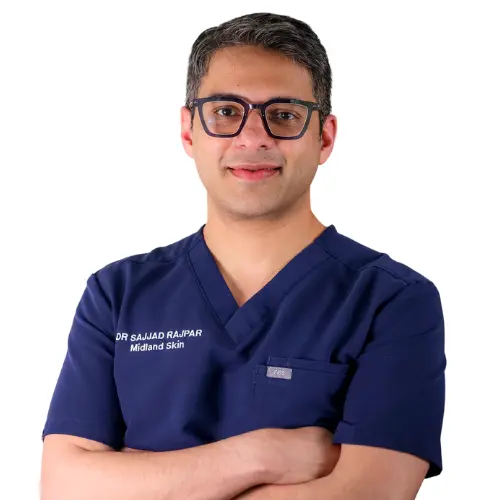
This page has been written and/or medically reviewed by Dr Sajjad Rajpar, Consultant Dermatologist and Medical Director of Midland Skin, Birmingham.
Dr Rajpar is on the GMC Specialist Register in Dermatology and has over 20 years’ experience in clinical dermatology. He provides clinical oversight to ensure the information on this page is accurate, balanced and consistent with current dermatology practice.
Dr Sajjad Rajpar
Date last updated: 6th Oct 2026
Book in with us
Expert, consultant led care in dermatology, skin surgery, eyelid surgery, lasers and aesthetics.
Disclaimer
The content on this website is provided for general information only. It is not, and must not be treated as, medical advice, a diagnosis, or a recommendation for any particular treatment. We make reasonable efforts to keep information accurate and up to date, but medicine and technology change, and content may not reflect the most current evidence, guidance, product information, or individual practice. You should not rely on this website to make decisions about your health or treatment. Always seek personalised advice from an appropriately qualified healthcare professional. Any examples, images, testimonials, and outcome descriptions are illustrative only. Results vary between individuals and no outcome can be guaranteed.

