
Fully ablative CO2 laser resurfacing
CO2 and Erbium YAG laser resurfacing in Birmingham
At Midland Skin we offer CO2 and Erbium YAG laser resurfacing treatment for patients in Birmingham, Solihull, Coventry, Wolverhampton, Worcester and the Midlands.

Quick Facts about fully ablative laser resurfacing

Best for
Lines, sun damage, acne scars
Anaesthetic
Local or sedation
Duration
About 1 hour

Recovery
2-3 weeks
Consultant
Consultant dermatologist
Price
See below
What is fully ablative laser resurfacing?
CO2 laser resurfacing is one of the most powerful techniques used on the face to promote rejuvenation whilst combatting issues associated with ageing, sun damage, texture and acne scarring.
Erbium YAG laser resurfacing is equally powerful at resurfacing the skin; this advice applies to fully ablative CO2 laser resurfacing and fully ablative Erbium YAG laser resurfacing which are both offered at Midland Skin in Birmingham.
Fully ablative laser resurfacing is used to tackle issues such as:
- Ageing of the skin
- Fine lines & wrinkles
- Deeper lines
- Lack of elasticity
- Solar elastosis (thickened yellow skin with a cobblestone appearance)
- Smokers’ lines (also called barcode lines) around the mouth
- Sun damage and precancerous change
- Sun-induced pigmentation and sun spots
- Ageing around the eyes for eye lift and eyelid tightening
- Certain forms of acne scars, usually as part of a broader management plan
CO2 stands for carbon dioxide. CO2 laser resurfacing is a significant procedure that delivers visible, lasting results. It is particularly effective for those looking to improve skin texture and stimulate skin regeneration, as the laser penetrates deeply to remodel and promote the growth of new, healthy skin.
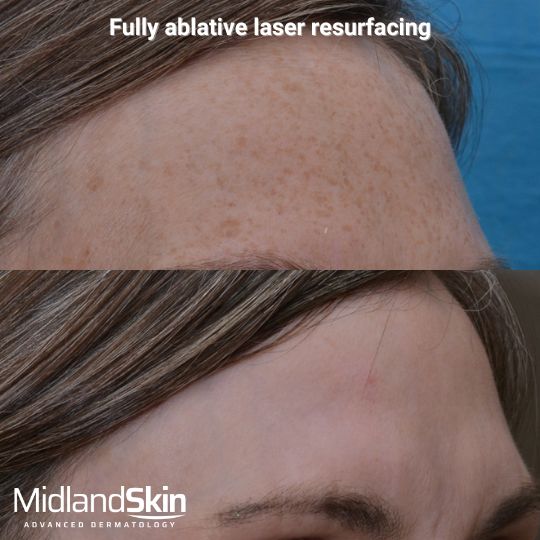
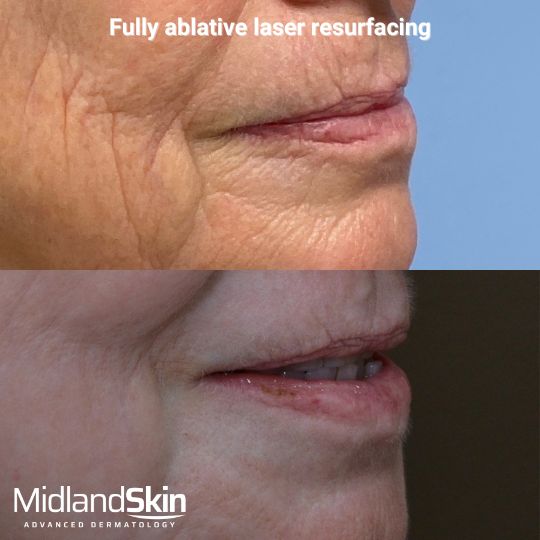
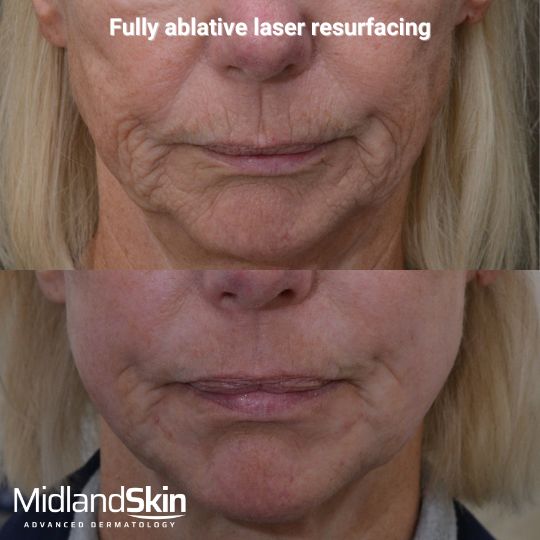
Before and after pictures of fully ablative laser resurfacing




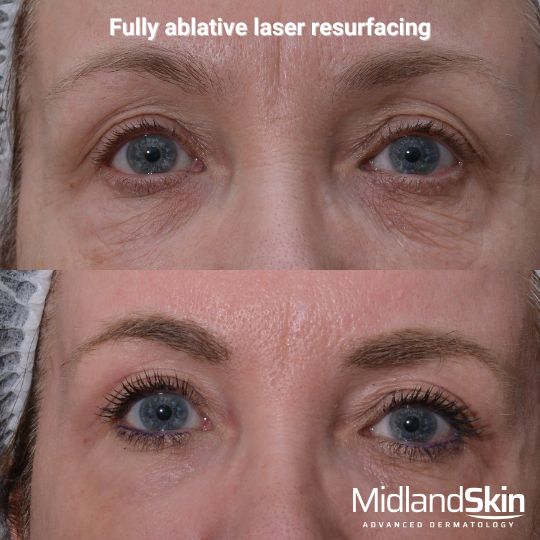
Fully ablative CO2 laser resurfacing videos
Before and after fully ablative CO2 laser
Under eye fully ablative CO2 laser resurfacing
Fully ablative CO2 laser around the eyes
Healing diary after fully ablative CO2 laser
Insertion of eye shields before fully ablative CO2 laser
How does fully ablative CO2 laser resurfacing work?
The laser is used to peel the top layers of the skin, layer by layer. This eliminates aged and sun-damaged cells, forcing them to renew and regenerate. It also smoothes out any textural changes, caused by scars such as acne scars.
There is also heating of the skin, known as a thermal effect. This thermal effect tightens the skin and stimulates new collagen production.
This makes the skin appear healthier, tighter, smoother, fuller and brighter.
Fully ablative resurfacing is used on the face, including eyelids, to improve skin quality and stimulate tightening.
How does a fully ablative CO2 laser differ from fractional laser?
A fractional laser makes tiny holes in the skin at set distances apart. The skin between the holes is not treated. This means a proportion of the skin ranging from 5% to 40% of the skin’s surface area, is treated. As fractional laser only treats a proportion of the skin, the healing is much faster however treatment often needs to be repeated.
Fully ablative laser peels 100% of the skin layer by layer. This means that 100% of the skin is treated.
Fractional laser also penetrates deeper and therefore can be suitable for deep acne scars, complex scars and rejuvenation.
In many instances, fractional and ablative lasers are combined in one treatment.


Jane Moody

Who is fully ablative laser resurfacing suitable for?
Suitability is decided at consultation, but fully ablative resurfacing is most often considered when:
- Etched-in facial lines – lines still visible when the face is at rest
- Perioral or smokers’ lines – where fillers have not helped or are unlikely to
- Sun damage and solar elastosis – thickened, yellowed or cobblestoned skin
- Sun spots and sun-induced pigmentation
- Atrophic acne scarring – where surface irregularity is the main problem
- Loss of firmness around the eyes – including upper eyelid heaviness
- Fitzpatrick skin types I to III – where the risk of pigmentary change is lowest
- You can plan 2 to 3 weeks of recovery – and have support at home for the first 24 hours
Treatment areas
Resurfacing can be done across the whole face or targeted at a single area. All three are carried out under local anaesthetic or sedation — you choose which at your consultation, and many patients opt for intravenous sedation, which means being drowsy and comfortable throughout with little memory of the procedure.
Full face CO2 resurfacing
The most common treatment, and the one that gives the most complete change in skin quality and texture. It takes about an hour to perform. Because the entire surface is treated, the result is even, with no line between treated and untreated skin. The most common treatment is full face fully ablative CO2 laser resurfacing.
Eyelid CO2 resurfacing
The skin around the eyes is thin and creases early, and it is difficult to improve with anything applied topically. Resurfacing here softens fine lines and wrinkles, and can also lift the upper eyelids and tighten the lower lids.
Perioral lines
The vertical lines above the top lip, also called smokers’ lines or barcode lines. These are one of the hardest areas to treat well. Where the lines are etched in, resurfacing is usually more effective than fillers, because it resurfaces the skin rather than filling underneath it.
Book in with us
Ready to get started? Book a consultation with our team at Midland Skin. Friendly, expert advice tailored to you.
Which lasers for fully ablative CO2 laser resurfacing do you offer at Midland Skin?
Midland Skin has two fully ablative resurfacing lasers — a CO₂ laser and an Erbium YAG laser — which is unusual for a clinic in the Midlands. Having both means the laser can be matched to your skin and your concern rather than to whichever device a clinic happens to own.
Lumenis Ultrapulse CO2 laser
The Lumenis Ultrapulse is a high-powered CO₂ laser (wavelength 10,600 nm, 240 W). Its high peak power allows energy to be delivered in very short pulses, so more of it goes into vaporising the skin surface and less into unintended heating of the surrounding tissue. The heat that is produced is controlled and stimulates tightening and new collagen.
Sciton Joule X
The Sciton Joule X Erbium YAG laser has a wavelength of 2940 nm. Erbium YAG is widely used for “cold” resurfacing, where the aim is to remove tissue with minimal heat. The Erbium YAG laser has an absorption 12-fold greater than the carbon dioxide laser for water. Because of this feature, a much higher percentage of targeted tissue is ablated rather than heated. This feature is harnessed in resurfacing perioral lines (smokers’ lines) and certain types of acne scarring.
What results can I expect and how long do they last?
Improvement is immediate. In the first weeks the skin is healing. As the skin re-forms and new collagen develops, texture, tone and firmness continue to improve over the months that follow, so the result is judged well after the point at which the skin has healed.
The benefit is long-lasting. In our experience, results from fully ablative resurfacing last around 3 to 10 years.
Resurfacing does not stop the ageing process. Your skin continues to age, and further sun exposure continues to cause damage, so how long your result lasts depends in part on sun protection and skincare afterwards.
Not everyone responds to the same degree and a particular cosmetic outcome cannot be guaranteed.
Treating dynamic lines beforehand improves your result. Lines caused by muscle movement, such as forehead lines and crow’s feet, continue to be creased into the skin as it heals. Where these are present, we treat them with botulinum toxin two or more weeks before your resurfacing, so the newly formed skin is not being folded while it settles. This is planned at your consultation and is charged separately from your resurfacing treatment.
Risks and what to expect
Fully ablative resurfacing is a real procedure with a real recovery, and you should go into it knowing what can happen. Most of what follows is either expected healing or uncommon, and much of it is actively prevented — antibiotics and antiviral medication are prescribed in advance for exactly this reason.
Part of normal healing
- Redness, swelling, weeping and crusting in the first week
- Redness of the treated skin that fades gradually, on average over 6 weeks to 6 months
- Skin that is temporarily more sensitive to sun, heat and skincare products
Less common, and usually manageable
- Pigmentary change — skin that heals darker (post-inflammatory hyperpigmentation) or, less commonly, lighter than the surrounding skin. Delayed lightening can appear months after treatment
- Bacterial infection, which is why antibiotics are prescribed before treatment
- Reactivation of cold sores, which is why antiviral medication is prescribed before treatment
- Milia — small white bumps as the skin re-forms
- Irritation or allergy to aftercare products
Uncommon
- Scarring, including raised or thickened scarring
- Persistent redness lasting longer than expected
- Chronic inflammation
- With lower eyelid treatment, tightening that pulls the eyelid downwards
- An incomplete result, or a result that falls short of what you hoped for
Careful patient selection is the main reason serious problems are rare, which is what the consultation is for. The two-week cooling-off period then gives you time to weigh all of this against what you stand to gain, without any pressure to decide.
When fully ablative resurfacing is not recommended
Some people are not suitable for fully ablative resurfacing, usually because the risk of poor healing or lasting pigment change is too high. You are unlikely to be offered treatment if any of the following apply:
- Immunosuppression, or a tendency to develop skin infections
- Isotretinoin within the last 6 months
- Current smoking, which impairs wound healing
- Active inflammatory skin disease in the area to be treated, such as acne
- A history of keloid or hypertrophic scarring
- Very sensitive skin, or rosacea
- Melasma
- Difficulty following the aftercare instructions
- Fitzpatrick skin types IV to VI (darker skin tones, including South Asian and East Asian skin)
Why skin type matters
Post-inflammatory hyperpigmentation and visible demarcation are recognised complications of CO2 laser resurfacing, and the risk rises with skin phototype. In darker skin it is both more likely to happen and slower to fade, which is why we do not offer fully ablative resurfacing to these patients in usual circumstances.
Being unsuitable for this particular treatment does not mean nothing can be done. Options carrying a lower risk of pigment change can be discussed at your consultation, including fractional laser resurfacing.
Treatment pathway
Laser resurfacing consultation
Your skin is assessed to establish whether fully ablative CO2 or Erbium YAG resurfacing is appropriate, and what you are hoping to achieve is discussed.
Suitability, plan and cooling-off
If you are suitable, the treatment, recovery and risks are explained in full and a treatment estimate is provided in the form of a care plan. A two-week cooling-off period follows before you book.
Treatment
The procedure takes about an hour and is carried out under local anaesthetic or intravenous sedation, whichever you have chosen. You go home the same day with a caregiver.
Review consultation at 12 weeks
You are reviewed 12 weeks after treatment to assess your result, check how the skin has settled and guide your ongoing skincare and sun protection.
The laser resurfacing consultation
Every procedure starts with a consultation. The doctor examines your skin, assesses whether fully ablative CO2 or Erbium YAG resurfacing is appropriate for you, and talks through what you are hoping to achieve.
This is also where the practical detail is covered — what the treatment involves, what the recovery is really like, and the risks and benefits, so you can weigh them up properly. If another treatment would suit you better, that will be discussed too.
If you are suitable, you will be given a treatment estimate and can choose whether to have the procedure under local anaesthetic or with intravenous sedation.
Why treatment is never carried out on the same day
We then ask you to take at least two weeks to think it over. This is the cooling-off period. When you are ready to go ahead, you can book your procedure.
Downtime and healing after CO2 laser
Fully ablative resurfacing is a treatment you plan around rather than fit in. The recovery is longer than with lighter treatments for the same reason the result lasts years rather than months — the full surface of the skin is treated and replaced.
There are two stages, and it helps to keep them separate.
The skin surface heals in 2 to 3 weeks. The first week involves redness, swelling, weeping and crusting as the new skin forms. By the end of the second or third week the surface has closed over, and this is the point at which most people wear make-up and return to work and normal activities.
Residual redness settles more slowly, on average over 6 weeks to 6 months. This is the treated skin looking pink rather than raw, it fades gradually, and it can be covered with make-up throughout. You are not housebound during this stage.
Plan for 2 to 3 weeks away from work and social commitments, and expect the pink tone to take a while longer to disappear entirely.

How do I prepare for fully ablative CO2 laser resurfacing?
Four weeks before
- Stop smoking — it significantly impairs wound healing
- Eat well, so your body is in the best position to heal
- Book enough time off work and away from your usual commitments
- Arrange a caregiver to stay with you for at least the first 24 hours, particularly if you are having sedation
- Avoid sunbeds, tanning and fake tan from this point onwards
- Collect your pre-operative prescription
- Stock up on your usual painkillers, such as paracetamol or ibuprofen
- Let us know if your medical circumstances have changed since your consultation
- Have any dynamic lines treated with Botox by our team if you have been advised to do so e.g forehead, crow’s feet, frown, perioral — this improves your final result
Two weeks before
- Stop all products containing AHAs, BHAs, retinoids or exfoliants
- Read through your information leaflet with your caregiver
- Plan your meals for the first week, ideally soft food, as you will not be going out
- Keep alcohol to a minimum
The day before
- Start your prescribed antibiotic and antiviral medication in the evening
- Set up somewhere comfortable to recover — books, a TV, a footstool, plenty of cushions
- Shower, but skip hair products and perfume, which can be flammable
On the day
- Arrive with no make-up, moisturiser, sunscreen, fragrance or skincare of any kind on your face
- Leave jewellery and contact lenses at home
- Dress comfortably and practically — something loose, with a low neck that zips or unbuttons, and flat shoes. Not your best clothes
- Having sedation: no solid food or milky drinks for 6 hours beforehand. Water, squash, black tea or coffee up to 2 hours before
- Not having sedation: a light meal a couple of hours beforehand is fine
- Arrange your journey home with your caregiver or by taxi — you must not drive after treatment
The first month afterwards
- You will be given detailed aftercare instructions and medications
- Skincare stays very simple throughout: wash your face twice a day and apply a barrier ointment several times a day
Sare B
On the day: what to expect FAQs
Who will perform my treatment?
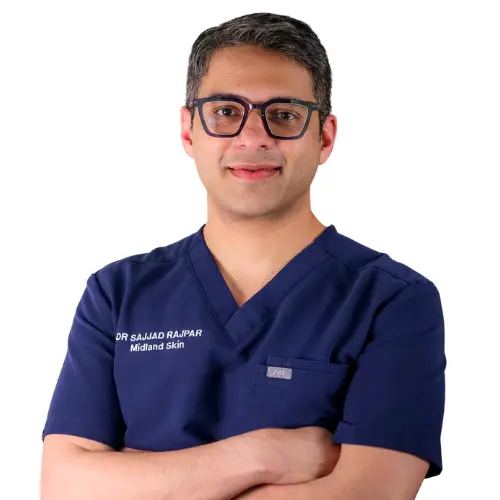
Your treatment is performed by Dr Sajjad Rajpar, Consultant Dermatologist. You will meet him at your consultation, so you know who will be treating you on the day.
Will I have local anaesthetic or sedation?
Both are available and you choose at your consultation.
If you are having sedation you must avoid solid food and milky drinks for 6 hours beforehand. Water, squash and black tea or coffee can be taken up to 2 hours before.
Will the treatment hurt?
The area is fully numbed before treatment begins. You may feel warmth and pressure but should not feel pain. If you have chosen sedation you will be drowsy and comfortable throughout.
Afterwards the skin often feels hot and stinging for several hours, which is managed with the painkillers and aftercare you will already have at home.
How long will I be at the clinic?
The treatment itself takes about an hour for a full face. Allow longer overall for numbing, preparation and settling afterwards, and longer again if you are having sedation.
Can I drive home, or do I need someone with me?
You must not drive after treatment. Arrange for a caregiver to bring you home or travel by taxi.
A caregiver should stay with you for at least the first 24 hours, and this is essential if you have had sedation.
What will my skin look like when I leave?
Your skin will be red, swollen and covered in ointment. Swelling usually peaks over the first 48 hours, and weeping and crusting are normal during the first week. This is expected healing, not a complication.
After treatment: recovery and aftercare FAQs
What does aftercare involve day to day?
You will be given detailed written aftercare instructions and medications.
In the first month the routine is deliberately very simple: washing the face twice a day and applying a barrier ointment several times a day.
When can I go back to work and be seen in public?
Most people need 2 to 3 weeks. Plan this time off before you book rather than afterwards.
When can I wear makeup again?
Once the skin surface has healed, usually at the two to three week point. Make-up can then be used to cover any remaining redness.
How long will the redness last?
The skin surface heals within the first few weeks, but residual redness settles more slowly, on average over 6 weeks to 6 months. It fades gradually and varies from person to person.
What sun protection will I need afterwards?
Sun protection matters more after resurfacing than at any other time, because newly healed skin is far more likely to develop pigmentation.
You will be advised to avoid sun exposure, use a high-factor sunscreen daily and avoid tanning and fake tan.
What should I do if I am worried about how my skin is healing?
Contact the clinic. Your review is at 12 weeks, but do not wait for it if something concerns you – particularly increasing pain, spreading redness, unusual discharge or feeling generally unwell.
Why choose Midland Skin for laser resurfacing?
Ablative lasers are widely available, but they are not always used by doctors. At Midland Skin your skin is assessed and treated by a consultant dermatologist on the GMC Specialist Register, not by a non-medical laser operator.
- Two fully ablative platforms. . We have both a CO₂ and an Erbium YAG resurfacing laser, which few clinics in the region offer, so the laser can be matched to your skin and your concern rather than to whatever device the clinic happens to own.
- Local anaesthetic or sedation. Both are available on site, so comfort is your choice rather than a limitation of the setting.
- A structured review. You are seen again at 12 weeks to assess the result and guide your skincare and sun protection, rather than being discharged once the skin has healed.
- An honest answer about suitability. Not everyone is a candidate for fully ablative resurfacing. If it is not right for you, we will say so and discuss what is.
Book in with us
Ready to get started? Book a consultation with our team at Midland Skin. Friendly, expert advice tailored to you.
Fees
Fully ablative laser resurfacing Show pricing
Book ConsultationFully ablative laser resurfacing to the full face
Mareike Hansen
References used for this article
- Bin Dakhil A, Shadid A, Altalhab S. Post-inflammatory hyperpigmentation after carbon dioxide laser: review of prevention and risk factors. Dermatol Reports. 2023;15(4):9703. doi:10.4081/dr.2023.9703.
About the Author
This page has been written and/or medically reviewed by Dr Sajjad Rajpar, Consultant Dermatologist and Medical Director of Midland Skin, Birmingham.
Dr Rajpar is on the GMC Specialist Register in Dermatology and has over 20 years’ experience in clinical dermatology. He provides clinical oversight to ensure the information on this page is accurate, balanced and consistent with current dermatology practice.
Dr Sajjad Rajpar
Date last updated: 14th Oct 2026
Book in with us
Expert, consultant led care in dermatology, skin surgery, eyelid surgery, lasers and aesthetics.
Disclaimer
The content on this website is provided for general information only. It is not, and must not be treated as, medical advice, a diagnosis, or a recommendation for any particular treatment. We make reasonable efforts to keep information accurate and up to date, but medicine and technology change, and content may not reflect the most current evidence, guidance, product information, or individual practice. You should not rely on this website to make decisions about your health or treatment. Always seek personalised advice from an appropriately qualified healthcare professional. Any examples, images, testimonials, and outcome descriptions are illustrative only. Results vary between individuals and no outcome can be guaranteed.

