
TCA CROSS for acne scars
Targeted treatment for selected deep, pitted acne scars
TCA CROSS can improve selected ice-pick and boxcar acne scars by making them appear shallower and less noticeable. Suitability depends on an in-person acne scar assessment.


Quick Facts about TCA CROSS

Best for
Ice-pick & selected boxcar scars

Treatment
Focal TCA application

Anaesthetic
Usually not required

Recovery
Scabs for 3–7 days

Sessions
Usually 4–6

Price
See below
TCA CROSS for acne scars in Birmingham and Solihull
TCA stands for trichloroacetic acid and CROSS stands for Chemical Reconstruction of Skin Scars.
TCA CROSS is a precise chemical treatment for selected acne scars. A very small amount of TCA is carefully placed inside each scar rather than applied as a full-face chemical peel. This produces a controlled healing response within the scar and stimulates the formation of new collagen.
The treatment is particularly useful for deep, narrow ice-pick scars and selected boxcar scars. It does not treat every type of acne scar, and many patients have a mixture of scars requiring more than one treatment technique.
Midland Skin provides TCA CROSS treatment from our Birmingham clinic, seeing patients from Solihull, Coventry, Wolverhampton, Worcester and across the Midlands.
Who is TCA CROSS suitable for?
Specialist assessment may be worthwhile if:
- You have deep, narrow ice-pick acne scars.
- You have selected small or deep boxcar scars.
- Individual pitted scars remain noticeable despite skincare or previous treatment.
- Your active acne is adequately controlled or being treated.
- You understand that improvement is gradual and usually requires several treatments.
- You are prepared for temporary frosting, redness and scabbing after each session.
- Your skin type, pigmentation history and treatment goals make the risks acceptable.
- Selected other atrophic scars may also be considered following assessment.
TCA CROSS is not usually the best treatment for predominantly rolling or tethered scars, widespread shallow textural change or flat red or brown acne marks. These may respond better to treatments such as subcision, fractional laser resurfacing, surgical scar excision or another approach.
Midland Skin offers TCA CROSS to patients with Fitzpatrick skin types I–V. Published reports from Brazil, Egypt, Korea and India have included patients with a range of skin tones. Darker skin types can be treated, but careful assessment, preparation and aftercare are particularly important because of the risk of post-inflammatory pigmentation.
How does TCA CROSS work?
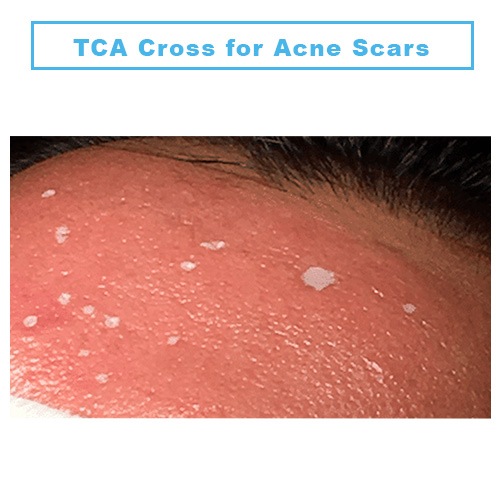
The TCA reacts with proteins in the treated skin, producing a temporary white appearance known as frosting.
This focal treatment reaches the base of the scar and creates a controlled injury. As the area heals, new type I collagen and elastic fibres are formed. Over a course of treatment, this can raise the base of the scar and reduce the shadow it creates.
Unlike a conventional chemical peel, TCA CROSS treats individual scars while limiting exposure of the surrounding skin.
TCA CROSS or combined acne scar treatment?
TCA CROSS may be carried out independently or as part of a combined acne scar treatment session.
Acne scars frequently include several different scar types. TCA CROSS may be used on deeper ice-pick or boxcar scars while another treatment addresses rolling scars, tethering or wider changes in skin texture.
Depending on your scar pattern, treatment may include:
- TCA CROSS for selected deep scars.
- Subcision for tethered or rolling scars.
- Fractional laser resurfacing for wider textural change.
- Surgical excision for selected individual scars.
The purpose of the acne scar assessment is to determine which treatments are recommended. If TCA CROSS is not suitable, the dermatologist will explain whether another treatment, treatment of active acne first, or no procedure is the more appropriate option.
What results can I expect from TCA CROSS?
For appropriately selected scars, TCA CROSS can reduce scar depth and make the scars less noticeable. Improvement develops gradually as collagen remodelling takes place and may not become apparent until after the second or third treatment.
Between four and six treatments are usually recommended, spaced approximately four to six weeks apart. The number required depends on the scar type, response to earlier sessions and the degree of improvement being sought.
Published research supports TCA CROSS as an effective treatment for appropriately selected scars. In the original Korean study, 30 of 32 patients treated with 100% TCA had a good clinical response. An Egyptian comparison study reported an average improvement of approximately 75% after four TCA CROSS sessions. More recent research continues to support TCA CROSS while showing that response and recovery vary according to scar type and treatment technique.
These findings come from specific treatment protocols and do not mean that every patient will achieve the same improvement. Complete removal of acne scars should not be expected.
Book in with us
Ready to get started? Book a consultation with our team at Midland Skin. Friendly, expert advice tailored to you.
Risks and limitations of TCA CROSS
Expected effects include brief stinging, frosting, redness and the development of small scabs over the treated scars.
Other possible risks include:
- Redness lasting longer than expected and occasionally persisting for several months.
- Post-inflammatory hyperpigmentation, causing treated areas to become darker.
- Rarely, hypopigmentation, causing treated areas to become lighter.
- Scars becoming wider, deeper or more noticeable.
- Little or no visible improvement.
- Infection.
- The need for further or alternative treatment.
The likelihood of improvement and the risk of pigment change or scar widening depend on the type of scar, skin type, treatment technique and aftercare. A particular cosmetic result cannot be guaranteed.
Treatment journey
Acne scar assessment
A Consultant Dermatologist assesses your scars in person, discusses what concerns you most and checks whether active acne or pigmentation needs to be treated first.
Suitability and treatment plan
The dermatologist decides whether TCA CROSS, another acne scar treatment or a combination is most appropriate and discusses the expected improvement, number of sessions, recovery and relevant risks.
TCA CROSS treatment
Once treatment has been agreed and appropriately planned, the skin is cleansed and TCA is applied precisely to the selected scars.
Review and further treatment
Healing and response are assessed before further treatment, with subsequent sessions usually spaced four to six weeks apart.
What happens during TCA CROSS treatment?
The skin is cleansed and a small amount of TCA is carefully placed inside each selected scar. The treatment is confined to the scars rather than applied across the whole face.
The treated areas then pass through several expected stages:
- Frosting. The scars turn white as the TCA reacts with proteins in the skin. This usually fades within approximately 30 minutes.
- Redness. The treated scars appear red once the frosting has settled.
- Scabbing. Small scabs usually form within one or two days and commonly remain for three to seven days.
- Residual redness. Once the scabs separate, the underlying skin remains pink or red. This usually fades over the following weeks but can sometimes remain visible for one or two months.
Practical TCA CROSS FAQs
Who performs TCA CROSS treatment?
Your TCA CROSS treatment will be performed by a Consultant Dermatologist with experience in assessing and treating acne scars.
How should I prepare for treatment?
Avoid tanning for at least two weeks before treatment and follow any individual skincare instructions provided by the clinic. Attend with clean skin and no makeup over the treatment area.
Please tell the clinic about your medication, allergies, previous problems with pigmentation or healing, and any recent skin treatments.
Does TCA CROSS hurt?
TCA application produces a brief stinging or burning sensation in the individual scars. This generally settles quickly and an anaesthetic is not usually required.
Can I drive home?
You can usually drive after TCA CROSS. If anything about your individual treatment plan makes this unsuitable, you will be advised before the procedure.
How much downtime should I allow?
The small scabs remain visible for approximately three to seven days. Many patients continue working during this period, although you may prefer to allow several days of social downtime.
Redness may remain after the scabs have separated and usually fades gradually over the following weeks.
How should I look after my skin?
Cleanse gently twice daily using a suitable gentle lotion cleanser. Apply Vaseline or Aquaphor ointment to the scabs four times daily, or as directed by the clinic.
Allow the scabs to separate naturally. Picking or scratching them may increase the risk of infection, pigmentation and scarring.
Avoid tanning from two weeks before treatment until two months after your final treatment and use appropriate sun protection as advised. If pigmentation develops, the dermatologist may recommend treatment to help it fade.
When can I wear makeup?
Makeup can usually be worn from day three onwards, provided the skin is intact and you follow the aftercare instructions given to you.
What should I do if I am concerned about healing?
Contact Midland Skin if you develop increasing pain, spreading redness, swelling, discharge or another unexpected change. The team will advise whether you need to be reviewed.
Fees
TCA Cross Show pricing
Book ConsultationInitial acne scar assessment
A separate acne assessment is required for those who also have active acne. Up to 25 minutes
TCA Cross (1-9 lesions)
TCA Cross (10-19 lesions)
References used for this article
- Chung HJ, Al Janahi S, Cho SB, Chang YC. Chemical reconstruction of skin scars (CROSS) method for atrophic scars: a comprehensive review. Journal of Cosmetic Dermatology. 2021;20(11). doi:10.1111/jocd.13556.
- Soysal MÇ, Akçalı C. Comparison of 70% and 100% concentration of trichloroacetic acid peeling efficacy with chemical reconstruction of skin scars technique in atrophic acne scar treatment. Archives of Dermatological Research. 2025;317(1):547.
- Lee JB, Chung WG, Kwahck H, Lee KH. Focal treatment of acne scars with trichloroacetic acid: chemical reconstruction of skin scars method. Dermatologic Surgery. 2002;28(11):1017–1021.
- Leheta TM, El Tawdy AM, Abdel Hay RM, Farid S. Percutaneous collagen induction versus full-concentration trichloroacetic acid in the treatment of atrophic acne scars. Dermatologic Surgery. 2011.
- Yug A, Lane JE, Howard MS, Kent DE. Histologic study of depressed acne scars treated with serial high-concentration trichloroacetic acid. Dermatologic Surgery. 2006;32(8):985–990.
About the Author
This page has been written and/or medically reviewed by Dr Sajjad Rajpar, Consultant Dermatologist and Medical Director of Midland Skin, Birmingham.
Dr Rajpar is on the GMC Specialist Register in Dermatology and has over 20 years’ experience in clinical dermatology. He provides clinical oversight to ensure the information on this page is accurate, balanced and consistent with current dermatology practice.
Dr Sajjad Rajpar
Date last updated: 22nd Sep 2026

Book in with us
Expert, consultant led care in dermatology, skin surgery, eyelid surgery, lasers and aesthetics.
Disclaimer
The content on this website is provided for general information only. It is not, and must not be treated as, medical advice, a diagnosis, or a recommendation for any particular treatment. We make reasonable efforts to keep information accurate and up to date, but medicine and technology change, and content may not reflect the most current evidence, guidance, product information, or individual practice. You should not rely on this website to make decisions about your health or treatment. Always seek personalised advice from an appropriately qualified healthcare professional. Any examples, images, testimonials, and outcome descriptions are illustrative only. Results vary between individuals and no outcome can be guaranteed.

