
Wart & Verruca Removal in Birmingham
Specialist assessment and treatment for warts and verrucas
At Midland Skin we offer wart and verruca treatment for patients in Birmingham, Solihull, Coventry, Wolverhampton, Worcester and the Midlands.


Quick Facts about wart and verruca treatment

Best for
Persistent warts & verrucas

Appointment
Initial dermatology assessment

Treatment
Cryotherapy or prescription

Sessions
Usually more than one

Provider
Consultant dermatologist

Price
See below
Wart & Verruca removal in Birmingham and Solihull
If you are suffering from stubborn warts & verrucas, Midland Skin offer options for wart and verruca removal in Birmingham & Solihull.
Warts and verrucas are infections of the skin caused by the Human Papilloma Virus.
While many warts resolve on their own or with minimal treatment, some individuals experience persistent and resistant warts that are challenging to eliminate.
Warts are spread by direct contact from one person to another or via surfaces where skin cells with wart virus has been shed, for example, in a changing room or shower. Warts can also spread from one part of the body to another by touch and transference of the wart virus.
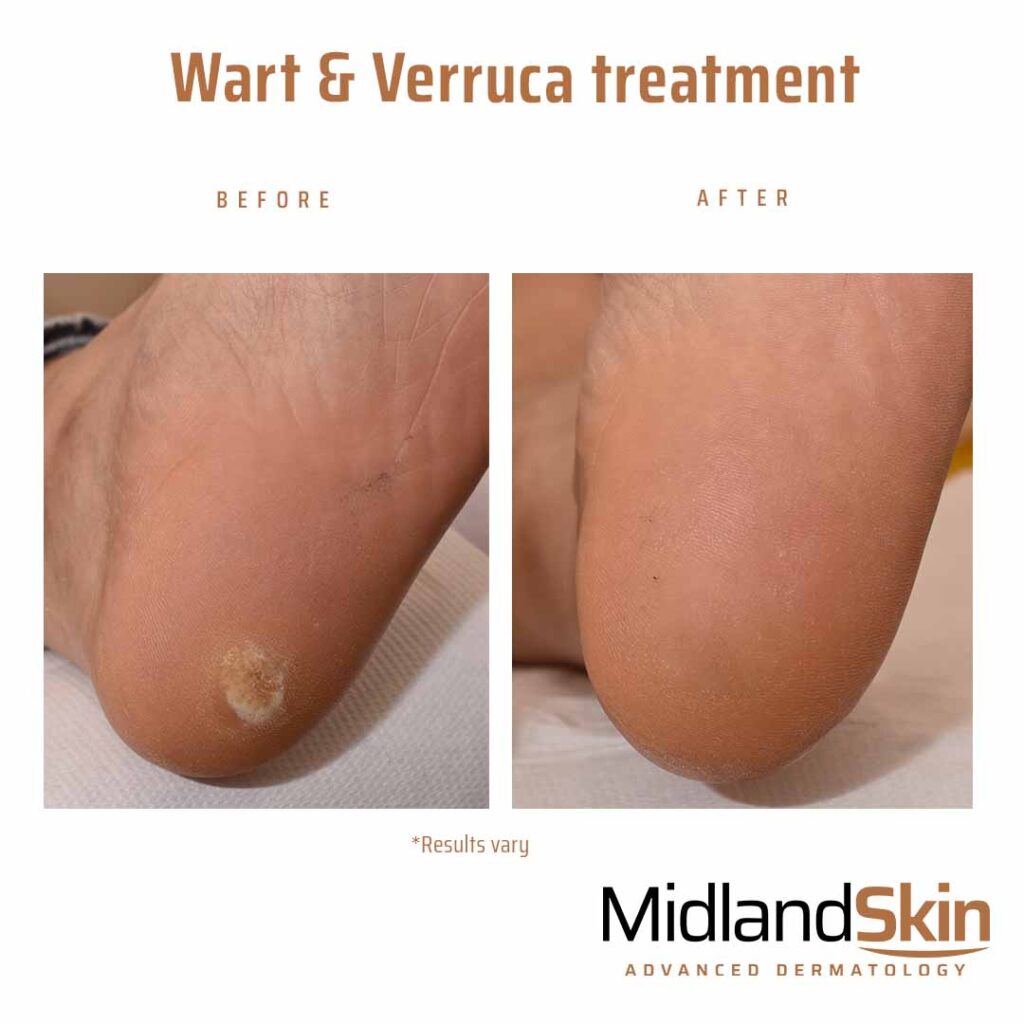
What are the different types of warts?
The word “wart” is used to describe many different types of skin lesions.
This discussion is limited to warts caused by Human Papilloma Virus, which are also known as viral warts.
Here are the different types of viral wart:
- Common warts. There are warty lumps found around the nails, on the backs of the fingers and on the toes.
- Periungual warts. These are common warts that occur around the nails. In some instances, warts can damage the way the nail grows.
- Verrucas or Plantar warts. Verrucas or plantar warts are warts that develop on the soles of the feet. Verrucas can grow inwards and cause thickening of the skin, which leads to pain on walking. Verrucas can also spread outwards and multiply, causing a mosaic pattern.
- Palmar warts. Palmar warts are warts that develop on the hands. They can occur anywhere on the palms, including the fingers and pulps.
- Plane warts. Plane warts are flat-topped warts that occur on the face, backs of the hands or shins. On the face, they are more likely to spread with shaving.
- Filiform warts. Fronds stick out from a base.

Trevor Cooper

When should I see a dermatologist about a wart or verruca?
Most warts eventually clear on their own, but some persist for years, spread, or become uncomfortable. A dermatology assessment is worthwhile when:
- The wart has not cleared – despite wart paints or pharmacy treatments
- It keeps coming back – after previous treatment
- It is painful or affecting walking – particularly verrucas on the sole of the foot
- Warts are spreading – to other sites or multiplying
- The wart is around the nail – where it may affect nail growth
- The diagnosis is not certain – some skin lesions look like warts but are not
- You have a weakened immune system – where warts can be more widespread and stubborn
Why the diagnosis matters
Not every lump or rough patch of skin is a viral wart. Corns and calluses on the feet, seborrhoeic keratoses, skin tags and — occasionally — skin cancers can be mistaken for warts. Treating the wrong thing wastes time and delays the right treatment.
Your consultant dermatologist will examine the lesion, often with dermoscopy, before recommending treatment.
How are warts treated at Midland Skin?
Treatment depends on the type of wart, where it is, how long you have had it and what you have already tried. Your consultant will discuss the options with you at your assessment.
Cryotherapy
The wart is frozen with liquid nitrogen. It is quick and can usually be carried out at the same appointment as your assessment, once your consultant has confirmed it is suitable. Most people need a course of treatments, spaced a few weeks apart, rather than a single session. Cryotherapy stings at the time and the area may blister afterwards.
Prescription topical treatment
Stronger preparations than those sold over the counter may be prescribed for you to apply at home, either on their own or alongside cryotherapy. These work gradually and need to be used consistently over weeks.
Not everyone needs treatment
Warts often clear on their own, particularly in children. If your warts are not troubling you, waiting is a reasonable option, and your consultant will say so.
Bleomycin
Bleomycin injection is offered at Midland Skin for resistant warts that have not cleared with cryotherapy or prescription treatment. You can read more on our bleomycin factsheet.
Treatment pathway
Initial dermatology assessment
You meet with a consultant dermatologist who examines the lesion, confirms the diagnosis and reviews previous treatments you have tried.
Treatment
Treatment is discussed with you. Cryotherapy can usually be carried out at the same appointment where suitable. Prescription treatment may also be recommended.
Review and further treatment
A review consultation is required to assess response, decide whether further treatment sessions are needed and discuss ongoing management.
What results should I expect?
Warts are stubborn, and honest expectations matter more here than with most skin conditions.
Response varies considerably by site. Warts on the hands generally respond better than verrucas on the soles of the feet, which are the most difficult to clear. Warts around the nails are also harder to treat.
Published clearance rates for cryotherapy vary widely, from under 20% to over 70%. Much of that variation comes down to how many sessions were given and how often. Trials using more frequent treatment report better results, and around five sessions is typical.
Most people need several sessions. Some warts clear completely, some improve without fully resolving, and some do not respond. Warts can also return after clearing, or appear at new sites, because the virus can persist in the skin.
If your warts are not responding after a reasonable course of treatment, your consultant will discuss whether continuing is worthwhile or whether a different approach is appropriate.
Your appointment: practical FAQs
Who will assess me?
You will be seen by a consultant dermatologist, who will examine the lesion, confirm the diagnosis and discuss treatment with you.
Can I have treatment at my first appointment?
Usually, yes. Cryotherapy can generally be carried out at the initial assessment once your consultant has confirmed it is suitable. Some warts are better treated differently, and treatment cannot be assumed before assessment.
Does cryotherapy hurt?
It stings during treatment and for a short while afterwards. Most people find it uncomfortable rather than painful. Treatment on the sole of the foot tends to be more tender.
What happens to the skin afterwards?
The treated area usually becomes red and sore, and may blister within a day or two. The blister settles over about a week. Keep the area clean and dry, and avoid picking at it.
Can I walk, work and exercise normally afterwards?
Yes. There is no downtime after cryotherapy, though a treated verruca on the sole may be tender to walk on for a few days.
Should I bring details of what I have already tried?
Yes — it is helpful to know which paints, pharmacy treatments or previous freeze treatments you have used, and for how long.
Book in with us
Ready to get started? Book a consultation with our team at Midland Skin. Friendly, expert advice tailored to you.
Fees for wart assessment and treatment
Wart and verruca treatment Show pricing
Book ConsultationInitial dermatology assessment
Up to 25 minutes
Cryotherapy – Small
Cryotherapy – Medium
Cryotherapy – Large
Bleomycin Band A
Per session
Bleomycin Band B
Per session
Review consultation
Standard, up to 20 minutes
References used for this article
- García-Oreja S, Álvaro-Afonso FJ, Tardáguila-García A, López-Moral M, García-Madrid M, Lázaro-Martínez JL. Efficacy of cryotherapy for plantar warts: A systematic review and meta-analysis. Dermatol Ther. 2022;35(6):e15480. doi:10.1111/dth.15480.
- Singal A, Grover C. Efficacy and Safety of Intralesional Bleomycin in the Management of Ungual Warts. Skin Appendage Disord. 2020 Nov;6(6):346-350. doi:10.1159/000510989.
About the Author
This page has been written and/or medically reviewed by Dr Sajjad Rajpar, Consultant Dermatologist and Medical Director of Midland Skin, Birmingham.
Dr Rajpar is on the GMC Specialist Register in Dermatology and has over 20 years’ experience in clinical dermatology. He provides clinical oversight to ensure the information on this page is accurate, balanced and consistent with current dermatology practice.
Dr Sajjad Rajpar
Date last updated: 26th Sep 2026

Book in with us
Expert, consultant led care in dermatology, skin surgery, eyelid surgery, lasers and aesthetics.
Disclaimer
The content on this website is provided for general information only. It is not, and must not be treated as, medical advice, a diagnosis, or a recommendation for any particular treatment. We make reasonable efforts to keep information accurate and up to date, but medicine and technology change, and content may not reflect the most current evidence, guidance, product information, or individual practice. You should not rely on this website to make decisions about your health or treatment. Always seek personalised advice from an appropriately qualified healthcare professional. Any examples, images, testimonials, and outcome descriptions are illustrative only. Results vary between individuals and no outcome can be guaranteed.

