
Male pattern hair loss
Specialist assessment and treatment for male pattern hair loss
At Midland Skin we offer specialist assessment and treatment for male pattern hair loss, also known as androgenetic alopecia, for patients in Birmingham, Solihull, Coventry, Wolverhampton, Worcester and the Midlands.


Quick Facts about male pattern hair loss

Best for
Receding or thinning hair

Appointment
Initial hair loss assessment
Treatment
Prescription medication
Symptoms
Hairline or crown thinning
Provider
Consultant dermatologist

Price
See below
What is male pattern hair loss?
Male pattern hair loss, also called androgenetic alopecia, is the most common cause of hair loss in men. It may affect up to around 80% of men by the age of 80. It can begin in the late teens, although it commonly becomes noticeable during the twenties or thirties.
It usually causes gradual recession at the temples and frontal hairline, thinning over the crown, or a combination of both. However, not every man develops the same pattern or progresses to the same extent.
Male pattern hair loss is a non-scarring condition. The affected hair follicles gradually become smaller through a process called miniaturisation. The hairs they produce become finer and shorter until scalp coverage becomes visibly reduced.
When should I see a dermatologist for male pattern hair loss?
Specialist assessment can confirm whether the hair loss is male pattern hair loss, identify whether another condition may also be contributing and help you make an informed decision about treatment.
An initial hair loss assessment is particularly worthwhile when:
- your hairline is receding or the hair over your crown is becoming thinner
- the hair loss started at a young age or appears to be progressing
- you are experiencing increased shedding as well as patterned thinning
- the hair loss is sudden, patchy or associated with redness, scaling, discomfort or other scalp symptoms
- treatment you have already tried has not worked or has caused side effects
- you are considering prescription medication, a bespoke hair tonic, PRP or hair transplantation

Rob Bowers

Why earlier assessment may be worthwhile
Medical treatments work primarily by preserving existing hair and strengthening follicles that are still producing miniaturised hairs. They are less likely to restore areas that have been completely bald for a long time.
If your hair loss is progressing and preserving your existing hair matters to you, assessment is usually more valuable before the loss becomes advanced.
What will I understand after my assessment?
- The most likely cause of your hair loss.
- Whether more than one type of hair loss may be present.
- The current pattern and extent of miniaturisation.
- Whether investigations are appropriate.
- Which treatment options are medically suitable.
- What improvement and maintenance may realistically involve.
Why getting the diagnosis right matters
A receding hairline or thinning crown may appear typical of male pattern hair loss, but not all hair loss in men has the same cause.
A naturally maturing hairline, temporary excessive shedding known as telogen effluvium, alopecia areata and inflammatory or scarring scalp conditions can produce different types of hair loss. More than one condition may also occur at the same time.
These conditions do not all respond to the same treatment. Starting a preselected medication or procedure without establishing the likely diagnosis can delay appropriate management.
Your dermatologist examines the hair and scalp and may use a dermatoscope to look for miniaturisation and other diagnostic features. Clinical photographs may be taken to provide a baseline against which future changes can be assessed.
Treatment pathway
Initial hair loss assessment
You meet with a Consultant Dermatologist who reviews the pattern and progression of your hair loss, relevant medical and family history, medications and treatments you have already tried. Your hair and scalp are examined using a dermatoscope where appropriate.
Care plan
The likely diagnosis and treatment options are discussed with you. Your plan may include topical or oral prescription treatment, a bespoke prescription hair tonic, PRP or advice about other hair-restoration options. Tests are only arranged where the findings suggest another or additional cause of hair loss.
Review consultation
A review consultation is required to assess your response and tolerance to treatment and decide whether treatment should be continued, changed or stopped. Your dermatologist will also discuss ongoing management where appropriate.
What causes male pattern hair loss?
Male pattern hair loss develops because genetically susceptible hair follicles respond to male hormones, particularly dihydrotestosterone, or DHT. DHT causes susceptible follicles over the frontal scalp, temples and crown to miniaturise. Hair at the sides and back of the scalp is usually less affected.
The tendency is inherited through multiple genes rather than a single “baldness gene”. It may come from either side of the family and can appear to skip generations. Male pattern hair loss does not usually mean that your testosterone level is abnormal.
How does male pattern hair loss progress?
The Hamilton–Norwood scale describes the commonly recognised stages of male pattern hair loss. Some men mainly develop recession at the temples, others notice crown thinning first, and some develop both.
The rate of progression varies considerably. Some men change gradually over many years, while others experience more noticeable progression over a shorter period. Earlier onset may be associated with more extensive progression, although the rate and eventual extent cannot be predicted reliably.
Hair over the sides and back of the scalp often remains relatively preserved and may provide donor hair for transplantation. However, donor density and suitability require proper assessment by a hair-transplant specialist.

How is male pattern hair loss treated at Midland Skin?
Treatment depends on the diagnosis, extent of hair loss, previous treatment, medical history and your priorities. No particular medication or result can be guaranteed before assessment.
The main aim is usually to slow further progression and preserve existing hair. Some treatments may also thicken miniaturised hairs and improve visible density.
Topical minoxidil
Topical minoxidil can be bought from a pharmacy without a prescription and is available as a lotion or foam. It can help maintain hair and improve density in some men, but not everyone responds.
It must be used consistently and continued for its benefits to be maintained. It can cause scalp irritation, unwanted hair growth outside the treated area and temporary increased shedding when treatment is started.
Oral minoxidil
Midland Skin also provides oral minoxidil treatment for appropriately selected patients.
Oral minoxidil is prescribed off-label for hair loss. It is not suitable for everyone, and the potential benefits, cardiovascular history, other medications, side effects and monitoring requirements must be considered before it is prescribed.
Finasteride
Finasteride reduces the conversion of testosterone to DHT. It can slow progression and improve hair density in some men.
Finasteride is a prescription medicine and requires an informed discussion about suitability and possible sexual and psychological side effects. The MHRA advises that patients taking finasteride should be monitored for sexual side effects and changes in mood. Further safety information is provided on our finasteride page and in the patient information supplied with the medication.
Dutasteride
Dutasteride blocks both main forms of the enzyme that converts testosterone to DHT and generally suppresses DHT more strongly than finasteride.
Midland Skin may prescribe dutasteride for selected men following specialist assessment. Dutasteride is prescribed off-label for male pattern hair loss in the UK and is not appropriate for everyone. Its potential benefits, sexual and psychological side effects, other medications and your individual circumstances will be discussed before treatment is prescribed.
Bespoke prescription hair tonics
A bespoke topical prescription may be considered for selected patients. This allows the dermatologist to recommend a topical formulation based on the diagnosis, previous treatment, tolerance and individual circumstances.
A bespoke formulation is not automatically more appropriate than a standard treatment and will only be prescribed following assessment.
Platelet-rich plasma treatment
Midland Skin offers platelet-rich plasma, or PRP, treatment for selected patients with male pattern hair loss.
PRP is prepared from a sample of your own blood. The platelet-rich component is injected into areas of thinning hair with the aim of supporting existing, miniaturised follicles.
PRP may improve hair density or thickness in some patients, particularly where active follicles remain. It cannot recreate follicles in areas that have been bald for a long time, and results vary.
PRP may be used independently or alongside medical treatment. It usually involves an initial course followed by maintenance treatment. The recommended plan depends on the extent of hair loss, previous treatment and response.
Hair transplantation
While Midland Skin does not offer hair transplantation, medical treatment may still be relevant before or after transplantation in terms of stabilising the condition.
Supplements and commercially promoted treatments
Nutritional supplements do not treat male pattern hair loss unless a relevant deficiency is present.
A wide range of injections, devices and hair-growth products are promoted for thinning hair. The quality of evidence, treatment protocols, costs and need for maintenance vary. A dermatology assessment can help you decide whether a proposed treatment is likely to offer worthwhile benefit for your particular type of hair loss.
What results can I expect from treatment?
Male pattern hair loss is a progressive condition rather than something that can usually be permanently cured.
Treatment is generally better at preserving hair and thickening miniaturised follicles than restoring hair to areas that have been bald for a long time. The earlier stages therefore usually offer more opportunity for medical treatment than advanced areas with very little remaining hair.
Responses vary and treatment normally needs to be used for several months before it can be judged properly. Even with appropriate treatment, complete regrowth cannot be guaranteed.
Most effective medical treatments need to be continued to maintain their benefit. If treatment is stopped, any hair preserved or gained through treatment is usually gradually lost. Clinical photographs and structured review are more reliable than judging small day-to-day changes in the mirror.
Your hair loss appointments: FAQs
Who will assess me?
You will be assessed by a Consultant Dermatologist. A Consultant Dermatologist is a medically qualified doctor who has completed specialist training in diseases affecting the skin, hair and scalp. Dermatology is the only recognised medical specialty whose specialist training includes the diagnosis and management of hair loss conditions.
Why do I need an assessment if I already know which treatment I want?
We welcome patients who have researched their options or have a particular treatment in mind. Your preferences and goals will form an important part of the discussion. The clinician prescribing treatment must confirm the likely diagnosis, consider alternative or additional causes, assess whether the treatment is medically appropriate and be satisfied that they are willing to accept professional responsibility for prescribing it. A particular medication or formulation cannot therefore be guaranteed before assessment.
Do you prescribe treatment for early-onset male pattern hair loss?
Yes. Midland Skin assesses and treats early-onset male pattern hair loss, including in young adults. Early assessment can be particularly valuable because there may be more existing hair to preserve. Treatment depends on your diagnosis, medical history, age and individual circumstances.
Do you prescribe dutasteride for male pattern hair loss?
Yes, Midland Skin may prescribe dutasteride for selected patients. Dutasteride is not licensed for male pattern hair loss in the UK and is therefore prescribed off-label. It requires a careful discussion about the potential benefits, limitations and side effects. Your dermatologist will decide whether finasteride, dutasteride or another treatment is the more appropriate option.
What if I do not want to take tablets?
Depending on the findings, topical treatment, a bespoke prescription hair tonic or PRP may be considered. Avoiding tablets does not mean that every alternative will automatically be suitable.
Do you offer PRP for male pattern hair loss?
Yes. Midland Skin offers PRP treatment for selected patients with male pattern hair loss. An initial hair loss assessment is required before PRP can be booked. PRP is most likely to be considered where miniaturised hairs and functioning follicles remain. Your dermatologist will assess whether it is appropriate and whether it should be used independently or alongside medical treatment.
Can PRP be combined with minoxidil, finasteride or dutasteride?
Yes. PRP and medical treatments work in different ways and may be combined where appropriate. Combination treatment is not automatically necessary for every patient. The decision depends on the extent and progression of your hair loss, previous treatment, medical suitability, priorities and willingness to continue long-term treatment.
Will I need blood tests?
Blood tests are not routinely required when the history and examination are typical of male pattern hair loss. Investigations may be appropriate when the hair loss is unusually rapid or diffuse, when there are scalp symptoms, or when the history or examination suggests another contributing medical or nutritional factor. A scalp biopsy is only considered in selected cases where the diagnosis remains uncertain.
How should I prepare for my appointment?
Attend with your hair and scalp accessible for examination. Avoid hair fibres, scalp concealers and heavy styling products on the day. Continue any current hair-loss treatment unless you have been advised otherwise. Bring details of treatments and supplements you have used, how long you used them for and any side effects. Earlier photographs showing how your hair has changed can also be helpful.
Why is a review consultation required?
Hair-loss treatments take time to assess and may require ongoing prescribing and safety monitoring. The review consultation allows your dermatologist to compare progress, assess side effects and decide whether treatment should be continued, adjusted or stopped. If the response is not as expected, the diagnosis and treatment plan can also be reconsidered.
Why choose Midland Skin for male pattern hair loss?
Hair-loss treatment should begin with establishing what is causing the hair loss, rather than assuming that every patient needs the same medication, supplement, injection course or surgical procedure.
At Midland Skin your assessment is carried out by a Consultant Dermatologist who can examine the whole scalp, identify overlapping causes of hair loss, discuss prescription options and provide structured medical review.
This is particularly valuable when the pattern is not straightforward, previous treatment has not worked or you want an independent medical opinion before committing to long-term treatment or hair transplantation.
Book in with us
Ready to get started? Book a consultation with our team at Midland Skin. Friendly, expert advice tailored to you.
Fees
Male pattern hair loss Show pricing
Book ConsultationInitial hair loss and scalp assessment
Up to 25 minutes
Review consultation
Standard, up to 20 minutes
References used for this article
- York K, Meah N, Bhoyrul B, Sinclair R. A review of the treatment of male pattern hair loss. Expert Opin Pharmacother. 2020;21(5):603–612. doi:10.1080/14656566.2020.1721463.
- Gupta AK, Bamimore MA, Foley KA. Efficacy of non-surgical treatments for androgenetic alopecia in men and women: a systematic review with network meta-analyses and an assessment of evidence quality. J Dermatolog Treat. 2022;33(1):62–72. doi:10.1080/09546634.2020.1749547.
- Kuczara A, Waśkiel-Burnat A, Rakowska A, Olszewska M, Rudnicka L. Trichoscopy of androgenetic alopecia: a systematic review. J Clin Med. 2024;13(7):1962. doi:10.3390/jcm13071962.
- Fu JM, Akiska YM, Mirmirani P, et al. Low-dose oral minoxidil initiation for patients with hair loss: an international modified Delphi consensus statement. JAMA Dermatol. 2025;161(1):87–95. doi:10.1001/jamadermatol.2024.4593.
- Donnelly C, Minty I, Dsouza A, et al. The role of platelet-rich plasma in androgenetic alopecia: a systematic review. J Cosmet Dermatol. 2024;23(5):1551–1559. doi:10.1111/jocd.16185.
- Medicines and Healthcare products Regulatory Agency. Finasteride and dutasteride: updated safety warnings for psychiatric side effects and sexual dysfunction. Drug Safety Update. May 2026.
About the Author
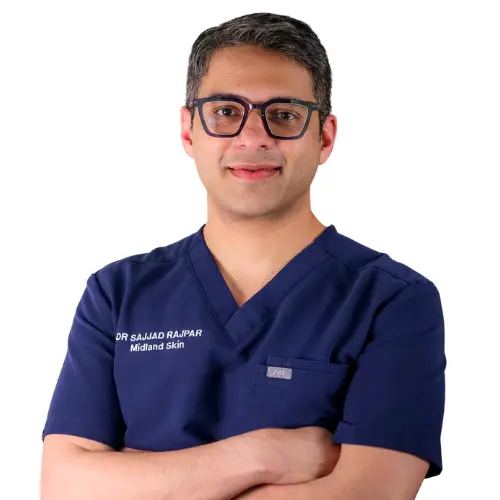
This page has been written and/or medically reviewed by Dr Sajjad Rajpar, Consultant Dermatologist and Medical Director of Midland Skin, Birmingham.
Dr Rajpar is on the GMC Specialist Register in Dermatology and has over 20 years’ experience in clinical dermatology. He provides clinical oversight to ensure the information on this page is accurate, balanced and consistent with current dermatology practice.
Dr Sajjad Rajpar
Date last updated: 21st Sep 2026
Book in with us
Expert, consultant led care in dermatology, skin surgery, eyelid surgery, lasers and aesthetics.
Disclaimer
The content on this website is provided for general information only. It is not, and must not be treated as, medical advice, a diagnosis, or a recommendation for any particular treatment. We make reasonable efforts to keep information accurate and up to date, but medicine and technology change, and content may not reflect the most current evidence, guidance, product information, or individual practice. You should not rely on this website to make decisions about your health or treatment. Always seek personalised advice from an appropriately qualified healthcare professional. Any examples, images, testimonials, and outcome descriptions are illustrative only. Results vary between individuals and no outcome can be guaranteed.

