
Genital Skin Tag Removal
Our expert doctors offer same day genital skin tag removal in Birmingham and Solihull
At Midland Skin we offer genital skin tag removal treatment for patients in Birmingham, Solihull, Coventry, Wolverhampton, Worcester and the Midlands.
Skin tags in the groin and genital area are common, and many people put off doing anything about them. Removal is a straightforward procedure carried out while you are awake.


Quick Facts about genital skin tag removal

Best for
Skin tags in groin and genital skin

Treatment
Snip excision or cautery
Anaesthetic
Local anaesthetic

Duration
15-30 minutes

Recovery
About 5-7 days

Price
See below
Skin tag removal in Birmingham and Solihull
Skin tags are a common problem that almost half the population have. Skin tags can be removed safely and effectively in Birmingham, Solihull and the Midlands.
Skin tag removal is a straightforward procedure that can be carried out while you are awake. Skin tag removal takes only 15 to 30 minutes.
What is a skin tag?
A skin tag is a tiny bulge or bump of extra skin on a pedicle. A skin tag can be tiny, and from 1-2 mm in length, to over 3 or 4cm in length.
The medical name for a skin tag is acrochordon and fibroepithelial polyp.
Skin tags may be skin coloured, though sometimes they can be pink or dark. They are usually smooth on their surface. Sometimes they look a bit flaccid and wrinkled.
Some people may only have one or two skin tags while others are prone to developing tens or even hundreds.
Which areas do we treat?
Skin tags are fleshy projections of skin that can be found anywhere on the body. We treat skin tags in the following areas:
- Groin – including the skin folds
- Suprapubic skin
- Penis and scrotum
- Labia majora
- Perineum
- Buttocks and upper inner thighs
Skin tags we do not treat
We do not offer treatment for skin tags on the anal margin (area of darker skin around the anal opening) or the surrounding perianal area (the area 5cm around the anal opening). We also do not offer treatment for skin tags on the labia minora and clitoral area.
Skin tags at the anal margin and in the perianal area can be associated with haemorrhoids, anal fissures or inflammatory bowel disease, so they are better assessed by a colorectal service rather than removed as a cosmetic lesion.

Gary Stevens

Why the diagnosis matters more here
Getting the diagnosis right is more important on genital skin than anywhere else on the body, because the commonest thing mistaken for a genital skin tag is a genital wart, and the two are treated differently.
The 2024 BASHH national guideline lists skin tags (fibromas) in the differential diagnosis of anogenital warts, alongside normal anatomical variants such as pearly penile papules, vulval papillomatosis and Fordyce spots, other infections such as molluscum contagiosum, and, less commonly, intraepithelial neoplasia and malignant lesions.
This matters in both directions. Being told you have genital warts when the lesion is a harmless skin tag causes real and avoidable distress. Treating a wart as though it were a skin tag leaves the underlying infection untreated.
Your clinician examines the lesions, uses dermoscopy where appropriate, and tells you what they are before anything is removed.
If the lesions are genital warts
We treat genital warts as well as genital skin tags, so if that is what the lesions turn out to be, you have not come to the wrong place. Your clinician will explain what the treatment options are, how many sessions are likely to be needed and what to expect, and will discuss this with you before proceeding.
Genital warts are caused by HPV, and treatment removes the visible lesions rather than clearing the virus. Because of this, your clinician may also recommend screening for other sexually transmitted infections through a sexual health service. Warts extending to the anal margin or beyond it are better managed by a sexual health service, where internal examination can be carried out.
How are genital skin tags removed?
Two methods are used for removal of skin tags.
- Snip excision. The skin tag is snipped off using sterile scissors. The wound is then cauterised.
- Cautery. The skin tag is focally burnt off using electrosurgery with a very fine tip.
A local anaesthetic injection is used. This is not required if the skin tag is very small. Very large skin tags may be cut out and the skin stitched together.
We are able to treat up to 7 skin tags per session.
Treatment pathway for genital skin tag removal
Enquiry
Tell us where the lesions are and how many there are. You can upload photographs, or mark the location on the diagram in the enquiry form if you would rather not send images. Photographs are needed if you would like to be considered for same-day removal.
Initial assessment
Your clinician examines the lesions, considers the likely diagnosis, confirms whether removal is appropriate and discusses the method, the likely healing and the alternatives with you. If the diagnosis differs from the impression formed from your photographs, the proposed treatment and fee will be explained again before anything goes ahead.
Removal
Where treatment is appropriate and you wish to go ahead, the skin tags are removed under local anaesthetic. For selected typical skin tags this can be during the same visit.
Healing and review
You are given aftercare advice and dressings where needed. A wound check or suture removal appointment is arranged where required, and any histology result is discussed with you.
Discretion and what the appointment is like
Most people who come to us about genital skin tags have been putting it off. It is worth saying plainly what the appointment involves.
You will be seen in a private consulting room. You undress only the area being examined and are given a drape. The examination is brief and focused on the lesions you have asked about, and you are welcome to bring someone with you.
If you would rather not upload photographs of the area when you enquire, you do not have to. You can mark the location on the diagram in the enquiry form instead, or book a Specialist Skin Surgery Assessment and have the lesions examined in person first.
Same-day assessment and removal
Same-day removal must be requested in advance. Indicate on the enquiry form that you would like to be considered for a same-day procedure and upload clear photographs of the lesions.
Being offered a same-day appointment does not guarantee that a procedure will be carried out. Suitability is confirmed at your assessment, and your clinician may advise a separate appointment if the diagnosis is uncertain, the lesions are not skin tags, histology is needed first, or you would benefit from time to consider the options. Very complex cases are not treated on the same day.
Full details of how the same-day pathway works, what it includes and what happens if a procedure does not go ahead are on our Same Day Consultations and Procedures page.
Healing and aftercare in genital skin
A very superficial wound results. This is covered with Vaseline and will scab over and heal over a period of a few days, usually between 5 to 7 days. Skin in the groin is warmer, more occluded and more prone to rubbing than skin elsewhere, so wounds here are usually covered with a splash-proof dressing until they have healed.
Keep the treated areas clean and dry. They can be cleansed once or twice a day with water and a cotton pad. Avoid heavy exercise or anything strenuous for the rest of the day, and wear loose clothing and cotton underwear while the area settles. Most people can return to an office job straight away.
There can be discomfort for a day or two after the procedure, especially in sensitive areas such as the groin. In this case, we advise taking a simple painkiller such as paracetamol.
Small lesions usually heal without a trace. Larger lesions may heal with a slight scar that may be very slightly paler, or a mild indentation. This is generally a very safe procedure with a high level of satisfaction.
Skin tags do not recur once they have been treated. If you are prone to skin tags, new ones can develop over time.
Your appointment: practical questions
Do I need to do anything to prepare?
No shaving or hair removal is needed beforehand. Attend as normal, and tell us about any medical conditions, allergies and medication.
Please do not stop blood-thinning medication, or any other prescribed medication, unless specifically advised to do so by the clinician responsible for prescribing it.
Will it hurt?
The skin is numbed with a local anaesthetic injection, which stings briefly. Genital skin is sensitive, so the injection is often the least comfortable part. You will feel pressure and touch during the procedure but not pain.
When can I have sex or go back to the gym?
Avoid strenuous exercise, swimming and sexual activity until the area has healed, usually around a week. Your clinician will give you specific advice for your procedure.
Will the lesions be sent to the laboratory?
Typical skin tags with no uncertain features do not usually require histology. Where the diagnosis is not clear-cut, or a lesion has any suspicious features, tissue is sent for laboratory examination. This carries an additional charge unless already included in your quotation.
Andrew Tombs
Book in with us
Ready to get started? Book a consultation with our team at Midland Skin. Friendly, expert advice tailored to you.
Other skin lesions
Our clinic also offers the removal of moles, skin tags, cysts, warts, seborrhoeic keratoses, sebaceous gland hyperplasia and milia cysts.
Fees
Genital skin tag removal Show pricing
Book ConsultationSeborrhoeic keratosis & skin tag – 1 large or 3 small
Seborrhoeic keratosis & skin tag – 2 large or up to 7 small
Seborrhoeic keratosis & skin tag – complex / larger session
Seborrhoeic keratosis & skin tag – groin, face or eyelid
References used for this article
- Nugent D, Apoola A, Coleman H, et al. British Association for Sexual Health and HIV national guideline for the management of anogenital warts in adults (2024). Int J STD AIDS. 2024. doi:10.1177/09564624241233338.
- Skin Tag (Acrochordon). In: StatPearls [Internet]. Treasure Island (FL): StatPearls Publishing; 2025.
About the Author
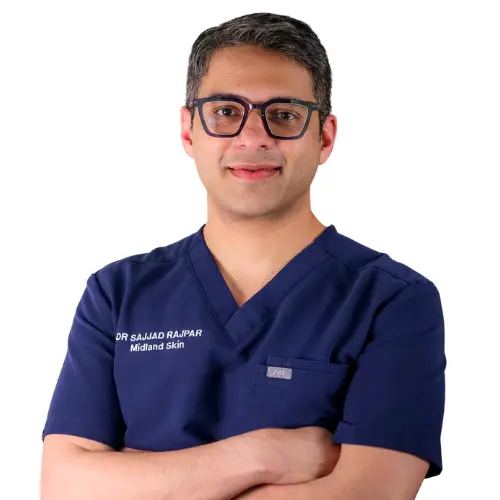
This page has been written and/or medically reviewed by Dr Sajjad Rajpar, Consultant Dermatologist and Medical Director of Midland Skin, Birmingham.
Dr Rajpar is on the GMC Specialist Register in Dermatology and has over 20 years’ experience in clinical dermatology. He provides clinical oversight to ensure the information on this page is accurate, balanced and consistent with current dermatology practice.
Dr Sajjad Rajpar
Date last updated: 22nd Sep 2026
Book in with us
Expert, consultant led care in dermatology, skin surgery, eyelid surgery, lasers and aesthetics.
Disclaimer
The content on this website is provided for general information only. It is not, and must not be treated as, medical advice, a diagnosis, or a recommendation for any particular treatment. We make reasonable efforts to keep information accurate and up to date, but medicine and technology change, and content may not reflect the most current evidence, guidance, product information, or individual practice. You should not rely on this website to make decisions about your health or treatment. Always seek personalised advice from an appropriately qualified healthcare professional. Any examples, images, testimonials, and outcome descriptions are illustrative only. Results vary between individuals and no outcome can be guaranteed.

