
What is a Dermatologist?
A Dermatologist is a medical doctor who has specialised in the diagnosis and treatment of medical, surgical and cosmetic disorders of the skin, hair and nails.
At Midland Skin we offer Dermatology appointments for patients in Birmingham, Solihull, Coventry, Wolverhampton, Worcester and the Midlands.


What is a consultant dermatologist?
A consultant dermatologist is a fully trained specialist in conditions of the skin, hair and nails. They are medical doctors who have completed general medical training and then several further years of specialist training in dermatology, covering medical, surgical and cosmetic treatment.
You can find out more about our team of Dermatologists here.
“Dermatologist” is not a protected title
In the UK, anyone can describe themselves as a dermatologist. The title is not protected in law, and it is used by practitioners with very different levels of training.
This means you may come across:
- Consultant dermatologists – doctors who have completed full specialist training in dermatology and are on the GMC Specialist Register for Dermatology
- GPs with an interest in skin – qualified doctors with additional dermatology experience, but who have not completed specialist dermatology training
- Cosmetic doctors and aesthetic practitioners – who may treat the appearance of the skin without holding a dermatology specialist qualification
- Non-medical practitioners – who may use the term without any medical degree at all
None of these are necessarily doing anything wrong, but they are not the same thing. If you want a specialist opinion on a skin condition, it is worth checking exactly who you are seeing.
How do you know you are seeing a consultant dermatologist?
You should check for:
- A UK medical qualification – MB ChB, MBBCh, MB BChir, MB BS, BM BCh, BM BS or BM
- MRCP(UK) – the postgraduate diploma in general medicine
- A dermatology specialist qualification – SCE (Dermatology) or MRCP(UK)(Dermatology), depending on when the doctor trained
- Entry on the GMC Specialist Register for Dermatology – the definitive check
The letters used after a doctor’s name have changed over the years, so the most reliable check is the GMC Specialist Register. You can search it at gmc-uk.org and look for Dermatology under the doctor’s specialty.
What training does a consultant dermatologist have?
Becoming a consultant dermatologist takes a minimum of 13 years of education and training after leaving school.
- Years 1-5: Medical degree. A dermatologist first has to qualify as a medical doctor by completing a five-year medical degree, learning the fundamentals of medicine across the whole body. UK medical graduates receive the degrees of Bachelor of Medicine and Bachelor of Surgery. You should look for one of the following qualifications after their name: MB ChB, MBBCh, MB BChir, MB BS, BM BCh, BM BS or BM.
- Years 6 & 7: Foundation training Two years working in hospital and primary care, caring for patients admitted to hospital and seen in the emergency department.
- Years 8 & 9: Internal medicine training and the MRCP diploma. A minimum of two years specialising further in general medicine, with posts in areas such as cardiology, endocrinology, respiratory medicine and acute medicine. Doctors must pass the MRCP(UK) diploma examination to demonstrate a high level of knowledge and skill in treating the whole body.
- Years 10 to 13: Specialist training in Dermatology. A minimum of four years training in dermatology – the diagnosis and treatment of skin, hair and nail conditions in adults and children. Doctors work across hospitals and clinics under the supervision of experienced dermatologists, developing the day-to-day skills needed to practise independently. Training in medical, surgical and laser procedures is acquired during this period, and doctors also carry out research to advance the specialty. Trainees must also pass the Specialty Certificate Examination in Dermatology. Depending on when they trained, consultants may use SCE (Dermatology) or MRCP(UK)(Dermatology) after their name, or simply MRCP(UK).
- Year 13 onwards: Entry to the GMC Specialist Register. Once all training and examinations are complete, doctors are assessed by an independent committee and granted a Certificate of Completion of Training (CCT) in Dermatology. They can then join the Specialist Register of the General Medical Council as a fully qualified consultant dermatologist.
What does a dermatologist treat?
Dermatologists diagnose and treat conditions affecting the skin, hair and nails – several thousand distinct diagnoses in total. Patients range from newborns to the very elderly.
Common reasons for seeing a dermatologist include:
- Skin cancer, including basal cell carcinoma, squamous cell carcinoma and melanoma
- Moles and other skin lesions
- Acne and acne scarring
- Rosacea and redness
- Rashes and itchy skin
- Eczema and other inflammatory skin conditions
- Psoriasis
- Hair loss
- Nail problems
- Sun damage and skin ageing
- Laser treatments
- Dermatologists are also trained in dermatological surgery – including biopsy, excision of cancerous and benign growths, nail surgery, cryosurgery and electrosurgery
When is it worth seeing a dermatologist?
Skin conditions are common, and many settle without specialist input. A dermatology assessment is particularly worthwhile when:
- a rash, lump or skin change is persistent, spreading or changing
- a mole looks different from your others, or has changed in size, shape or colour
- a skin condition keeps coming back
- treatments you have already tried have not worked
- the diagnosis is uncertain
- the condition is affecting your sleep, comfort, work or confidence
A specialist assessment establishes what you are actually dealing with before treatment decisions are made – which matters, because conditions that look similar can require quite different treatment.
How do I see a consultant dermatologist?
There are two routes: the NHS or a private dermatology clinic.
NHS referrals are made by your GP. Waiting times vary considerably by region and can be several months for non-urgent referrals.
Privately, waiting times are usually much shorter – typically a few weeks or less.
At Midland Skin you can either be referred by your GP or refer yourself. You do not need a GP referral to book, though it is helpful to bring any relevant letters or details of treatments you have already tried. Appointments are with a consultant dermatologist on the GMC Specialist Register.
Book in with us
Ready to get started? Book a consultation with our team at Midland Skin. Friendly, expert advice tailored to you.
About the Author
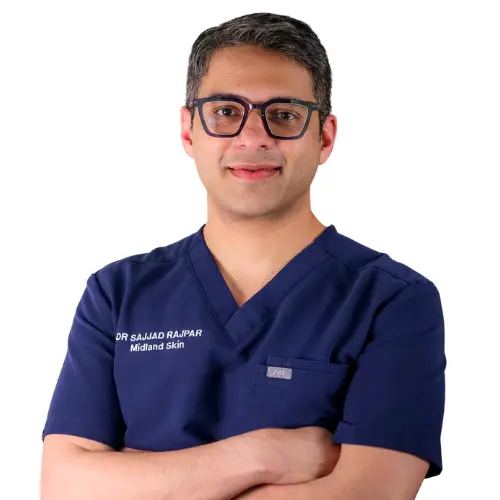
This page has been written and/or medically reviewed by Dr Sajjad Rajpar, Consultant Dermatologist and Medical Director of Midland Skin, Birmingham.
Dr Rajpar is on the GMC Specialist Register in Dermatology and has over 20 years’ experience in clinical dermatology. He provides clinical oversight to ensure the information on this page is accurate, balanced and consistent with current dermatology practice.
Dr Sajjad Rajpar
Date last updated: 23rd Sep 2026
Book in with us
Expert, consultant led care in dermatology, skin surgery, eyelid surgery, lasers and aesthetics.
Disclaimer
The content on this website is provided for general information only. It is not, and must not be treated as, medical advice, a diagnosis, or a recommendation for any particular treatment. We make reasonable efforts to keep information accurate and up to date, but medicine and technology change, and content may not reflect the most current evidence, guidance, product information, or individual practice. You should not rely on this website to make decisions about your health or treatment. Always seek personalised advice from an appropriately qualified healthcare professional. Any examples, images, testimonials, and outcome descriptions are illustrative only. Results vary between individuals and no outcome can be guaranteed.

