
Skin Tag Removal
Skin tag removal in Birmingham, with same-day removal available by request
At Midland Skin we offer skin tag removal treatment for patients in Birmingham, Solihull, Coventry, Wolverhampton, Worcester and the Midlands. Skin tags can be removed from most areas of the body, including the eyelids and genital skin. Where the lesions are typical and photographs have been reviewed in advance, assessment and removal may take place at the same visit.


Quick Facts about skin tag removal

Best for
Skin tags, any body site
Treatment
Snip excision or cautery
Anaesthetic
Local anaesthetic

Duration
15-30 minutes

Recovery
About 5-7 days

Price
See below
Skin tag removal in Birmingham and Solihull
Skin tags are extremely common, around half of adults have at least one. At Midland Skin they are removed under local anaesthetic by a clinician trained in minor skin surgery, usually in a single short visit.
What is a skin tag?
A skin tag is a tiny bulge or bump of extra skin on a pedicle. A skin tag can be tiny, and from 1-2 mm in length, to over 3 or 4cm in length.
The medical name for a skin tag is acrochordon and fibroepithelial polyp.
Skin tags may be skin coloured, though sometimes they can be pink or dark. They are usually smooth on their surface. Sometimes they look a bit flaccid and wrinkled.
Some people may only have one or two skin tags while others are prone to developing tens or even hundreds.
They tend to appear where skin rubs against skin or clothing, and are more common with increasing age, in pregnancy and in people carrying more weight. Multiple skin tags are also a recognised association of insulin resistance and type 2 diabetes, although having them does not mean there is an underlying metabolic problem, and most people with skin tags are otherwise well.
When is skin tag removal worth considering?
There are many reasons why you might want to have skin tags removed. Removal may be worth considering when:
- Appearance – you do not like how they look, or they have become prominent
- Catching and snagging – on clothing, jewellery, razors or seatbelts
- Irritation – itching, soreness or bleeding after rubbing
- Increasing numbers – you are prone to developing them and want to keep them under control
- Awkward sites – eyelids, neck, underarms, under the breast or genital skin
- Uncertainty – you are not sure the lesion is a skin tag at all
Once a skin tag has developed, it will not go away on its own.
We would not advise cutting or tying off a skin tag yourself. It risks bleeding, infection and an avoidable scar, and if the lesion is not a skin tag, the opportunity to have it examined properly is lost.
Where do skin tags occur?
Skin tags are fleshy projections of skin that can be found anywhere in the body. Skin tag removal is requested most often for skin tags located in the following areas:
- eyelids
- face
- neck
- under arms
- under the breast
- on the trunk
- in the groin, genitals
- on the thighs
- on the arms and legs
Skin tags on the eyelids
Eyelid skin tags are one of the areas we are asked about most. Eyelid skin is thin and mobile, so removal is carried out with fine scissors or a very fine cautery tip under local anaesthetic, taking care to protect the lid margin and the lashes. We treat skin tags on the eyelid skin and on the lid margin itself.
Skin tags in the groin and genital area
We also treat skin tags in the groin and on genital skin. More information on skin tag removal in the genital area can be found here.

Gary Stevens

Not everything that looks like a skin tag is one
Skin tags themselves are benign. They do not turn into skin cancer.
Several other lesions can look similar, however, and a few of them matter. Warts, melanocytic naevi, pedunculated seborrhoeic keratoses and, uncommonly, polypoid melanoma all sit in the differential diagnosis of a skin tag. Sometimes skin tags may look like:
- Comedones – these are white, do not have a central crater or thread veins, and occur as part of acne. Treatment of comedones is with hyfrecation.
- Moles – mature moles or intradermal naevi can be confused with skin tags. We offer mole removal too.
- Warts and seborrhoeic keratoses – warts are usually rough and have an irregular surface. We offer wart and seborrhoeic keratosis removal too.
This is why every lesion is examined, with dermoscopy where appropriate, before anything is removed. If the clinician is concerned about the appearance of a lesion, or the history raises a concern, you will be advised how it is best dealt with. This may include review by a consultant dermatologist, or sending the tissue for histological analysis at an additional cost.
How are skin tags removed at Midland Skin?
Two methods are used for removal of skin tags.
- Snip excision. The skin tag is snipped off using sterile scissors. The wound is then cauterised.
- Cautery. The skin tag is focally burnt off using electrosurgery with a very fine tip.
A local anaesthetic injection is used. This is not required if the skin tag is very small.
Very large skin tags may be cut out and the skin stitched together.
Which method is used depends on the size, site and appearance of each lesion, and is decided with you at your assessment.
Treatment pathway for skin tag removal
Enquiry and photographs
Tell us where the skin tags are, how many there are, and whether you would like to be considered for same-day removal. Clear photographs help us advise on the right appointment and give a more realistic fee estimate.
Initial assessment
Your clinician examines the lesions, uses dermoscopy where appropriate, considers the likely diagnosis and discusses the method, the mark likely to be left and the alternatives, including leaving them alone.
Removal
Where treatment is appropriate and you wish to go ahead, the skin tags are removed under local anaesthetic. For selected typical skin tags this can be during the same visit.
Healing and review
You are given aftercare advice and dressings where needed. Most areas heal within a week. A wound check or suture removal appointment is arranged where required, and any histology result is discussed with you.
Same-day assessment and removal
Same-day removal must be requested in advance. When completing the enquiry form, indicate that you would like to be considered for a same-day procedure and upload clear photographs of the lesions and the surrounding skin.
We review the photographs and confirm whether a Same-Day Initial Assessment and Procedure Package is appropriate, or whether a separate assessment is the better route.
Photographs are used to select the most appropriate appointment. They do not provide a diagnosis, do not replace an in-person examination, and being offered a same-day appointment does not guarantee that a procedure will be carried out. Your clinician confirms suitability at the assessment and may advise a separate appointment if the diagnosis is uncertain, the lesion is not a skin tag, histology is needed first, or you would benefit from time to consider the options. Very complex cases are not treated on the same day.
Full details of how the same-day pathway works, what it includes and what happens if a procedure does not go ahead are on our Same Day Consultations and Procedures page.
Healing, scarring and what to expect afterwards
A very superficial wound results. This is covered with Vaseline, and will scab over and heal over a period of a few days, usually between 5 to 7 days. A dressing is not required unless it is in an area that is prone to rubbing or chafing, in which case a dressing is used to protect the skin until it has healed.
You will be asked to apply Vaseline four times a day, to avoid heavy exercise or anything strenuous for the rest of the day, and to keep the treated areas clean and dry. They can be cleansed once or twice a day with water and a cotton pad. Most people can return to an office job straight away.
Small lesions usually heal without a trace. Larger lesions may heal with a slight scar that may be very slightly paler, or a mild indentation. A small change in texture and skin colour may be noted on close-up examination at the site from which the skin tag was removed. It is advisable to treat skin tags when they are small, as healing is simpler and quicker, though skin tags of any size can be removed.
This is generally a very safe procedure with a high level of satisfaction. Bleeding, infection and a change in pigmentation at the treated site are uncommon but possible, and a permanent mark cannot be ruled out, particularly with larger lesions.
Will they come back?
Skin tags do not recur once they have been treated. If you are prone to skin tags, new ones can develop elsewhere over time, and some patients return periodically to keep them under control.
Your appointment: practical questions
Who will carry out my procedure?
Skin tag removal is carried out by a clinician trained and experienced in minor skin surgery. You will meet the clinician treating you, and they will examine the lesions and answer your questions before anything is removed.
What should I do before my appointment?
Come with the area accessible and, for facial or eyelid lesions, without make-up. Tell us about any medical conditions, allergies and medication, and let us know if the lesions have changed since you sent your photographs.
Please do not stop blood-thinning medication, or any other prescribed medication, unless specifically advised to do so by the clinician responsible for prescribing it.
Will it hurt, and how long does it take?
The skin is numbed with a local anaesthetic injection, which stings briefly. You will feel pressure and touch but not pain. Very small tags can often be treated without anaesthetic.
Removal itself usually takes 15 to 30 minutes, depending on the number of lesions, with the assessment beforehand in addition.
How many skin tags can be treated in one session?
A number can be treated per session, usually up to 7. Very complex cases, for example a large number of lesions or very large lesions needing stitches, are not suitable for same-day treatment and are planned at a separate appointment.
Will the skin tag be sent to the laboratory?
Typical skin tags with no uncertain or concerning features do not usually require histology. Where the diagnosis is not clear-cut, or the lesion has any suspicious features, tissue is sent for laboratory examination. This carries an additional charge unless already included in your quotation.
Can I drive home afterwards?
For most sites, yes. Local anaesthetic around the eyes, upper cheeks or forehead can occasionally cause temporary swelling or blurred vision, so if you are having eyelid lesions treated, please arrange for someone to drive or accompany you home.
Book in with us
Ready to get started? Book a consultation with our team at Midland Skin. Friendly, expert advice tailored to you.
Fees
Skin tag removal Show pricing
Book ConsultationSeborrhoeic keratosis & skin tag – 1 large or 3 small
Seborrhoeic keratosis & skin tag – 2 large or up to 7 small
Seborrhoeic keratosis & skin tag – complex / larger session
Seborrhoeic keratosis & skin tag – groin, face or eyelid
Jon Tiffen
References used for this article
- Joseph Chandran B, Nair SP. A clinico-morphological study of acrochordons and the association with diabetes mellitus. Cureus. 2025;17(2):e78549. doi:10.7759/cureus.78549.
- Skin Tag (Acrochordon). In: StatPearls [Internet]. Treasure Island (FL): StatPearls Publishing; 2025.
About the Author
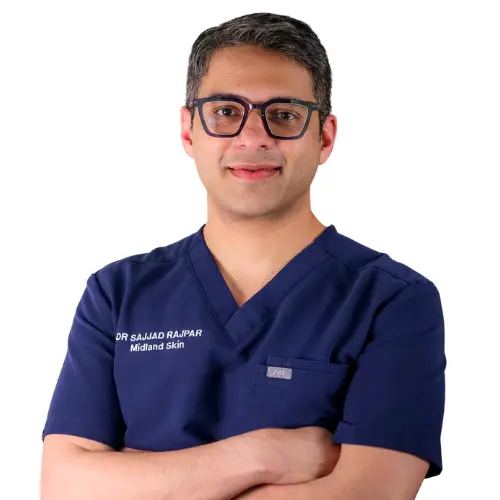
This page has been written and/or medically reviewed by Dr Sajjad Rajpar, Consultant Dermatologist and Medical Director of Midland Skin, Birmingham.
Dr Rajpar is on the GMC Specialist Register in Dermatology and has over 20 years’ experience in clinical dermatology. He provides clinical oversight to ensure the information on this page is accurate, balanced and consistent with current dermatology practice.
Dr Sajjad Rajpar
Date last updated: 22nd Sep 2026
Book in with us
Expert, consultant led care in dermatology, skin surgery, eyelid surgery, lasers and aesthetics.
Disclaimer
The content on this website is provided for general information only. It is not, and must not be treated as, medical advice, a diagnosis, or a recommendation for any particular treatment. We make reasonable efforts to keep information accurate and up to date, but medicine and technology change, and content may not reflect the most current evidence, guidance, product information, or individual practice. You should not rely on this website to make decisions about your health or treatment. Always seek personalised advice from an appropriately qualified healthcare professional. Any examples, images, testimonials, and outcome descriptions are illustrative only. Results vary between individuals and no outcome can be guaranteed.

