
Blepharoplasty surgery in Birmingham and the Midlands
Upper and lower eyelid surgery by a consultant oculoplastic surgeon, under local anaesthetic with optional sedation
At Midland Skin we offer blepharoplasty surgery for patients in Birmingham, Solihull, Coventry, Wolverhampton, Worcester and the Midlands.


Quick Facts about blepharoplasty

Best for
Hooded lids & eye bags

Anaesthetic
Local ± sedation

Duration
1–2 hours

Recovery
1–2 weeks
Consultant
Oculoplastic surgeon

Price
See below
What is Blepharoplasty?
Blepharoplasty, commonly referred to as eyelid lift surgery or eye bag surgery, removes or repositions excess skin, muscle and fat from the upper or lower eyelids.
With age, the skin around the eyes thins and loses elasticity, and the fat that cushions the eye can push forward. The result is hooded or heavy upper lids, bags and puffiness under the eyes, and a tired look that sleep, creams and make-up do not fix. In more advanced cases, upper eyelid skin rests on the lashes and narrows your field of vision.
Surgery lifts the upper lid or smooths the lower lid while keeping the natural shape of your eyes. It is one of the most effective and long-lasting procedures for the eye area, but it does not treat every concern around the eyes, which is why assessment by an oculoplastic surgeon comes first.
Before and after blepharoplasty
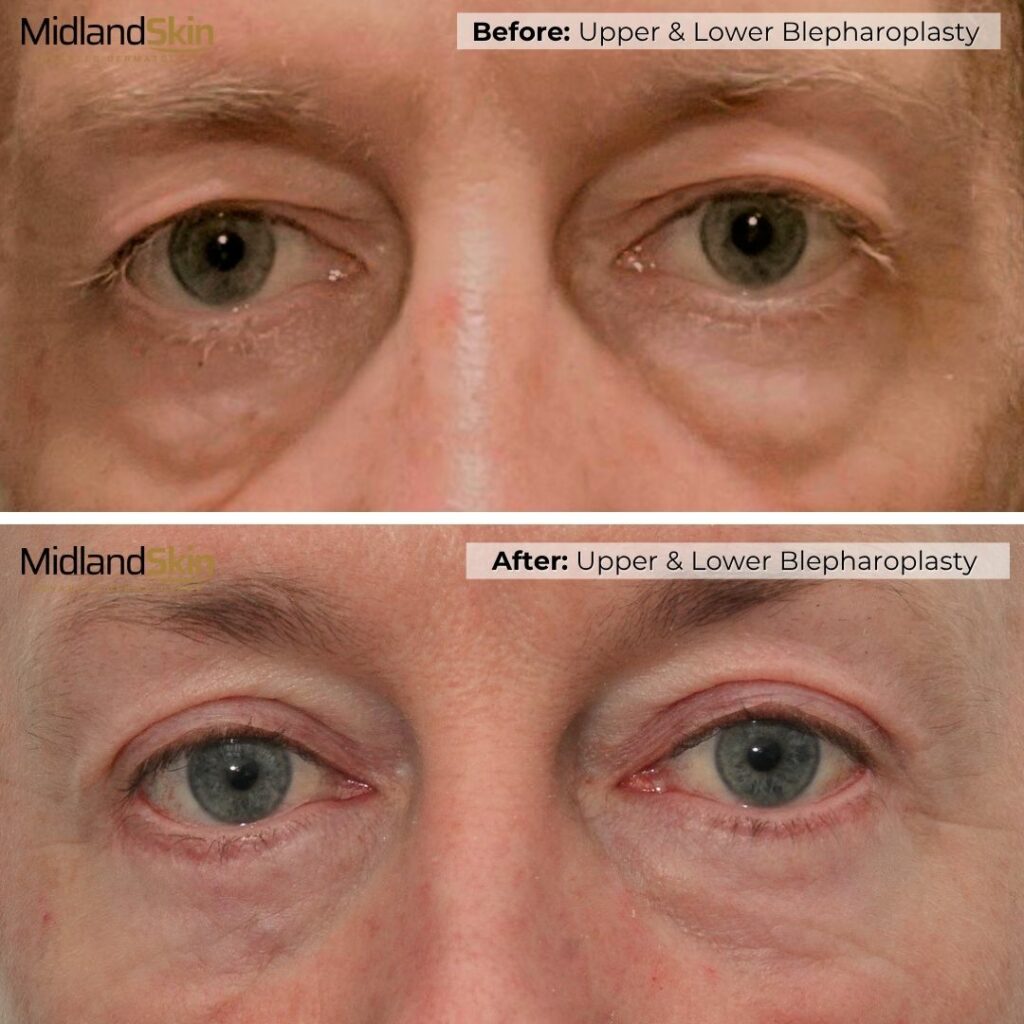
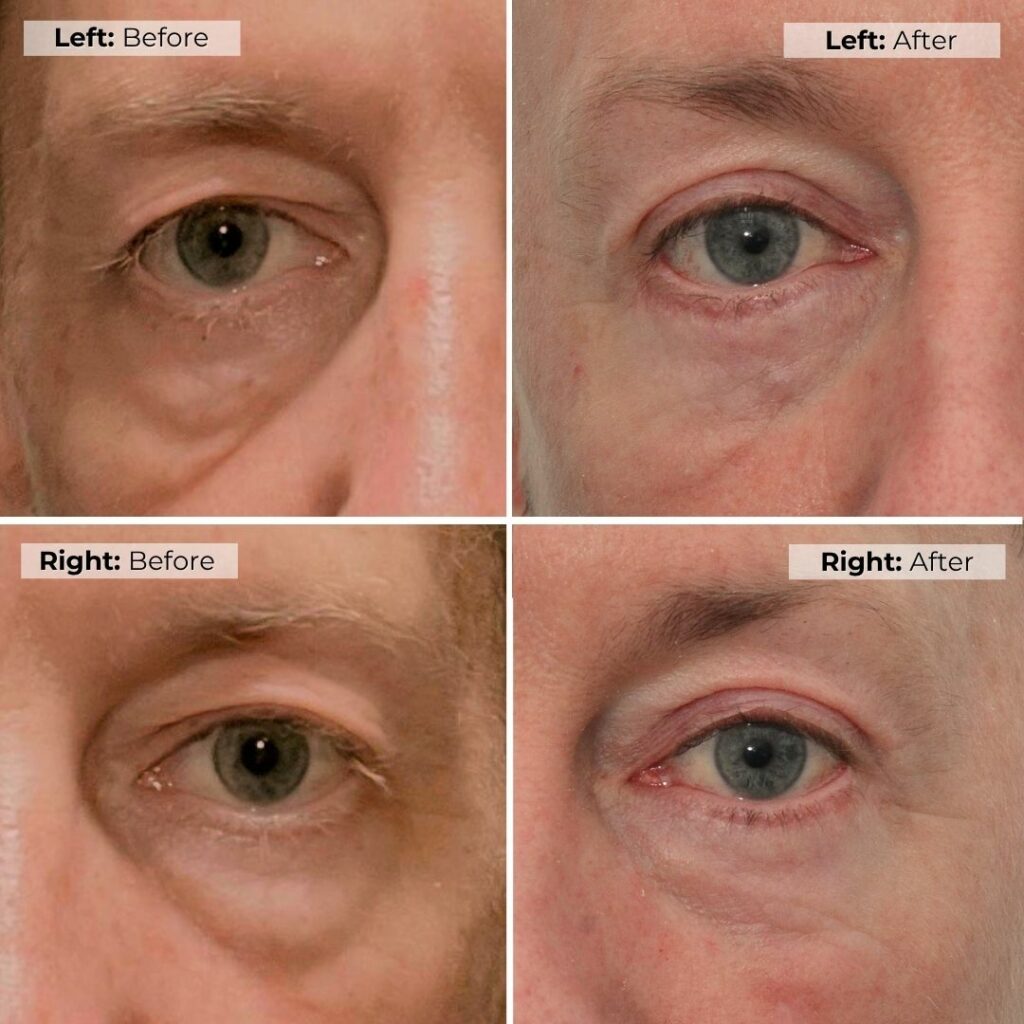
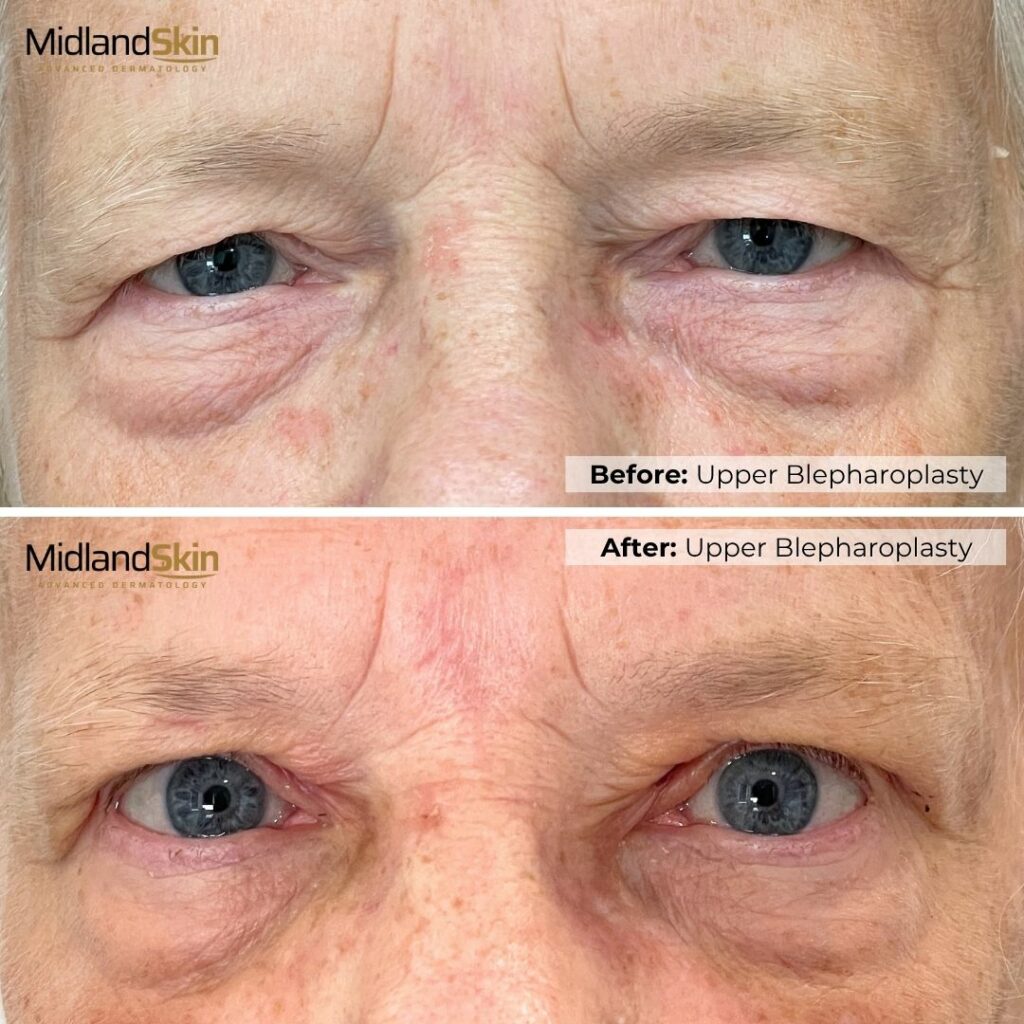
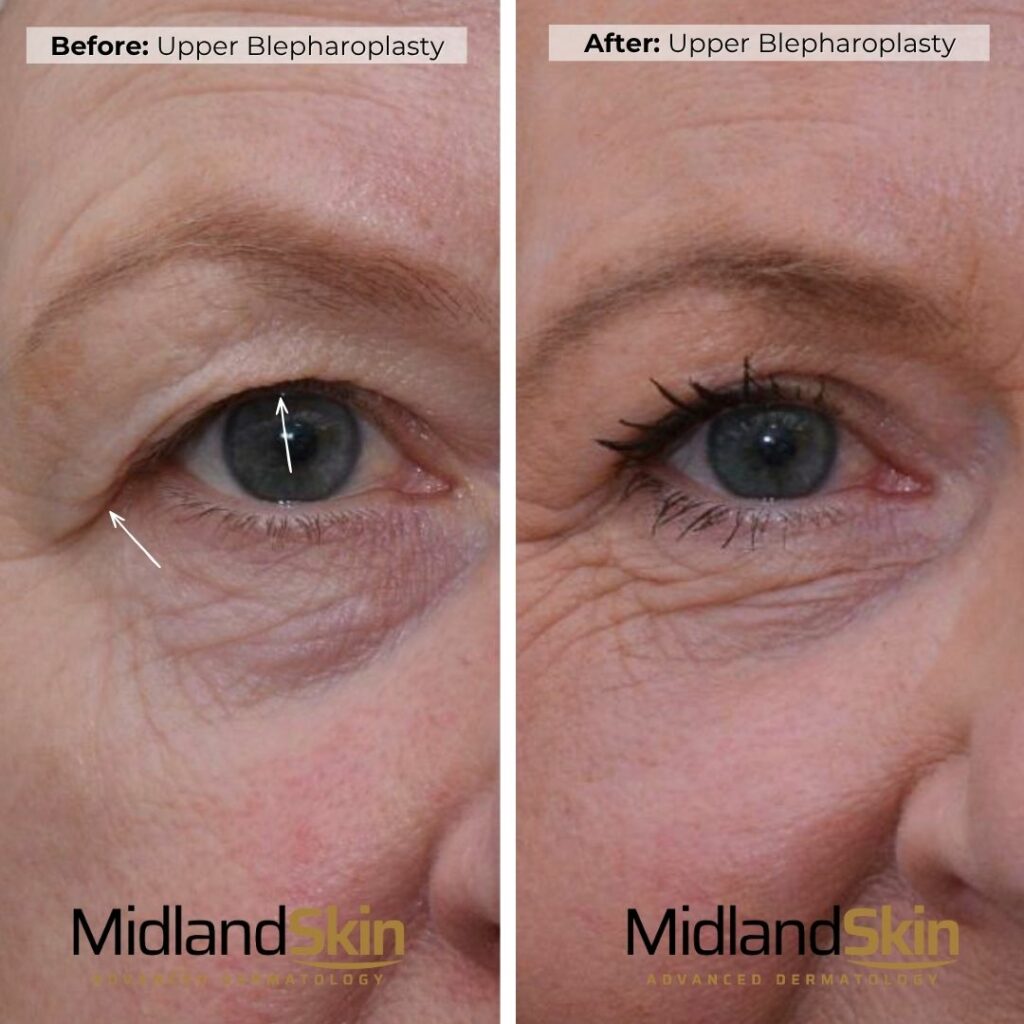
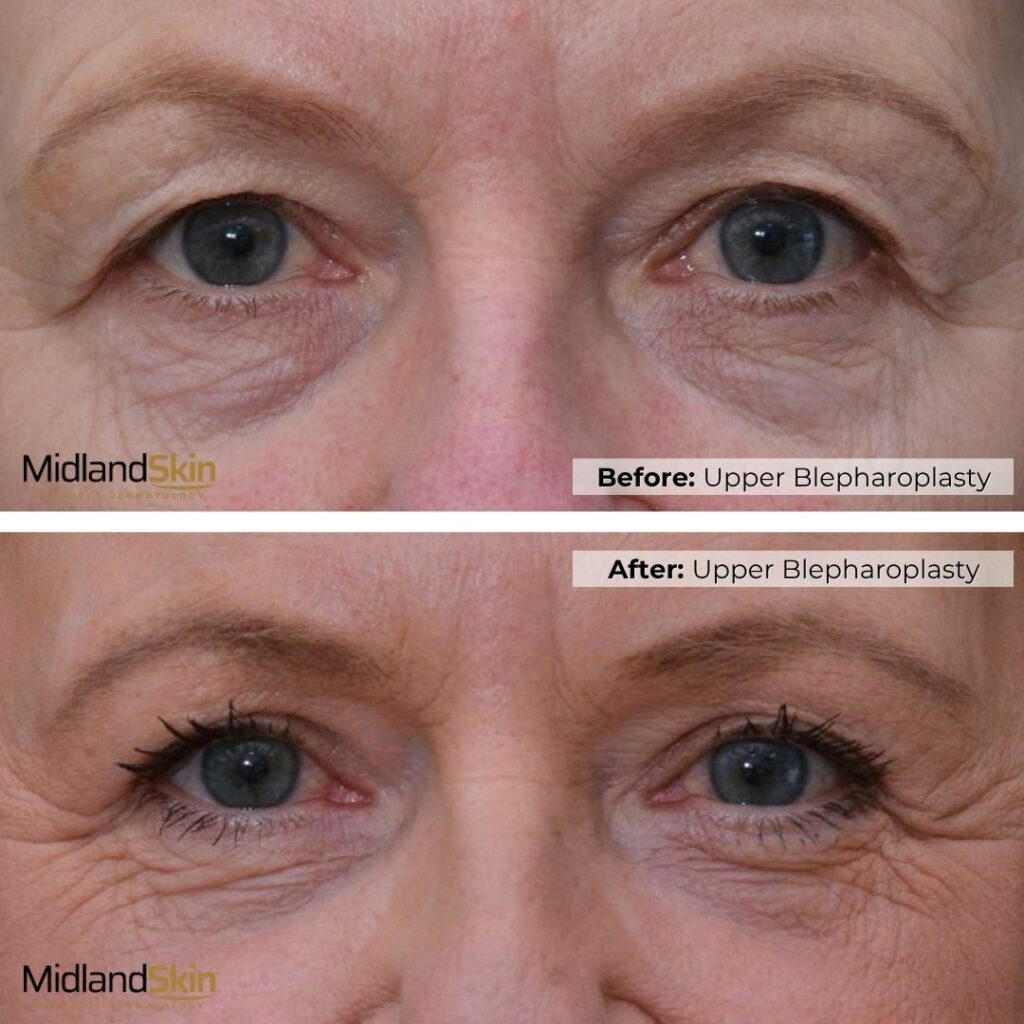
Blepharoplasty videos
Blepharoplasty at Midland Skin
Blepharoplasty reaction first glimpse (1)
Blepharoplasty reaction first glimpse (2)
Is blepharoplasty right for me?
Blepharoplasty is worth considering if you have:
- Hooded or heavy upper eyelids – excess skin folding over the lid or resting on the lashes
- Upper eyelid skin that narrows your vision – particularly your upper or outer field, or when reading and driving
- Under-eye bags – bulging fat pads that give a puffy, tired look even when you are well rested
- Loose or crêpey skin beneath the eyes
- Eyes that look older or more tired than you feel
- A visible difference between the two eyelids
- Unsatisfactory results or complications from previous eyelid surgery
The best candidates for surgery are healthy, non-smoking adults who have realistic expectations about the outcomes of the procedure.
Why choose Midland Skin for blepharoplasty
Blepharoplasty is a delicate procedure that requires specialist knowledge of the intricate anatomy of the eyes and surrounding structures. While plastic surgeons and cosmetic surgeons can perform eyelid surgery, oculoplastic surgeons have additional, highly specialised training in both ophthalmology (eye surgery) and plastic surgery of the eyelids, orbit, and tear ducts. This is why, at Midland Skin, eyelid surgery is carried out by a consultant oculoplastic surgeon.
The eyelids are unique in their anatomy, with extremely delicate skin, essential muscles for vision, and close proximity to the eyes. A poorly executed blepharoplasty can result in functional complications such as dry eyes, difficulty closing the eyelids (lagophthalmos), asymmetry, or vision issues. Oculoplastic surgeons are specifically trained to avoid and manage these risks.
At Midland Skin:
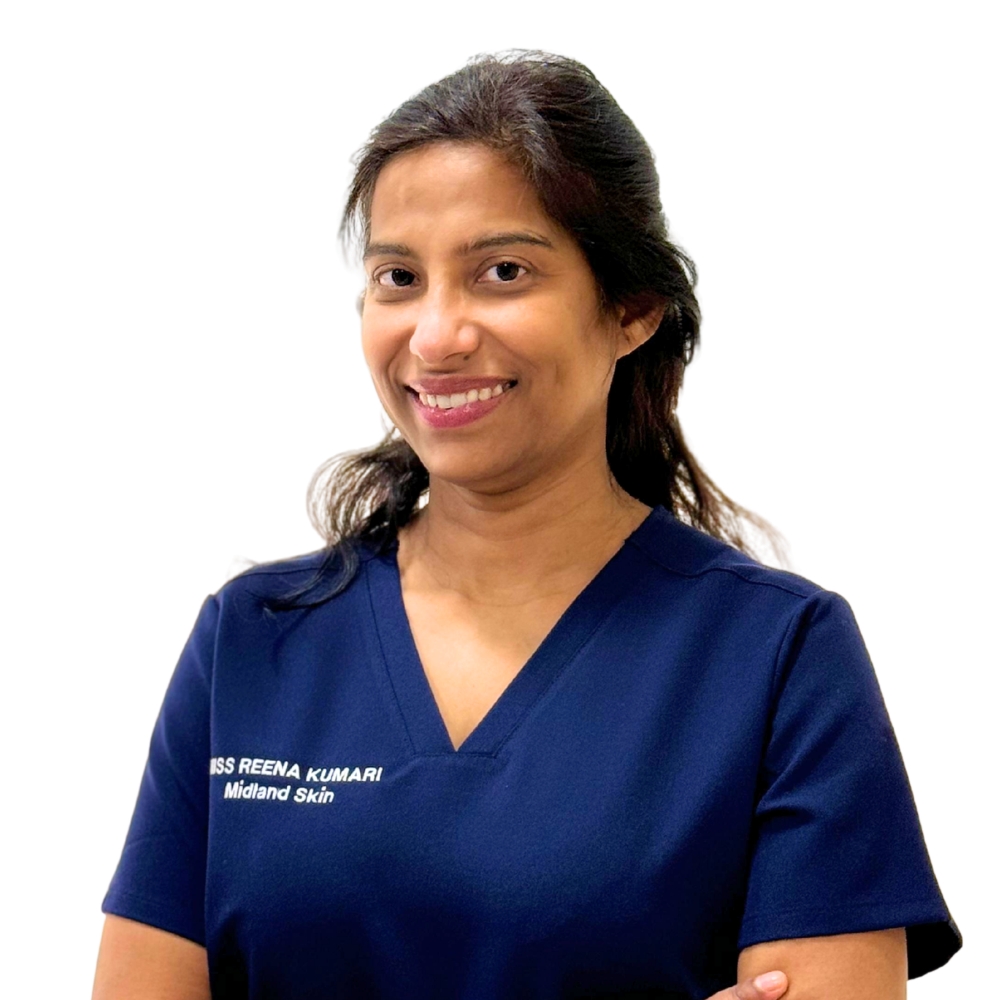
- Your consultation, consent and surgery are all with the same consultant oculoplastic surgeon, Miss Reena Kumari
- Surgery is a day procedure under local anaesthetic, with intravenous sedation from an anaesthetist if you prefer: no general anaesthetic, no hospital stay
- Eye surface, tear film, eyelid position and brow are assessed before surgery is recommended, so you are offered the right procedure rather than the one you searched for
- Ptosis surgery, eyelid malposition correction, laser resurfacing and Sofwave are all available on site if a combined approach will give a better result
- Surgery at our CQC-registered clinic
- Consultant on the GMC Specialist Register
- A two-week cooling-off period before you decide

Lucie Michael

Upper, lower or both? Blepharoplasty options at Midland Skin
The treatment can be performed on the upper eyelids, lower eyelids, or both, depending on the individual’s concerns.
Upper Eyelid Blepharoplasty (Eyelid lift surgery)
The upper blepharoplasty procedure primarily targets sagging or hooded eyelids caused by excessive skin and fat. For some individuals, excessive skin on the upper eyelids can extend over the eyelashes, creating a heavy, droopy appearance and, in more severe cases, even obstructing vision.
The excess is removed through an incision hidden in the natural crease of the eyelid, so the scar is not visible when the eyes are open. Recovery is usually quicker than for the lower lids.
Lower Eyelid Blepharoplasty (Eye bag surgery)
Lower blepharoplasty focuses on improving the appearance of under-eye bags, puffiness, and wrinkles beneath the eyes. The bulging fat is removed or, where there is hollowing beneath the bag, repositioned to smooth the transition from eyelid to cheek. It can be done from the inside of the eyelid, leaving no visible scar, or through a fine incision just below the lashes when loose skin also needs tightening. The lower eyelid is less forgiving than the upper, so your surgeon may also support the lid to stop it being pulled downwards as it heals.
Upper and lower blepharoplasty together
Where both are needed they can be carried out in the same session. This is a longer procedure with a longer recovery, and dry-eye symptoms afterwards are more common than with either alone.
Revision blepharoplasty
If you have previously had a blepharoplasty and you have experienced unsatisfactory results or complications that need addressing, our team will be able to offer you an opinion. Revision surgery is more complex than first-time surgery and is not always advisable; sometimes an honest opinion is the most useful outcome of the consultation.
Combining blepharoplasty with other procedures
Being a multidisciplinary consultant-led team, we are uniquely positioned to offer combination treatments that may be required with blepharoplasty surgery, such as:
- Ptosis surgery
- Eyelid malposition correction
- Laser resurfacing to improve the skin quality around the eyes, and reduce fine lines and wrinkles
- Non surgical brow lift with Sofwave
What blepharoplasty can and cannot do
Not every concern around the eyes is helped by blepharoplasty, and a few are made worse by it. At your consultation, your surgeon will establish which of these applies to you.
Blepharoplasty treats: excess eyelid skin, bulging fat pads, heaviness and hooding, and vision narrowed by upper lid skin.
It does not treat:
- A drooping eyelid caused by a weakened lifting muscle (ptosis). This needs ptosis surgery, sometimes combined with blepharoplasty, and can be unmasked by removing skin alone.
- A low or heavy brow, which mimics hooded lids. A brow lift, or non-surgical lifting with Sofwave, may be the better option.
- Hollowing under the eyes without bulging fat, which needs a different approach.
- Dark circles caused by pigmentation or thin skin.
- Crow’s feet and fine lines, which are treated with laser resurfacing or anti-wrinkle injections.
- Malar bags or festoons, the swelling on the cheekbone below the eye bag, which standard lower blepharoplasty does not reliably improve.
Matching the operation to the actual problem is the most important decision in eyelid surgery, and the commonest cause of disappointment when it is missed.
Results, risks and what the evidence shows
What to expect from a good result
A well-planned blepharoplasty produces a rested, more open appearance that still looks like you. The change is long-lasting: ageing continues, but the excess skin and fat that were removed do not return in the same way, and most people never need the operation repeated. Where upper eyelid skin was narrowing your vision, the improvement is immediate.
The evidence supports this. A 2025 meta-analysis restricted to randomised trials found that dry-eye symptoms were, on average, significantly reduced after upper blepharoplasty compared with before surgery, most likely because the lids no longer weigh on the eye, and patient satisfaction did not differ between the surgical techniques compared.
What it will not do
Blepharoplasty does not stop ageing, lift the brow, remove crow’s feet or change dark circles. The final appearance cannot be guaranteed, and a small number of patients need a minor adjustment, most often for a little residual skin or slight asymmetry.
Risks
- Expected after every blepharoplasty: bruising and swelling for one to two weeks, tightness, watery or gritty eyes, blurred vision from ointment, and numb eyelid skin for a few weeks. Scars sit in the eyelid crease or just below the lashes and fade to a fine line over several months.
- Less common: dry eye that persists beyond the early weeks; difficulty fully closing the eyes (lagophthalmos), usually temporary; asymmetry; the lower eyelid pulling down or rounding; infection; bleeding; and a drooping lid revealed once the excess skin is gone. In the randomised evidence, incomplete closure was several times more likely when muscle was removed together with the skin, which is why muscle-sparing technique is preferred where possible. Reviews of lower blepharoplasty report lower-lid malposition in up to around 5% of patients in some series, most settling with time or a small corrective procedure, and no major complications affecting vision in the studies included in the most recent systematic review.
- Rare but serious: bleeding behind the eye after surgery, which can threaten sight if not treated quickly. It is very rare, and it is the reason you will be given clear instructions on what to do if you develop sudden pain, swelling or a change in vision.
Treatment pathway for blepharoplasty
Consultation with your oculoplastic surgeon
You meet Miss Reena Kumari, Consultant Oculoplastic Surgeon, who examines your eyelids, brow, eye surface and tear film, checks eyelid position and closure, and discusses what you are hoping to achieve. Photographs are taken, and a visual field test may be arranged where vision is affected.
Treatment plan and cooling-off period
Your surgeon confirms whether blepharoplasty is appropriate, upper, lower or both, or whether another procedure would suit you better, and explains the risks, recovery and likely result. You receive written information and decide together whether you would like sedation. In line with Royal College of Surgeons standards, consent is a two-stage process with a cooling-off period of at least two weeks before surgery, and the surgeon who operates is the surgeon who leads your consultation.
Surgery
Blepharoplasty is carried out at Midland Skin as a day procedure under local anaesthetic. If you would rather not be aware of the surgery, intravenous sedation from an anaesthetist can be arranged. Either way, you go home the same day with someone to drive you.
Follow-up
You are seen at around one week for stitch removal and a wound check, and again at three months, when the scars have settled enough to judge the result. Further review is arranged if anything needs attention.
Book in with us
Ready to get started? Book a consultation with our team at Midland Skin. Friendly, expert advice tailored to you.
What the surgery involves
Blepharoplasty is carried out under local anaesthetic. Injections are used to numb the eyes and the surrounding structures. You are awake and comfortable throughout the whole process. Being awake has a practical advantage: your surgeon can ask you to open and close your eyes during surgery to check eyelid height and symmetry. If you would prefer to be less aware, intravenous sedation given by an anaesthetist can be added. You are then drowsy and relaxed rather than asleep, and most people remember little of the procedure. Sedation is agreed at your consultation, not on the day.
Before the anaesthetic, the skin to be removed is marked with you sitting upright, so the amount matches your eyelids rather than a template. The excess skin and fat are then removed or repositioned, and the incisions are closed with fine stitches. Antibiotic ointment is applied; a bulky dressing is not usually needed. Upper eyelid surgery takes around an hour, lower eyelid surgery one to one and a half hours, and combined surgery around two hours.
Recovery: a realistic timeline
Following blepharoplasty, patients can expect some swelling, bruising, and mild discomfort, which typically subsides within a few weeks. To support optimal healing, the following guidelines should be followed:
- Keep your head elevated while sleeping for the first few nights.
- Apply cold compresses to reduce swelling and bruising.
- Avoid strenuous activities for at least two weeks.
- Use prescribed eye drops or ointments to prevent dryness or irritation.
- Wear sunglasses to protect your eyes from excessive sunlight exposure.
As a guide:
- Days 1–3: swelling and bruising at their peak; eyes feel tight and watery; simple painkillers are usually enough.
- Week 1: stitches removed at 5–7 days; bruising fading; many people are comfortable going out in sunglasses.
- Week 2: most people are back at work; your surgeon will advise when make-up and contact lenses can be resumed.
- Weeks 3–6: remaining swelling settles and normal activities resume as advised by your surgeon.
- 3–6 months: scars fade to a fine line and the final result is visible.
Most patients feel comfortable returning to work within 1 to 2 weeks, with full recovery expected over several weeks to a few months.
JMB Cox
On the day: what to expect FAQs
What does the consultation cost and include?
Your consultation is a full oculoplastic assessment with Miss Reena Kumari, including clinical photographs. It is charged separately, and the fee is not deducted from the cost of surgery.
Who will perform my blepharoplasty?
Your surgery is performed by Miss Reena Kumari, Consultant Oculoplastic Surgeon. She carries out your consultation, takes your consent and performs your surgery, so the surgeon who assesses you is the surgeon who operates. If you choose sedation, it is given and monitored by an anaesthetist.
Will I be awake during the surgery?
Under local anaesthetic alone, yes: awake, comfortable and able to respond to your surgeon. With intravenous sedation you are drowsy and relaxed, can still respond when asked, and usually remember little afterwards. Blepharoplasty at Midland Skin is never done under general anaesthetic.
How should I prepare for surgery?
Come without eye make-up, mascara or contact lenses, bring your glasses, wear a top that opens at the front, and arrange for someone to drive you home.
Under local anaesthetic alone you can eat and drink normally. If you are having sedation, do not eat for six hours before your appointment; you may drink clear fluids until two hours before.
Do I need to stop any medication?
Tell us about blood thinners (including aspirin), fish oil, vitamin E and herbal supplements, as these increase bruising. Do not stop prescribed medication without advice; your surgeon will tell you what to do and when.
Will the procedure hurt?
The local anaesthetic injections sting for a few seconds; if you are having sedation, you will be drowsy before they are given. After that you feel pressure and touch, not pain, and the anaesthetic is topped up if needed.
How long will I be at the clinic?
Allow two to three hours in total. If you have sedation, allow about an hour longer to recover before you leave.
Can I drive home?
No. Under local anaesthetic alone, ointment and swelling blur your vision for the rest of the day. After sedation you must not drive, drink alcohol or sign important documents for 24 hours, and a responsible adult should stay with you overnight.
Can someone come with me?
Yes. They are welcome to wait for you and take you home, and after sedation someone must.
Does sedation cost extra?
Yes. Sedation is an additional fee.
After surgery: recovery and aftercare FAQs
What will I look like immediately afterwards?
Swollen and bruised, with ointment on the incisions. Bruising peaks at two to three days and is usually gone within two weeks; sunglasses cover most of it.
Will I have stitches or a dressing?
Fine stitches along the eyelid crease (upper) or just below the lashes (lower). If lower eyelid surgery is done from the inside of the lid, there are no skin stitches. A dressing is not usually needed. Stitches are removed at around 5–7 days.
When can I wash my face, wear make-up or contact lenses?
Keep the incisions dry and free of make-up until your surgeon says otherwise. You will be advised at your one-week review when eye make-up and contact lenses can be resumed.
When can I go back to work and exercise?
Most patients feel comfortable returning to work within 1 to 2 weeks. Avoid strenuous exercise, swimming, heavy lifting and bending for at least two weeks, or for as long as your surgeon advises.
When will I be reviewed?
At around one week, and again at three months.
What should I do if I am concerned about healing?
Contact the clinic if you have increasing pain, spreading redness, bleeding that does not settle with gentle pressure, or any change in vision.
Fees for blepharoplasty
Blepharoplasty Show pricing
Book ConsultationInitial oculoplastic assessment
Upper lid blepharoplasty (both sides)
Includes first review consultation
Lower lid blepharoplasty (both sides)
Includes first review consultation
Upper and lower lid blepharoplasty (both sides)
Includes first review consultation
Sedation
IV sedation by a consultant anaesthetist.
Book in with us
Ready to get started? Book a consultation with our team at Midland Skin. Friendly, expert advice tailored to you.
References used for this article
- Todorov D, Mitchell S, Al-Hashimi M, et al. Functional and Aesthetic Outcomes After Upper Blepharoplasty: A Systematic Review and Meta-analysis of Randomized Control Trials. Aesthet Surg J. 2025;45(6):554–562. doi:10.1093/asj/sjaf022.
- Gimenez AR, Rohrich R, Borab Z, Fisher S, Fagien S, Rohrich RJ. Safety and Complications in Lower Eyelid Blepharoplasty: A Systematic Review. Plast Reconstr Surg Glob Open. 2025. doi:10.1097/GOX.0000000000007102.
- Rodrigues C, Carvalho F, Marques M. Upper Eyelid Blepharoplasty: Surgical Techniques and Results – Systematic Review and Meta-analysis. Aesthetic Plast Surg. 2023. doi:10.1007/s00266-023-03436-6.
- Royal College of Surgeons of England. Professional Standards for Cosmetic Surgery. London: RCS; 2016.
- General Medical Council. Guidance for doctors who offer cosmetic interventions. GMC; 2016.
About the Author
This page has been written and/or medically reviewed by Miss Reena Kumari, Consultant Ophthalmologist & Oculoplastic Surgeon at Midland Skin, Birmingham.
Miss Kumari is on the GMC Specialist Register in Ophthalmology and fellowship trained in Oculoplastic Surgery. She provides clinical oversight to ensure the information on this page is accurate, balanced and consistent with current practice.
Miss Kumari
Date last updated: 28th Sep 2026
Book in with us
Expert, consultant led care in dermatology, skin surgery, eyelid surgery, lasers and aesthetics.
Disclaimer
The content on this website is provided for general information only. It is not, and must not be treated as, medical advice, a diagnosis, or a recommendation for any particular treatment. We make reasonable efforts to keep information accurate and up to date, but medicine and technology change, and content may not reflect the most current evidence, guidance, product information, or individual practice. You should not rely on this website to make decisions about your health or treatment. Always seek personalised advice from an appropriately qualified healthcare professional. Any examples, images, testimonials, and outcome descriptions are illustrative only. Results vary between individuals and no outcome can be guaranteed.

