
Treating Comedones in Acne
We offer treatments for acne comedones including hyfrecation
At Midland Skin, we offer consultations for comedones in acne with a Dermatologist for patients in Birmingham, Solihull, Coventry, Wolverhampton, Worcester, and the Midlands.


Quick Facts about comedones

Best for
Skin coloured bumps

Appointment
Initial acne assessment
Treatment
Topical, peels or hyfrecation

Symptoms
Bumps, texture

Provider
Consultant dermatologist

Price
See below
What are comedones?
Comedones are very important as they are the first lesions to occur in acne and many of them will become inflamed red spots. Two types of comedones are seen in acne. Open comedones – also called blackheads, and closed comedones – also called white heads.
Controlling comedones will mean that fewer inflamed papules and pustules will develop.

How and why do comedones occur?
Comedones are when pores (hair follicles) become clogged. The cells that line the fine hair follicles (‘pores’) on the face become very sticky in acne, and stick to each other and eventually block a pore. Grease produced by sebaceous glands builds up behind the clogged pore and causes the comedone to form.
The development of a comedone is actually quite a complex process and is not fully understood. The following factors are thought to be of relevance:
- These cells are abnormally sticky and stick to each other – this is called excessive corneal adhesion
- The cells that line the hair follicle increase in number – this is called pilo-sebaceous ductal hyperproliferation
The sebaceous glands in acne patients may produce abnormal lipids which may stimulate comedones formation. Male hormones (androgens) also play an important role in stimulating comedones to be formed and those who are sensitive to androgens or have a hormonal acne may have more comedones. It is also possible that cells in the duct produce chemicals called cytokines that drive up comedone numbers.

Types of comedones
If you have acne then you probably have one or more types of comedones on your skin. The common types of comedones are:
Microcomedones
These can not be seen with the naked eye and can only be seen under the microscope – they are minor clogging of the hair follicles from the reasons given above. These types of comedones can progress to acne spots and by topical medications.
Macrocomedones
Macrocomedones are more than 1mm in diameter and look like white or skin coloured bumps that are just under the skin. The best way to see them is to stretch the skin and use a side light.
Sandpaper comedones
Tiny closed comedones occurring close together in sheets on the forehead and cheeks.
When should I see a dermatologist for comedones?
Comedones respond to the right treatment, but the right treatment depends on which type you have. A dermatology assessment is particularly useful when:
- Over-the-counter products have not worked – comedones often need prescription-strength treatment
- You have persistent bumps under the skin – macrocomedones do not usually clear with creams alone
- The skin feels rough or sandpapery – closed comedones in sheets can be difficult to treat topically
- You are unsure what the bumps are – other conditions can look very similar
- New spots keep forming – controlling comedones reduces the inflamed spots that follow
- You are starting or taking isotretinoin – macrocomedones are best identified and treated before or early in a course

Scarlett Greenwood

Why getting the diagnosis right matters
Not every small bump on the face is a comedone, and the distinction matters because treatment differs.
Milia are tiny firm white cysts, most often around the eyes. They contain keratin rather than trapped sebum and are removed with a fine needle rather than treated with acne creams.
Sebaceous hyperplasia produces small soft yellowish bumps with a dimple in the centre, usually on the forehead and cheeks. These are enlarged oil glands, not blocked pores, and do not respond to comedonal acne treatment.
Sebaceous filaments on the nose are frequently mistaken for blackheads. They are a normal feature of the skin and do not need treating.
Establishing which of these you have avoids months of treatment that was never going to work.
Treatment pathway
Initial acne assessment
You meet with a dermatologist who examines your skin, identifies which types of comedones are present, and reviews your acne history, skincare and previous treatments
Care plan
A treatment plan is discussed with you. This may include skincare changes, prescription topical and oral treatment, a chemical peel, or hyfrecation where macrocomedones are present. Hyfrecation is booked as a separate appointment after your assessment.
Review consultation
A review consultation is required to assess your response to treatment and decide whether treatment should be continued, changed or stopped. Where a course of hyfrecation is underway, further treatments are planned at review.
Book in with us
Ready to get started? Book a consultation with our team at Midland Skin. Friendly, expert advice tailored to you.
How are comedones treated at Midland Skin?
Comedones can be treated with prescription topical therapies.
A prescription strength retinoid is the strongest remedy for comedones and studies show that 3 months of treatment can reduce comedones by 60%. Examples of prescription retinoids that reduce comedones are Tretinoin and Adapalene.
Benzoyl peroxide, especially when combined with a topical antibiotic can also reduce comedones by 30% at 3 months.
Chemical peels that contain salicylic acid are also very effective at improving comedones in acne, and are available at Midland Skin.
Which of these is appropriate depends on your assessment, and no particular prescription or procedure can be confirmed before you are seen.
How are macrocomedones treated?
Macrocomedones need to be treated with physical remedies as topical treatments do not work so well. Hyfrecation works extremely well for macrocomedones. The macrocomedones are gently touched with a fine metal probe that has a light electrical current running through it. This heats the skin around the macrocomedones for a fraction of second. The heat disrupts the cells that are clogging the pore and allows the comedone to clear. Hyfrecation is very similar to cautery of comedones which is another technique that has the same effect.
Hyfrecation is carried out at a separate appointment following your assessment. A course of 3 treatments 3 weeks apart is usually recommended to start, with further treatments as needed.
What are the risks of hyfrecation or radiofrequency of comedones?
Hyfrecation is a safe treatment when done correctly with low energies. As the energy is low and directly on a comedone, the risks of a scar forming or discolouration is very low. However, these would be the two most important risks to be aware of. Very occasionally acne may flare after hyfrecation though this is not very common either.
Macrocomedones and isotretinoin
Macrocomedones are important to identify before starting isotretinoin. They do not respond well to isotretinoin on their own, and their presence is recognised as a reason why acne can flare in the early weeks of a course.
Where macrocomedones are found, your dermatologist may recommend treating them with hyfrecation before isotretinoin is started, or during the early part of treatment. This is one of the reasons a proper skin examination matters before beginning a course.
What to expect from treatment
A closed comedone will usually last 1 to 3 weeks but can last longer at times.
Comedones tend to keep forming while the underlying acne is active, so treatment usually works best when comedone-directed treatment is combined with ongoing acne management. Clearing macrocomedones with hyfrecation treats the lesions present at the time; it does not stop new ones forming, which is why topical treatment is normally continued alongside.
elross sampaga
Your dermatology appointments: FAQs
Who will assess me?
You meet with a consultant dermatologist who examines your skin, identifies which types of comedones are present, and reviews your acne history and previous treatments.
Will I receive a prescription at my first appointment?
A treatment plan is discussed with you at your assessment. This may include prescription topical treatment, though what is appropriate depends on the examination.
Can hyfrecation be carried out at my first appointment?
No. Hyfrecation is booked as a separate appointment after your initial dermatology assessment, once your dermatologist has confirmed it is the right treatment for you.
Is any numbing cream used?
No numbing cream is needed. The skin is cleansed and the treatment is carried out. It takes about 10 to 15 minutes to complete. A warm pinch like sensation is felt each time.
What happens to my skin afterwards?
There may be a tiny scab at each location. There may also be some temporary redness where the treatment was carried out. You are able to cleanse the skin later that day with a gentle cleanser, and apply makeup as normal the following day.
Why is a review consultation required?
A review consultation is required to assess your response to treatment and decide whether treatment should be continued, changed or stopped. Where a course of hyfrecation is underway, further sessions are planned at review.
Fees for comedone treatment
Comedone treatment Show pricing
Book ConsultationInitial acne assessment
Up to 25 minutes
Hyfrecation or radiofrequency of comedones
References used for this article
- Cunliffe WJ et al. Comedone formation: etiology, clinical presentation, and treatment. Clin Derm 2004; 22: 367-74.
About the Author
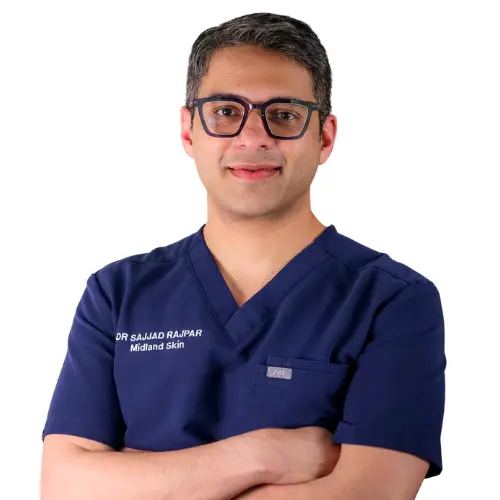
This page has been written and/or medically reviewed by Dr Sajjad Rajpar, Consultant Dermatologist and Medical Director of Midland Skin, Birmingham.
Dr Rajpar is on the GMC Specialist Register in Dermatology and has over 20 years’ experience in clinical dermatology. He provides clinical oversight to ensure the information on this page is accurate, balanced and consistent with current dermatology practice.
Dr Sajjad Rajpar
Date last updated: 26th Sep 2026
Book in with us
Expert, consultant led care in dermatology, skin surgery, eyelid surgery, lasers and aesthetics.
Disclaimer
The content on this website is provided for general information only. It is not, and must not be treated as, medical advice, a diagnosis, or a recommendation for any particular treatment. We make reasonable efforts to keep information accurate and up to date, but medicine and technology change, and content may not reflect the most current evidence, guidance, product information, or individual practice. You should not rely on this website to make decisions about your health or treatment. Always seek personalised advice from an appropriately qualified healthcare professional. Any examples, images, testimonials, and outcome descriptions are illustrative only. Results vary between individuals and no outcome can be guaranteed.

