
Sebaceous gland hyperplasia removal
Specialist sebaceous gland hyperplasia removal in Birmingham
Midland Skin offers specialist assessment and treatment of sebaceous gland hyperplasia for patients in Birmingham, Solihull and across the West Midlands.


Quick Facts about Sebaceous Gland Hyperplasia Removal

Best for
Unwanted facial bumps

Treatment
Radiofrequency ablation
Anaesthetic
Local anaesthetic

Treatment time
Usually around 30 minutes

Recovery
Usually 5–7 days

Specialist
Dermatologist
Sebaceous gland hyperplasia removal in Birmingham and Solihull
Sebaceous gland hyperplasia causes small yellowish or skin-coloured bumps, most commonly on the face. They are harmless, but can become increasingly noticeable, particularly when several develop across the forehead, cheeks, nose or chin.
Treatment is carried out following assessment by a dermatologist. Radiofrequency is commonly used for smaller lesions, while larger or more prominent lesions may require a different approach such as shave removal. The aim is to flatten the visible bump while keeping the risk of scarring as low as possible.

What is a sebaceous gland hyperplasia?
Sebaceous gland hyperplasia appears as small yellowish, cream or skin-coloured bumps caused by enlargement of the sebaceous glands surrounding a hair follicle.
Sebaceous glands normally produce sebum, the natural oil found on the skin. When the gland becomes enlarged it can produce a raised, shiny bump. A small central depression or opening may sometimes be visible, and fine thread veins can also become prominent over the surface.
Sebaceous gland hyperplasia most commonly develops on the forehead, cheeks, nose, under the eyes and chin. Some people develop only one or two lesions, while others gradually develop many across the face.
The sebaceous cells contain lipid, which is why the lesions often have a characteristic yellowish colour.
Are sebaceous gland hyperplasia cancerous?
No. Sebaceous gland hyperplasia is benign.
However, not every yellow or skin-coloured facial bump is sebaceous gland hyperplasia. Larger or unusual lesions can occasionally resemble other skin conditions, including certain skin cancers.
A dermatologist can usually identify typical sebaceous gland hyperplasia during examination. Where the diagnosis is uncertain, this needs to be resolved before cosmetic treatment is considered.
Who is sebaceous gland hyperplasia removal suitable for?
Treatment is not medically necessary because sebaceous gland hyperplasia is harmless. Removal may nevertheless be worthwhile when the lesions are bothering you because of their appearance or causing symptoms.
Treatment may be considered if:
- You have one or more noticeable sebaceous gland hyperplasia lesions.
- The bumps have become larger or more prominent.
- You are gradually developing increasing numbers of lesions.
- The lesions are particularly noticeable on the forehead, cheeks, nose or another part of the face.
- Previous treatment has not produced the result you wanted.
- You would like advice about the safest way to flatten or remove them.
- You are unsure whether the bumps are actually sebaceous gland hyperplasia.
Smaller lesions are generally simpler to treat and usually carry a lower risk of leaving a visible mark than very large lesions.
For people who develop numerous lesions, your dermatologist can discuss whether treating selected lesions periodically or considering a medical treatment approach is more appropriate.

C V

Not every facial bump is sebaceous gland hyperplasia
Several other common facial lesions can resemble sebaceous gland hyperplasia, including comedones, milia and intradermal moles.
Some basal cell carcinomas can also occasionally have a similar appearance.
This is particularly important for a solitary, unusually large, changing or otherwise atypical lesion. Diagnosis comes before cosmetic removal.
Book in with us
Ready to get started? Book a consultation with our team at Midland Skin. Friendly, expert advice tailored to you.
What results can I expect?
The aim of sebaceous gland hyperplasia removal is usually to flatten the visible lesion, rather than aggressively destroy the entire sebaceous gland.
This is important because sebaceous glands can extend deeper into the skin. Attempting to remove the whole gland too aggressively may increase the risk of scarring.
Smaller lesions often respond well to a single treatment. Larger lesions may require further treatment, and occasionally a slight residual bump may remain.
Some treated lesions can gradually become prominent again over time. If this happens, they can usually be treated again.
People who are prone to sebaceous gland hyperplasia may also continue to develop new lesions elsewhere on the face, even when previously treated lesions have responded well.
Do creams or home treatments remove sebaceous gland hyperplasia?
Sebaceous gland hyperplasia is an enlargement of the sebaceous gland rather than simply a blocked pore.
For this reason, the lesions cannot usually be squeezed or emptied like a spot or comedone.
Facials, comedone extraction, AHA or BHA washes, cosmetic peels and skincare serums do not remove the enlarged gland. Vitamin C serums and nicotinamide creams are also unlikely to remove established lesions.
If removal is wanted, a procedure is usually required.
Your sebaceous gland hyperplasia treatment pathway
Initial assessment
Your dermatologist examines the lesions, confirms whether they are consistent with sebaceous gland hyperplasia and discusses which areas are bothering you.
Care plan
The number, size and location of the lesions are assessed and the most appropriate treatment is discussed, including expected improvement, healing, recurrence and the risk of a visible mark. You will be provided with a care plan explaining the treatment and fees.
Treatment
Suitable lesions are treated using the agreed technique, most commonly radiofrequency for smaller lesions or another removal method where appropriate.
Follow-up
Where required, healing and treatment response can be reviewed and further treatment discussed for persistent, recurrent or additional lesions.
What happens during sebaceous gland hyperplasia removal?
For radiofrequency treatment, the lesion is usually numbed with a small injection of local anaesthetic.
A very fine needle is introduced into the sebaceous gland and a radiofrequency probe is applied. This may be repeated several times within the lesion.
You may feel a brief pinch from the local anaesthetic, but the treated area should then be numb.
The procedure leaves a very small superficial graze. Vaseline or another simple ointment is applied and the area is normally left without a dressing.
A small scab then develops while the skin heals.
Larger lesions may require a different technique, such as shave removal. Your dermatologist will recommend the most appropriate method during your assessment.
Healing after sebaceous gland hyperplasia removal
A small scab usually develops after treatment and commonly remains for around 5–7 days. Larger treated lesions can take longer to heal.
You will normally be advised to apply Vaseline twice daily while the area heals.
Small lesions usually heal very well. Larger lesions carry a greater possibility of leaving a slight mark, including an area that is a little paler than the surrounding skin or occasionally slightly indented.
This is one reason why smaller lesions are generally easier to treat than very large or longstanding lesions.
Sebaceous gland hyperplasia removal FAQs
Can I go back to work after treatment?
Most people can return to an office-based job immediately. The treated areas will, however, be visible as small red marks or scabs while they heal.
Can I exercise afterwards?
Avoid heavy exercise or strenuous activity for the rest of the day following treatment.
How should I clean the area?
Keep the treated area clean and avoid unnecessary rubbing or picking. It can usually be gently cleansed once or twice daily while healing.
Will I have a scar?
Any procedure that deliberately treats the skin can potentially leave a mark. With smaller sebaceous gland hyperplasia lesions, the risk that a scar is visible is usually low. Larger lesions are more likely to leave a small pale or slightly indented mark, which is why the treatment method and depth need to be carefully selected.
Can sebaceous gland hyperplasia grow back?
Yes. Because the sebaceous gland extends deeper into the skin, treatment is deliberately balanced against the risk of scarring. Some lesions can gradually become prominent again over time and can usually be treated again if necessary.
Will one treatment be enough?
Many smaller lesions require only one treatment. Larger lesions may occasionally need a second or third treatment to obtain the desired flattening.
Can I have lots of lesions treated?
Yes, but when there are numerous lesions your dermatologist may recommend treating them in stages rather than attempting to remove every lesion at once.
Tanya Evans
Fees
Sebaceous gland hyperplasia Show pricing
Book ConsultationInitial surgical assessment
Sebaceous gland hyperplasia – 1 large or 3 small
Sebaceous gland hyperplasia – 2 large or up to 7 small
Sebaceous gland hyperplasia – 7+ lesions
About the Author
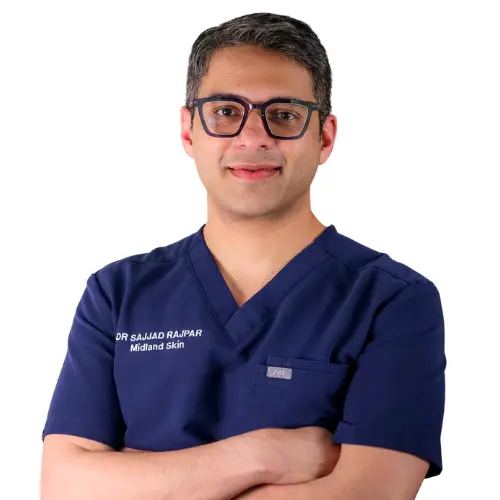
This page has been written and/or medically reviewed by Dr Sajjad Rajpar, Consultant Dermatologist and Medical Director of Midland Skin, Birmingham.
Dr Rajpar is on the GMC Specialist Register in Dermatology and has over 20 years’ experience in clinical dermatology. He provides clinical oversight to ensure the information on this page is accurate, balanced and consistent with current dermatology practice.
Dr Sajjad Rajpar
Date last updated: 21st Sep 2026
Book in with us
Expert, consultant led care in dermatology, skin surgery, eyelid surgery, lasers and aesthetics.
Disclaimer
The content on this website is provided for general information only. It is not, and must not be treated as, medical advice, a diagnosis, or a recommendation for any particular treatment. We make reasonable efforts to keep information accurate and up to date, but medicine and technology change, and content may not reflect the most current evidence, guidance, product information, or individual practice. You should not rely on this website to make decisions about your health or treatment. Always seek personalised advice from an appropriately qualified healthcare professional. Any examples, images, testimonials, and outcome descriptions are illustrative only. Results vary between individuals and no outcome can be guaranteed.

