
Hollywood Spectra MDF Laser Resurfacing in Birmingham
Improve acne scars, enlarged pores and uneven skin texture with minimal downtime
Hollywood Spectra MDF is a lower-downtime laser treatment for patients who want smoother, more even-looking skin without the recovery associated with more intensive ablative laser resurfacing. Suitability is confirmed at a laser treatment consultation.


Quick Facts about Spectra MDF Laser Resurfacing

Best for
Scars, pores & texture
Anaesthetic
None, cream or local

Duration
Around 45 minutes

Recovery
1-3 days; marks up to 7
Sessions
Usually four, monthly

Clinician
Doctor-led laser team
What is Spectra MDF laser resurfacing?
Spectra MDF is a form of fractional laser resurfacing used to improve selected acne scars, enlarged pores, uneven texture, fine lines and certain fine-line scars.
The Hollywood Spectra laser divides its energy into multiple focused microbeams. The MDF, or Multi-Depth Focusing, handpiece allows these beams to be directed to different depths within the skin.
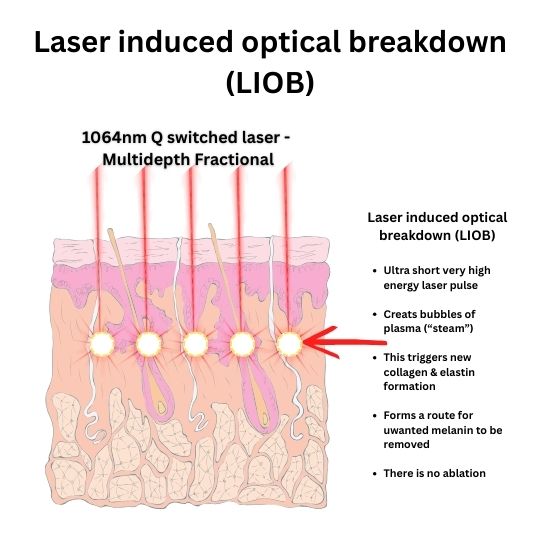
The laser creates tiny areas of optical breakdown beneath the surface. These stimulate a healing response and gradual collagen remodelling while leaving the skin’s surface largely intact.
This usually means a shorter recovery than ablative laser resurfacing, although improvement develops gradually and a course of treatment is normally required.

Lucy

Who is Spectra MDF laser treatment suitable for?
Spectra MDF assessment may be worthwhile if you would like to improve:
- Selected shallow or indented acne scars.
- Enlarged or prominent facial pores.
- Uneven or rough skin texture.
- Early fine lines and loss of skin smoothness.
- Selected fine-line traumatic or surgical scars.
- Your skin with a treatment offering comparatively little downtime.
Spectra MDF may be particularly useful when a lower-downtime treatment is preferred and gradual improvement over a treatment course is acceptable.
The appearance of a scar or pore concern alone does not establish whether Spectra MDF is the right treatment. Scar depth, tethering, skin type, active acne, previous treatment and the result you are hoping to achieve all affect the recommendation.
Deeper, tethered or ice-pick scars may require more intensive resurfacing or a combination treatment. If Spectra MDF is not the most appropriate option, your clinician will explain whether another treatment is more likely to provide worthwhile improvement.
How Spectra MDF is used at Midland Skin
Treatment is adapted according to the problem being treated. A typical course consists of four treatments approximately four weeks apart, although the final plan is determined following assessment.
Skin rejuvenation
A lower-intensity treatment can be used to produce gradual improvement in skin smoothness, brightness, texture and early fine lines. Redness and mild swelling are usually short-lived, and anaesthetic may not be required.
Enlarged pores and uneven texture
More focused treatment can be used where prominent pores and surface irregularities are the main concern. Anaesthetic cream may be considered. Redness, swelling and small red or purple pinpoint marks can occur afterwards.
Acne and fine-line scars
Higher-energy treatment may be directed specifically into selected scars to stimulate remodelling at different depths. Local anaesthetic may be used for comfort. Pinpoint bleeding or red-purple marks are more likely with this form of treatment and can remain visible for up to seven days.
Why choose Spectra MDF rather than a more intensive resurfacing laser?
The main advantage of Spectra MDF is the balance between improvement and recovery.
Because the treatment leaves the skin’s surface largely intact, redness and swelling usually settle more quickly than after ablative laser resurfacing. It may also be considered across a broad range of skin tones, with the treatment settings selected carefully for the individual.
Spectra MDF is generally used as a course of treatments, with improvement developing progressively. A more intensive resurfacing laser may be recommended when greater correction is the priority and the patient is prepared for a longer recovery.
The best option depends on the type and depth of the concern, your skin and how much downtime you can accommodate.
What results can I realistically expect?
Spectra MDF produces gradual improvement as new collagen forms and the skin remodels. Most patients require a treatment course rather than expecting the full result from one session.
Published studies of Hollywood Spectra MDF and closely related fractional Q-switched 1064 nm laser treatments have reported improvement in acne scars, enlarged pores and fine-line scars, including in patients with darker skin tones.
Enlarged pores and acne scars
In a published Hollywood Spectra MDF study, average improvement three months after the final treatment was:
- Approximately 58% improvement in enlarged pores.
- Approximately 34% improvement in acne scars.
Improvement continued between the six-week and three-month assessments, showing that results can continue to develop after the treatment course has finished. No adverse events or post-inflammatory hyperpigmentation were reported during the study.
Fine-line scars
Case reports assessed Hollywood Spectra MDF treatment for selected fine-line traumatic and surgical scars.
Following four treatments at monthly intervals, the treating physicians reported improvements of between 80% and 100% in scar visibility and skin texture. Patient satisfaction was high, and no significant complications were reported.
The expected effects after treatment were temporary redness, swelling and red-purple pinpoint marks.
Treatment in darker skin tones
A related study included 29 patients with skin types III-IV who received three fractional Q-switched 1064 nm laser treatments for acne scarring.
All patients showed improvement in their acne-scarring scores. Temporary redness was reported in three patients, with no other side effects observed.
These studies are encouraging and support Spectra MDF as a lower-downtime option for selected scars and pores. Individual results still vary according to the type and depth of the concern, and complete clearance cannot be guaranteed.
Further Spectra MDF treatment, maintenance treatment or a different approach may be recommended after the response has been assessed.
Risks and limitations
Expected temporary effects include warmth, redness, swelling, tenderness, pinpoint bleeding and small red or purple marks.
Less common complications include prolonged redness, a temporary acne flare, pigment change, blistering, infection, reactivation of cold sores and scarring.
Careful assessment, appropriate treatment settings and following the aftercare advice help reduce these risks. A particular degree of improvement or cosmetic result cannot be guaranteed.
Spectra MDF Treatment Pathway
Laser Treatment Consultation
Your clinician assesses your skin, the type and depth of the concern, your medical history, previous treatment and what you are hoping to improve.
Suitability and Treatment Plan
You are advised whether Spectra MDF is appropriate or whether another resurfacing or scar treatment is more likely to provide a worthwhile result.
Treatment Course
Following the required two-week cooling-off period, treatment is usually planned as four sessions approximately four weeks apart.
Review Consultation
Your response is assessed and any further Spectra MDF treatment, maintenance or alternative treatment is discussed.
Practical Spectra MDF Treatment FAQs
Who will perform my treatment?
Your treatment will be carried out by a suitably trained member of the Midland Skin laser team, following a medical assessment and agreed treatment plan.
You will be told who will perform your treatment before the course begins.
How should I prepare for treatment?
Avoid tanning and significant sun exposure for at least two weeks before treatment and use SPF 50+.
Do not have chemical peels, microneedling or another laser procedure in the treatment area during the two weeks before your appointment unless specifically agreed with your clinician.
Tell us about all medication you take, including recent antibiotics, retinoids and blood-thinning medication, and let us know if you have a history of cold sores. Antiviral medication may be recommended where appropriate.
Do not stop prescribed medication unless instructed by the clinician responsible for it. Please attend with clean skin and no makeup, creams, sunscreen or other products on the treatment area.
Will the treatment hurt?
This depends on the area, treatment depth and energy required.
Lower-intensity treatment may be manageable without anaesthetic. Anaesthetic cream or local anaesthetic may be used for more focused pore or scar treatment.
You may feel heat, sharp snapping sensations or discomfort during treatment. The skin can feel warm or sunburn-like for several hours afterwards.
What happens during treatment?
The treatment area is cleaned and appropriate eye protection is provided. Anaesthetic is used where required.
The laser is passed over the treatment area using the settings and treatment depths selected for your concern. More focused passes may be applied directly to individual scars or areas of prominent pores.
A soothing cream is applied afterwards, and you will be given aftercare instructions before leaving the clinic.
How long does treatment take?
Treatment usually takes around 45 minutes. Your appointment may be longer if anaesthetic is required beforehand.
What will my skin look like afterwards?
Redness and mild swelling commonly last for one to three days.
Small red or purple pinpoint marks, and occasionally pinpoint bleeding, are more likely after intensive pore or scar treatment. These can remain visible for up to seven days.
Can I drive and return to work?
Most patients can drive after treatment unless swelling affects their vision or they have been advised otherwise.
You may feel able to work the following day, but should allow for visible redness or pinpoint marks. If your appearance is important for work or an upcoming event, allow up to seven days before an important commitment.
When can I use skincare, wear makeup and exercise?
Gentle skincare and light makeup can usually be restarted the following day if the skin is intact, unless you are given different instructions.
Avoid strenuous exercise, saunas, steam rooms, hot baths and hot tubs for 48 hours. Continue using SPF 50+ and follow the aftercare instructions provided by the clinic.
What should I do if I am concerned after treatment?
Contact Midland Skin if you develop increasing pain, blistering, marked swelling, discharge, spreading redness or another unexpected reaction.
You will be advised whether a review consultation is required.
Fees
Hollywood Spectra MDF Show pricing
Book ConsultationInitial laser assessment with a consultant
Up to 25 minutes
Initial laser assessment with aesthetic practitioner
Spectra MDF Fractional laser – small area
Spectra MDF Fractional laser – intermediate area
Book in with us
Ready to get started? Book a consultation with our team at Midland Skin. Friendly, expert advice tailored to you.
References used for this article
- Park JY, Lee HC, Hwang JK. Pore and acne scar treatment with a Q-switched laser using a novel fractional MDF handpiece: a pilot study. Medical Lasers. 2022;11(1):31-39. doi:10.25289/ML.2022.11.1.31.
- Pérez Haded I, Sabbagh D. Scar resurfacing treatment with a Q-switched laser using a novel fractional multi-depth focusing handpiece: case reports. Medical Lasers. 2024;13(4):214-218. doi:10.25289/ML.24.028.
- Nisticò SP, Bennardo L, Sannino M, Negosanti F. Fractional Q-switched 1064 nm laser for the treatment of atrophic scars in Asian skin. Medicina. 2022;58(9):1219. doi:10.3390/medicina58091219.
About the Author
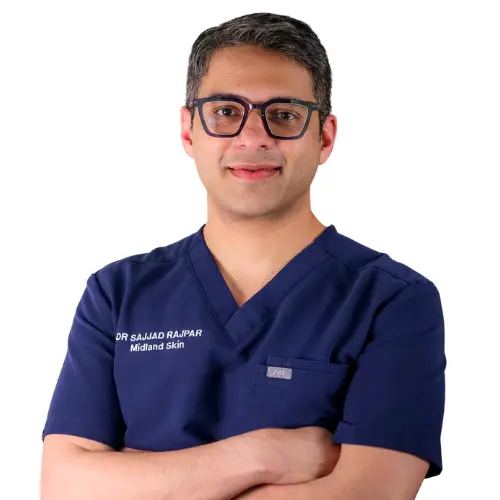
This page has been written and/or medically reviewed by Dr Sajjad Rajpar, Consultant Dermatologist and Medical Director of Midland Skin, Birmingham.
Dr Rajpar is on the GMC Specialist Register in Dermatology and has over 20 years’ experience in clinical dermatology. He provides clinical oversight to ensure the information on this page is accurate, balanced and consistent with current dermatology practice.
Dr Sajjad Rajpar
Date last updated: 28th Sep 2026
Book in with us
Expert, consultant led care in dermatology, skin surgery, eyelid surgery, lasers and aesthetics.
Disclaimer
The content on this website is provided for general information only. It is not, and must not be treated as, medical advice, a diagnosis, or a recommendation for any particular treatment. We make reasonable efforts to keep information accurate and up to date, but medicine and technology change, and content may not reflect the most current evidence, guidance, product information, or individual practice. You should not rely on this website to make decisions about your health or treatment. Always seek personalised advice from an appropriately qualified healthcare professional. Any examples, images, testimonials, and outcome descriptions are illustrative only. Results vary between individuals and no outcome can be guaranteed.

