
Alopecia areata
Specialist assessment and treatment for alopecia areata
At Midland Skin, we offer consultant dermatologist assessment and treatment for alopecia areata for patients in Birmingham, Solihull, Coventry, Wolverhampton, Worcester and across the Midlands.


Quick Facts about alopecia areata

Best for
Sudden or patchy hair loss
Appointment
Initial hair loss assessment
Treatment
Medication ± injections
Symptoms
Smooth bald patches
Provider
Consultant dermatologist

Price
See below
What is alopecia areata?
Alopecia areata is an autoimmune condition that causes non-scarring hair loss. The immune system mistakenly targets the hair follicles, interrupting normal hair growth without usually destroying the follicles permanently.
It most commonly causes one or more smooth, round or oval patches of hair loss on the scalp or beard. It can also affect the eyebrows, eyelashes and other body hair. Some people develop more widespread thinning rather than clearly defined patches.
The affected skin usually looks normal, although some people notice itching, tingling or burning around the time hair is lost. Small pits, ridges or brittleness can also develop in the nails.
Alopecia areata is not contagious. Because the follicles remain present, regrowth is possible, but the course of the condition is unpredictable.
When should I see a dermatologist for alopecia areata?
Specialist assessment is particularly valuable when hair loss has appeared suddenly, is spreading or the underlying diagnosis is uncertain.
An initial hair loss assessment is a sensible next step when:
- You have developed one or more new patches of hair loss.
- The hair loss is spreading or progressing rapidly.
- Your eyebrows, eyelashes, beard or body hair are affected.
- Hair loss involves the hairline, a large part of the scalp or the whole scalp.
- You have noticed nail pitting, ridging or brittleness.
- The condition has returned after previous regrowth.
- Previous treatment has not worked or the response has been incomplete.
- The hair loss is affecting your confidence, emotional wellbeing or day-to-day life.

Sara Galvin

Why getting the diagnosis right matters
Alopecia areata is usually diagnosed by examining the pattern of hair loss, the scalp and the affected hairs. A dermatoscope can help the dermatologist identify characteristic features that may not be obvious to the naked eye.
Other conditions can cause apparently similar hair loss. These include fungal scalp infection, hair pulling, pattern hair loss, telogen effluvium and some forms of scarring alopecia.
This distinction matters because these conditions require different treatment. Scarring alopecia can permanently damage the hair follicles and may require prompt treatment, while fungal scalp infection requires antifungal medication rather than steroid treatment.
Most people do not need tests to confirm straightforward alopecia areata. Blood tests or, occasionally, a scalp biopsy may be considered when the diagnosis is uncertain or the history and examination suggest another contributing condition.
How can alopecia areata affect the hair?
Alopecia areata can appear in several patterns:
- Patchy alopecia areata causes one or more defined areas of smooth hair loss. This is the most common presentation.
- Ophiasis alopecia causes a band of hair loss around the back and sides of the scalp.
- Diffuse alopecia areata causes more generalised thinning without obvious separate patches.
- Alopecia totalis describes complete or almost complete loss of scalp hair.
- Alopecia universalis describes extensive loss of scalp, facial and body hair.
The pattern and extent can change over time. Establishing how active and extensive the condition is helps determine which treatments are realistic.
Treatment pathway
Initial hair loss and scalp assessment
Your consultant dermatologist examines the scalp and affected areas. They review when the hair loss began, how quickly it has changed, previous episodes, treatments already tried, relevant medication and any associated medical conditions.
Care plan
A treatment plan is discussed based on the diagnosis, activity and extent of the hair loss, your age, the areas affected, previous treatment response, general health and treatment preferences. This may include prescription scalp treatment, steroid injections, oral medication or supportive measures. Blood tests are arranged only when clinically indicated or required before and during systemic treatment.
Review consultation
A review consultation is required to assess regrowth, identify any continuing or new hair loss and check for treatment side effects. The dermatologist will decide with you whether treatment should be continued, repeated, changed or stopped and discuss longer-term management where appropriate.
What causes alopecia areata?
Alopecia areata develops when immune activity around the hair follicle interrupts normal hair growth. Why this happens in one person at a particular time is not always clear.
Genetic susceptibility appears to play a part, and alopecia areata can occur alongside other autoimmune or inflammatory conditions, including autoimmune thyroid disease, vitiligo and atopic eczema. Having alopecia areata does not mean that you necessarily have one of these conditions or require routine screening for all of them.
Illness, significant emotional stress or other events may precede an episode in some people, but many develop alopecia areata without an identifiable trigger. It is not usually caused by shampoo, normal haircare, a particular food or something the patient has done wrong.
How is alopecia areata treated at Midland Skin?
Treatment depends on the extent and activity of the condition. A small stable patch is managed differently from rapidly progressive or extensive hair loss.
No treatment can guarantee regrowth or prevent every future episode. The dermatologist will explain the expected benefits, limitations and risks of the appropriate options.
Topical corticosteroid treatment
Potent corticosteroid creams, ointments or scalp applications may be prescribed for limited alopecia areata. They are used for a defined period and require review to assess regrowth and check for skin thinning or other local side effects.
Steroid injections
Steroid injections into the affected skin are an established first-line treatment for adults with limited or moderately extensive alopecia areata. They may also be considered for beard or eyebrow involvement on an individual basis.
The injections are placed across the patch and may need to be repeated. Possible side effects include temporary discomfort, skin thinning, a small indentation or a change in skin colour. Particular care is required when treating the eyebrows or other areas close to the eyes.
Find out more about steroid injections for hair loss.
Minoxidil as an additional treatment
Topical or oral minoxidil may sometimes be used alongside treatment that controls the underlying inflammation. It can support hair density or developing regrowth but is not normally relied upon as the sole treatment for active alopecia areata.
Treatments used for other forms of hair loss are not automatically suitable for alopecia areata. Current BAD guidance considers the evidence insufficient to recommend PRP as a standard treatment for this condition.
Oral corticosteroids and immune-modifying treatment
For rapidly progressive or more extensive alopecia areata, a short course of oral corticosteroids may sometimes be considered. Hair loss can recur as the dose is reduced or after treatment stops, and the potential side effects usually make prolonged treatment unsuitable.
Other immune-modifying medicines, including methotrexate or ciclosporin, may be considered for selected patients with moderate-to-severe disease. These treatments require careful assessment, blood tests and ongoing monitoring.
JAK inhibitor treatment for severe alopecia areata
Oral JAK inhibitors have significantly changed the treatment options for severe alopecia areata.
UK-licensed options now include:
- Ritlecitinib for adults and adolescents aged 12 years and over.
- Baricitinib for adults.
- Deuruxolitinib for adults.
At Midland Skin, a JAK inhibitor may be discussed where alopecia areata is sufficiently severe and the expected benefits justify the risks. A particular medication cannot be guaranteed before assessment.
These medicines affect immune signalling and require detailed medical screening, baseline blood tests and continued monitoring. They are not suitable for everyone, do not work for every patient and may require ongoing treatment to maintain regrowth. Hair loss can recur if treatment is interrupted or stopped.
Current availability and the cost of private prescribing, medication and monitoring will be explained before treatment is started.
Contact immunotherapy
Contact immunotherapy using diphenylcyclopropenone, usually called DPCP, may be considered for moderate-to-severe alopecia areata. It involves deliberately producing a controlled allergic reaction on the scalp through repeated applications.
Possible side effects include itching, blistering, eczema, swollen lymph glands and changes in skin colour. DPCP is available only through selected specialist services. Please check its current availability at Midland Skin before booking if you are specifically seeking this treatment.
Camouflage and practical support
Hair fibres, wigs, hairpieces and eyebrow camouflage can be helpful while waiting for regrowth or when treatment has not produced sufficient coverage.
Loss of eyelashes may make the eyes more vulnerable to dryness, dust and bright light. Protective glasses, sunglasses or lubricating eye drops may be helpful where appropriate. Areas of exposed scalp should also be protected from sunlight.
What course can I expect?
The course of alopecia areata varies considerably between individuals. Many people with limited patchy disease develop spontaneous regrowth, but it is not possible to predict accurately who will regrow hair, how long this will take or whether further episodes will occur.
Early regrowth may be fine or white. The hair often becomes thicker and may regain its usual colour as growth continues.
A more guarded outlook is associated with very extensive hair loss, ophiasis-pattern hair loss, nail involvement, onset in early childhood and alopecia totalis or universalis. However, meaningful regrowth can still occur, including with newer treatments.
Treatment can encourage or maintain regrowth, but it does not remove the underlying tendency to develop alopecia areata. Recurrence during or after treatment remains possible.
Colin Gee
Your hair loss appointments: FAQs
Who will assess me?
You will be assessed by a consultant dermatologist who is medically qualified to diagnose and manage diseases affecting the scalp, hair, skin and nails.
How should I prepare for the appointment?
Bring a list or photographs of treatments you have tried, details of relevant medication and any previous blood-test or biopsy results. Earlier photographs showing how the hair loss has changed can be particularly useful.
If possible, attend with the scalp clean and dry and avoid applying hair fibres or scalp concealers to the affected areas before examination and photography.
Will I need blood tests?
Most people with straightforward alopecia areata do not need blood tests to confirm the diagnosis.
Tests may be arranged when your symptoms or medical history suggest an associated condition, when another cause of hair loss needs to be excluded or before starting treatment that requires safety monitoring.
Will I receive treatment at my first appointment?
A prescription may be provided at the initial assessment when the diagnosis and appropriate treatment are sufficiently clear.
Steroid injections and other procedures are only carried out once the dermatologist has confirmed that they are suitable. They should not be assumed to be included in the initial assessment fee.
Do you prescribe JAK inhibitors for alopecia areata?
JAK inhibitors may be considered for severe alopecia areata. The dermatologist must first assess the extent of hair loss, previous treatments, medical history, infection and cardiovascular risk factors, other medication and whether the potential benefits justify the risks. Blood tests and ongoing monitoring are required.
Why is a review consultation required?
A review consultation is required to compare the hair loss with the clinical photographs or severity assessment, evaluate regrowth and check for side effects.
This allows the dermatologist to decide whether treatment should be continued, repeated, adjusted or stopped. Monitoring is particularly important when steroid injections or systemic medication are being used.
Why choose Midland Skin for alopecia areata assessment?
Hair loss treatment is most useful when it follows a reliable diagnosis.
At Midland Skin, your assessment is carried out by a consultant dermatologist rather than beginning with a predetermined treatment. The dermatologist can distinguish alopecia areata from other forms of hair loss, document its extent and activity and discuss treatments ranging from topical medication and steroid injections to systemic therapy for more severe disease.
Structured review also allows the diagnosis and care plan to be reconsidered if the hair loss does not behave or respond as expected.
Fees for alopecia areata
Alopecia areata Show pricing
Book ConsultationInitial hair loss and scalp assessment
Up to 25 minutes
Review consultation
Standard, up to 20 minutes
Steroid injection – Small area (up to 5cm²)
Steroid injection – Medium area (5-10cm²)
Support and further information
Alopecia areata can have a substantial emotional and social effect, even when the physical area of hair loss is relatively small. Please tell your dermatologist if the condition is affecting your confidence, relationships, work, education or emotional wellbeing.
Alopecia UK provides reliable information, peer support and local support groups for adults, children and families affected by alopecia.
References used for this article
- Harries MJ, Ahmed A, Ascott A, et al. British Association of Dermatologists living guideline for managing people with alopecia areata 2025. Br J Dermatol. 2026;194(2):e56–e73. doi:10.1093/bjd/ljaf452.
- British Association of Dermatologists. Alopecia areata patient information.
- National Institute for Health and Care Excellence. Ritlecitinib for treating severe alopecia areata in people 12 years and over. Technology appraisal guidance TA958. 2024.
- National Institute for Health and Care Excellence. Deuruxolitinib for treating severe alopecia areata. Technology appraisal guidance TA1178. 2026.
- Medicines and Healthcare products Regulatory Agency. MHRA approves deuruxolitinib to treat severe alopecia areata in adults. 2026.
- Electronic Medicines Compendium. Litfulo 50 mg hard capsules: Summary of Product Characteristics.
About the Author
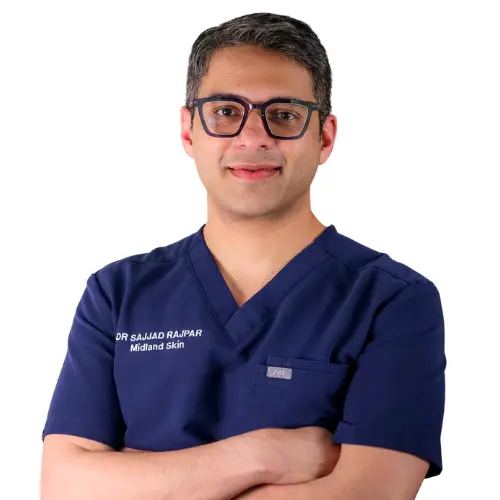
This page has been written and/or medically reviewed by Dr Sajjad Rajpar, Consultant Dermatologist and Medical Director of Midland Skin, Birmingham.
Dr Rajpar is on the GMC Specialist Register in Dermatology and has over 20 years’ experience in clinical dermatology. He provides clinical oversight to ensure the information on this page is accurate, balanced and consistent with current dermatology practice.
Dr Sajjad Rajpar
Date last updated: 26th Sep 2026
Book in with us
Expert, consultant led care in dermatology, skin surgery, eyelid surgery, lasers and aesthetics.
Disclaimer
The content on this website is provided for general information only. It is not, and must not be treated as, medical advice, a diagnosis, or a recommendation for any particular treatment. We make reasonable efforts to keep information accurate and up to date, but medicine and technology change, and content may not reflect the most current evidence, guidance, product information, or individual practice. You should not rely on this website to make decisions about your health or treatment. Always seek personalised advice from an appropriately qualified healthcare professional. Any examples, images, testimonials, and outcome descriptions are illustrative only. Results vary between individuals and no outcome can be guaranteed.

