
Specialist Skin Surgery Procedures
Consultant-led surgical assessment and treatment for skin lesions
Skin surgery covers a wide range of procedures, from removing a skin tag to excising a skin cancer. Every procedure at Midland Skin begins with a surgical consultation, so the right technique can be chosen and the likely scar discussed before anything is arranged.
At Midland Skin we offer Specialist Skin Surgery treatment for patients in Birmingham, Solihull, Coventry, Wolverhampton, Worcester and the Midlands.


Quick Facts about skin surgery

Best for
Skin lesions needing removal
Anaesthetic
Local anaesthetic

Duration
Varies by procedure

Recovery
5-14 days
Consultant
Dermatologist

Price
See below
What is skin surgery?
Skin surgery involves short procedures usually lasting 10 to 60 minutes that are performed under local anaesthetic to treat skin problems or to obtain a sample of skin for testing under the microscope (biopsy).
Your surgical consultation
Every skin surgery procedure at Midland Skin begins with a consultation. This is where the lesion is examined, the likely diagnosis established and the right technique chosen – before any procedure is arranged.
Your journey with us begins with a skin surgery consultation where you can benefit from an assessment by an expert to determine if a surgical procedure is suitable and, if so, which.
What the consultation covers
- What the concern is – examination and, where useful, dermoscopy
- Which procedure is most suitable – and why, where more than one option exists
- What the scar will be like – likely length, position and orientation
- What the alternatives are – including leaving the lesion alone
- Whether more than one procedure may be required
- Whether further tests or assessments are needed
- How histology results will be handled – what the findings could mean and how you will be told
- How to manage medications – including blood-thinning medication before and after
- How much time to plan for – time off work, physical activity, and whether you will need help at home
When considering any procedure, your doctor will discuss the risks and benefits as they apply to your individual circumstances. Here are some examples of things that may be discussed for you to take into consideration.
What can skin surgery treat?
Skin surgery at Midland Skin covers everything from minor removals to skin cancer surgery. The right technique depends on what the lesion is, where it sits and what you want to achieve.
Minor removals
- Skin tag removal
- Seborrhoeic keratosis removal
- Simple mole removal for raised moles
- Milia removal
- Sebaceous gland hyperplasia reduction
- Thread vein treatment
- Some lesions are eligible for same day assessment and treatment.
Lumps, cysts and more complex procedures
- Cyst removal
- Lipoma removal
- Mole removal with stitches, including for flat moles
- Complex lesion removal in sensitive areas such as the face
- Scar excision
Diagnostic procedures
- Skin biopsy
- Skin lesion removal for diagnosis
- Alopecia and scalp biopsy
Skin cancer surgery
- Skin cancer excision
- Skin cancer excision plus flap or skin graft
- Mohs surgery for skin cancer

Scott Campbell

Which techniques are used?
- Shave excision: this involves shaving lumps and bumps off flush to the skin surface
- Curettage: scraping away lesions
- Excision with stitches
- Cauterising, hyfrecation and radiofrequency: using heat from an electrical current
- Cryotherapy: using liquid nitrogen to freeze things
- Laser removal of skin lesions: Midland Skin offer a variety of different laser treatments for reducing or removing skin lesions
Treatment pathway for skin surgery
Surgical consultation
You meet a consultant dermatologist who examines the lesion, confirms the likely diagnosis and discusses what you are hoping to achieve.
Suitability and plan
The surgeon decides which technique is appropriate and discusses the alternatives, the likely scar, the risks and whether histology will be required.
Procedure
The procedure is carried out under local anaesthetic, usually at a separate appointment. This allows time to consider the information before you commit.
Wound check and review
Dressings and written aftercare are provided, with wound checks and suture removal where needed. A review consultation is arranged where histology results need discussing.
Book in with us
Ready to get started? Book a consultation with our team at Midland Skin. Friendly, expert advice tailored to you.
Benefits and risks of a procedure
One of the major advantages of a skin surgery consultation is that you should leave fully understanding the benefits and risks of any procedure. This allows you to make an informed choice on whether you would like to proceed. Examples of benefits and risks that are discussed are:
Benefits
- The likelihood of complete removal or cure from the procedure (often this is very high)
- The likelihood of any symptoms resolving
Risks
It is always important to be aware of any risks of a procedure and taking these into account when taking the decision to have surgery. The doctor will be able to go through any risks that may apply to you. Some examples include:
- Scar formation – a surgical procedure will usually leave some form of scar and at the consultation it is possible to discuss the likely length and orientation of any scars
- Discomfort – there can be discomfort after some procedures
- Bleeding – there is a risk of bleeding from a wound especially in the first 48 hours. The risk of bleeding may be increased for some people who may need to take extra precautions.
- Infection – there is a risk of infection following any surgical procedure in the first week. The risk of infection is increased with certain risk factors such as diabetes and immunosuppression.
- Delayed healing – some people may suffer from slow healing.
- Keloid and raised scars – some people are prone to elevated scar which may need additional separate treatment
- Numbness and nerve damage can also occur

Dan Jones
Having a procedure: practical questions
What should I do before my procedure?
We will review your medical history, allergies and medications, and explain the treatment, benefits, risks and alternatives before we begin.
Bring headphones and your favourite playlist if you would like to listen to music while you wait or during the procedure.
Please do not stop blood-thinning medication or any other prescribed medication unless specifically advised to do so by the clinician responsible for prescribing it.
Can I drive home afterwards?
Local anaesthetic does not affect your ability to drive, but pain, limited movement or visual obstructions such as swelling or a dressing could do. Legally, it is your responsibility to ensure you can remain in control of and fully operate the vehicle at all times.
Small procedures such as diagnostic biopsies or small excisions are unlikely to affect your ability to drive. However, if your treatment is on or near the eyes, sizeable, or near a joint limiting movement, you should arrange for someone to drive you or accompany you home.
Local anaesthetic around the eye, including in the upper cheeks and forehead, can occasionally cause temporary blurred vision or swelling, so it is not safe to drive or walk home alone afterwards.
What aftercare will I need?
You will receive dressings and written aftercare, and a wound check appointment if necessary, including suture removal if needed.
If antibiotics are prescribed, please collect these from your pharmacy on the way home. Normal charges apply.
How long does healing take?
These are general guides only. Your individual recovery may differ.
- Small removals such as skin tags, milia and sebaceous glands – about 5-7 days
- Shave or scrape procedures – about 7-10 days
- Excisions with stitches – around 7 days on the face, up to 14 days elsewhere
When can I exercise again?
Avoid strenuous exercise, swimming and heavy lifting for a minimum of 7 days for facial procedures and up to 14 days for procedures elsewhere.
When will I get my results?
If tissue is sent for histology, we may arrange a follow-up consultation to discuss the results and any next steps.
Book in with us
Ready to get started? Book a consultation with our team at Midland Skin. Friendly, expert advice tailored to you.
About our fees
The fees for a specialist skin consultation are provided on our fees page.
The fee for any procedure can be confirmed at the skin surgery consultation. Guide prices may have been provided to you in advance and can be reviewed here. Fees for surgery include any aftercare that is required such as appointments for wound checks, dressing changes and stitch removal as described below.
What is included in the procedure fees?
The following are included in quotes provided by us for procedures:
- Procedure fees including surgeon and theatre fees
- Aftercare advice and support relating to the procedure during working hours
- Dressing and initial spare dressings for you to use at home
- Up to two wound checks as and when required by a trained member of staff (who is non medical), including removal of sutures if sutures have been used
- Prescription for any antibiotics in case these are required (you would pay the pharmacy for the medications)
The following are not included:
- Additional wound checks, beyond two
- Treatment of keloid or adverse scarring
- Treatment for incomplete excision or recurrences
- Review consultations with your doctor which may be to review how the surgery has healed, for discussion of histology results (such as after a skin biopsy or mole biopsy) or to discuss further management
Fees
Specialist skin surgery Show pricing
Book ConsultationInitial surgical assessment
About the Author
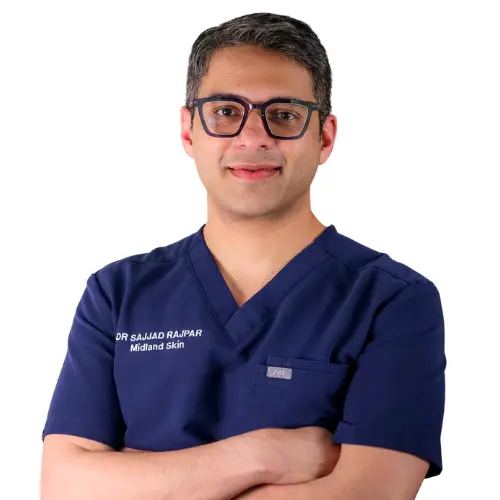
This page has been written and/or medically reviewed by Dr Sajjad Rajpar, Consultant Dermatologist and Medical Director of Midland Skin, Birmingham.
Dr Rajpar is on the GMC Specialist Register in Dermatology and has over 20 years’ experience in clinical dermatology. He provides clinical oversight to ensure the information on this page is accurate, balanced and consistent with current dermatology practice.
Dr Sajjad Rajpar
Date last updated: 26th Sep 2026
Book in with us
Expert, consultant led care in dermatology, skin surgery, eyelid surgery, lasers and aesthetics.
Disclaimer
The content on this website is provided for general information only. It is not, and must not be treated as, medical advice, a diagnosis, or a recommendation for any particular treatment. We make reasonable efforts to keep information accurate and up to date, but medicine and technology change, and content may not reflect the most current evidence, guidance, product information, or individual practice. You should not rely on this website to make decisions about your health or treatment. Always seek personalised advice from an appropriately qualified healthcare professional. Any examples, images, testimonials, and outcome descriptions are illustrative only. Results vary between individuals and no outcome can be guaranteed.

