
Skin Cancer Surgery
Specialist surgical removal and reconstruction for skin cancer
At Midland Skin we offer specialist skin cancer surgery for patients in Birmingham, Solihull, Coventry, Wolverhampton, Worcester and the Midlands. A diagnosis of skin cancer is worrying — our consultant-led team removes the cancer safely and repairs the area with as much care for appearance and function as for the cancer itself.


Quick Facts about skin cancer surgery

Best for
BCC, SCC & melanoma

Treatment
Surgical excision & repair

Anaesthetic
Local anaesthetic

Recovery
Usually 1-2 weeks
Consultant
Dermatologist / surgeon

Price
See below
What is skin cancer surgery?
Surgical excision is the treatment of choice for virtually all skin cancers, including the three most common in the UK — basal cell carcinoma (BCC), squamous cell carcinoma (SCC) and melanoma. The visible cancer is removed together with a planned border of surrounding skin, the wound is repaired, and the removed tissue is examined under the microscope to confirm the cancer has been fully cleared.
Who is skin cancer surgery suitable for?
Surgical excision may be the right option when:
- Diagnosed or suspected skin cancer – a BCC, SCC or melanoma
- A lesion suitable for planned removal and repair in one procedure
- Complete removal with a clear margin is the priority
- Confirming the diagnosis – where a biopsy is needed before wider treatment
- Cancer left behind or returning after a previous treatment
- Cosmetically or functionally sensitive sites needing careful reconstruction
For some tumours — particularly high-risk or poorly-defined cancers on the face — Mohs micrographic surgery may be recommended instead. The right approach is confirmed after assessment.
Why a safety margin of normal skin is removed — and why it varies
Skin cancers often send out tiny, root-like extensions beyond the edge you can see. To remove the cancer completely and reduce the chance of it returning, the surgeon takes the visible tumour plus a margin of normal-looking skin around and beneath it. That margin is planned in advance and depends mainly on the type of skin cancer, its size, its location, how well-defined its edges are, and whether it has been treated before.
As a general guide (your surgeon sets the final margin, following national guidelines):
- BCC – usually around 4 mm for low-risk tumours and at least 5 mm for higher-risk tumours. Some high-risk or poorly-defined facial BCCs are better treated with Mohs surgery.
- SCC – usually around 4 mm for low-risk tumours, 6 mm or more for high-risk, and 10 mm or more for very high-risk tumours.
- Melanoma – usually removed in two steps. A first, narrow excision confirms the diagnosis and measures how deep the melanoma is (the Breslow thickness). A wider excision is then planned from that measurement – commonly 5 mm for melanoma in situ, and 1-2 cm for invasive melanoma depending on its depth.
Wider margins mean a larger wound — which is why how the wound is repaired matters, and why sensitive areas sometimes need specialist reconstruction.

Lynne Clarke

Repairing the wound: stitches, flaps and grafts
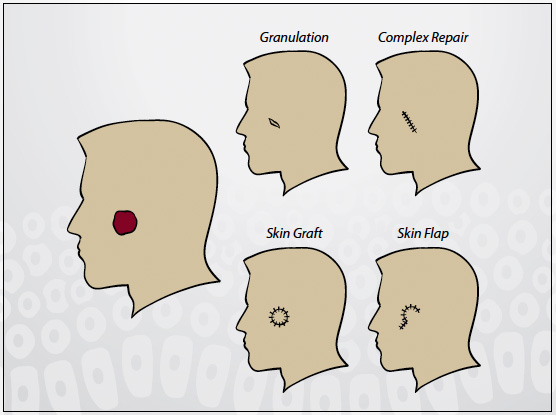
Once the cancer and its margin are removed, the wound needs to be repaired. As a specialist skin surgery centre, we offer the full range of reconstruction techniques and choose the one that gives the best healing, function and appearance for that site:
- Direct closure – the wound edges are brought together with stitches; suitable for many smaller wounds.
- Skin flap – nearby skin is carefully moved to cover the wound, matching colour and texture; often used on the face.
- Skin graft – skin is taken from another area to cover the wound where there is not enough local skin to close it.
- Healing by secondary intention – in selected sites, the wound is left to heal naturally, which can give a good result.
Because the final wound size is only known once the cancer is fully removed, the exact method of repair sometimes cannot be confirmed until the day. For some higher-risk cancers, repair may be planned for a later date once the pathology confirms the margins are clear.
A specialist team for complex and cosmetically sensitive areas
Skin cancers on the face — around the eyes, nose, lips and ears — need particular care to protect both appearance and function. Your treatment at Midland Skin is consultant-led, drawing on a team that includes consultant dermatologists, dermatological surgeons, and colleagues in facial plastic and oculoplastic (eyelid) surgery. Complex or delicate reconstructions can be planned with the right specialist, and difficult cases discussed together, so you get the most appropriate result for your particular cancer and its location.
Where a tumour would be better treated with Mohs micrographic surgery — which checks the margins under the microscope during the operation — we can offer that too.
How successful is surgery?
For most non-melanoma skin cancers (BCC and SCC), surgical excision has high cure rates when the cancer is completely removed. After surgery, the tissue is examined under the microscope to confirm full clearance.
Occasionally the pathology shows the margins are involved or very close — meaning a little cancer may remain — and further treatment (a further excision, Mohs surgery or radiotherapy) may be recommended as a separate procedure. No surgery can guarantee a cancer will never return, and new skin cancers can develop elsewhere over time, so ongoing skin checks matter. For melanoma, surgery removes the primary tumour; depending on its depth and features, further tests or treatment may be advised.
Treatment Pathway for Skin Cancer Surgery
Initial surgical assessment
A consultant assesses the lesion, confirms the likely diagnosis or arranges a biopsy, and discusses what removal would involve.
Diagnosis & surgical plan
The cancer type, the margin needed and how the wound will be repaired are planned with you, along with the risks and expected outcome. For melanoma, a diagnostic excision usually comes first, with the wider excision planned once the depth is known.
Surgery
The cancer is removed with its planned margin and the wound repaired, usually as a day case under local anaesthetic. The removed tissue is sent for microscopic examination.
Results & review
You receive your results, the wound is checked, any stitches removed, and scar care and next steps discussed. Ongoing skin surveillance is arranged where appropriate.
Risks and things to be aware of
All skin cancer surgery leaves a scar, and the likely size and direction of the scar will be explained to you beforehand. Scars are usually flat and paler than the surrounding skin, but they can sometimes stretch, darken, or become red and raised. Other possible risks include:
- bleeding and infection
- loss of sensation in and around the scar, which can be long-lasting
- rarely, nerve injury causing neuropathic pain or muscle weakness, which can occasionally be permanent
- incomplete removal of the cancer, or the cancer returning – if this happens, further treatment may be needed as a separate procedure
- occasionally, treatment for a troublesome scar may be needed, also a separate procedure
- sometimes additional laboratory testing of the removed tissue is required
Any further procedures or additional testing may involve an additional charge. Your surgeon will discuss all of this with you and answer your questions before you decide to go ahead.
Mrs Cheslin
On the day: what to expect FAQs
Who will perform my surgery?
Your surgery is consultant-led. Depending on the site and complexity, your care may involve a consultant dermatologist, a dermatological surgeon, or a facial plastic or oculoplastic specialist. You will meet your surgeon at your consultation, so you know who is treating you.
Will the procedure hurt?
The area is thoroughly numbed with local anaesthetic. The injections may sting briefly, but you will not feel pain during the procedure, only pressure or touch. You stay awake throughout, and the anaesthetic is topped up if needed.
What should I do before surgery?
Your surgeon will give you specific advice at your consultation, including anything you need to do about your usual medicines. Please tell us about any medications and health conditions when you book.
Can I drive myself home?
Local anaesthetic by itself does not affect your ability to drive, but pain, restricted movement or anything obscuring your vision, such as swelling or a dressing, can. It is your legal responsibility to remain in full control of the vehicle. Small procedures such as diagnostic biopsies or small excisions are unlikely to affect your driving. However, if your treatment is on or near the eyes, sizeable, or near a joint that limits movement, please arrange for someone to drive you or accompany you home. Local anaesthetic around the eye, including the upper cheeks and forehead, can occasionally cause temporary blurred vision or swelling, so it is not safe to drive or walk home alone afterwards.
Should someone come with me?
You are welcome to bring someone with you. Plan for a period of rest afterwards and arrange support from family, particularly for larger procedures or those near the eye.
After the procedure: recovery and aftercare FAQs
Will I have a dressing and what aftercare will I need?
A dressing is applied at the end of the procedure and you will be given written aftercare advice. Keeping the area clean, dry and protected, and following the instructions carefully, supports healing and reduces the risk of bleeding or infection.
When do stitches come out?
This depends on the site treated and the type of repair. Your surgeon will tell you when and where any stitches need to be removed and will arrange the appointment.
How much time should I take off?
Plan to take things easy afterwards. How long you need depends on the site, the size of the wound and your job. Your surgeon will give you specific advice and a fit note if needed.
When will I get my results?
Your results are discussed at your review appointment. The timing will be explained to you after your surgery.
What if I am worried about healing?
Contact the clinic if you have increasing pain, bleeding, or signs of infection such as spreading redness, swelling or discharge.
Fees
Skin cancer surgery Show pricing
Book ConsultationInitial surgical assessment
Biopsy of skin
Skin cancer excision (per lesion)
Mohs surgery for skin cancer
Includes first review consultation
Review consultation
Standard, up to 20 minutes
Skin cancer surgery under private medical insurance
Midland Skin is recognised by all major UK private medical insurers, including Bupa, AXA Health, Vitality and WPA.
If you have private medical insurance:
- Contact your insurer to request pre-authorisation for a dermatology consultation. You may need a referral from your GP.
- Your insurer will issue you a pre-authorisation number. You will require this when booking a consultation.
- If surgery is recommended at your consultation, we will provide the procedure codes your insurer needs to authorise treatment.
- Contact your insurer for a pre-authorisation for the surgery. You will require this when booking the procedure.
- Once you have had the procedure, our team will liaise with your insurer directly for the procedure fees.
Book in with us
Ready to get started? Book a consultation with our team at Midland Skin. Friendly, expert advice tailored to you.
Bob Townsend
References used for this article
- Nasr I, McGrath EJ, Harwood CA, et al. British Association of Dermatologists guidelines for the management of adults with basal cell carcinoma 2021. Br J Dermatol. 2021;185(5):899–920. doi:10.1111/bjd.20524.
- Keohane SG, Botting J, Budny PG, et al. British Association of Dermatologists guidelines for the management of people with cutaneous squamous cell carcinoma 2020. Br J Dermatol. 2021;184(3):401–414. doi:10.1111/bjd.19621.
- National Institute for Health and Care Excellence. Melanoma: assessment and management (NG14). NICE; updated 2022.
About the Author
This page has been written and/or medically reviewed by Dr Sajjad Rajpar, Consultant Dermatologist and Medical Director of Midland Skin, Birmingham.
Dr Rajpar is on the GMC Specialist Register in Dermatology and has over 20 years’ experience in clinical dermatology. He provides clinical oversight to ensure the information on this page is accurate, balanced and consistent with current dermatology practice.
Dr Sajjad Rajpar
Date last updated: 28th Sep 2026
Book in with us
Expert, consultant led care in dermatology, skin surgery, eyelid surgery, lasers and aesthetics.
Disclaimer
The content on this website is provided for general information only. It is not, and must not be treated as, medical advice, a diagnosis, or a recommendation for any particular treatment. We make reasonable efforts to keep information accurate and up to date, but medicine and technology change, and content may not reflect the most current evidence, guidance, product information, or individual practice. You should not rely on this website to make decisions about your health or treatment. Always seek personalised advice from an appropriately qualified healthcare professional. Any examples, images, testimonials, and outcome descriptions are illustrative only. Results vary between individuals and no outcome can be guaranteed.

