
Skin Cancer Treatment in Birmingham
Specialist diagnosis, treatment and follow-up for skin cancer
At Midland Skin, our consultant dermatologists and skin cancer surgeons diagnose, treat and follow up skin cancer for patients in Birmingham, Solihull, Coventry, Wolverhampton, Worcester and the Midlands.


What is skin cancer?
Skin cancers are growths that most often develop on sun-exposed areas such as the face, ears, scalp, arms and back. Left untreated, they can enlarge, ulcerate and, in some cases, spread. The good news is that most skin cancers are curable when they are found early and treated appropriately.
Skin cancer care at Midland Skin
- Consultant Dermatologist led diagnosis, screening, treatment and follow-up
- Full range of skin cancer surgery, including Mohs micrographic surgery with an on-site frozen-section laboratory
- Complex facial and eyelid tumours managed with our oculoplastic and reconstructive team under one roof
- Selected topical and non-surgical options for superficial and pre-cancerous lesions
- Melanoma and higher-risk cancers coordinated through a skin cancer multidisciplinary team, with onward referral for sentinel lymph node biopsy or systemic treatment where needed
- Structured follow-up and ongoing skin surveillance after treatment
Our skin cancer services

Diagnosis & Assessment
3 Treatments

Types of Skin Cancer
3 Treatments

Treatment
4 Treatments

Advanced Care & Follow-up
3 Treatments
Our skin cancer team
Skin cancer at Midland Skin is managed by a multidisciplinary team of consultant dermatologists and skin cancer surgeons, working alongside oculoplastic and reconstructive colleagues. Rather than relying on a single clinician, this team approach means your diagnosis, treatment and follow-up draw on the right expertise for your particular skin cancer, and higher-risk cancers are discussed collectively within a skin cancer MDT.
Types of skin cancer
There are three common types of skin cancer: basal cell carcinoma (BCC), squamous cell carcinoma (SCC) and melanoma. BCC and SCC are the most common and are usually treated successfully with surgery. Melanoma is less common but more serious and needs prompt assessment. Your dermatologist will identify the type, as this determines the right treatment.
When should I see a dermatologist about a possible skin cancer?
Booking a specialist assessment is worthwhile if you have:
- a new lump, spot or patch that is growing or changing
- a sore or scab that will not heal, or that keeps bleeding or crusting
- a mole that is changing in size, shape or colour, or has become itchy or is bleeding
- a lesion your GP or optometrist has asked to be checked
- a skin cancer that has already been diagnosed and needs treatment
- a previous skin cancer, sun damage, or a history of increased sun exposure
- a weakened immune system, for example after an organ transplant or while taking immunosuppressive medication

Melissa Brady

How is skin cancer diagnosed?
Skin cancer is usually recognised by an expert eye, supported by dermoscopy, which examines the skin with a specialist magnifying device. Where the diagnosis is uncertain, or before planning treatment, a small sample (biopsy) may be taken and examined under the microscope to confirm the type. Getting this right matters, because different skin cancers, and different subtypes, are treated in different ways.
Treatment pathway for skin cancer
Initial assessment
You see a consultant dermatologist who examines the lesion, uses dermoscopy and, where appropriate, checks the rest of your skin, and discusses your concerns and history.
Diagnosis and plan
Where needed, a biopsy confirms the diagnosis. Your dermatologist then discusses the most appropriate treatment, the alternatives and what to expect. Higher-risk cancers are reviewed within a skin cancer multidisciplinary team.
Treatment
Once treatment has been planned and agreed, it is carried out. Depending on the cancer this may be surgical excision, Mohs surgery, curettage or a topical treatment, sometimes at a separate appointment.
Follow-up and surveillance
You are reviewed after treatment to check healing and confirm the outcome. Because a previous skin cancer raises the chance of another, we arrange ongoing skin surveillance where appropriate.
How is skin cancer treated at Midland Skin?
The right treatment depends on the type of skin cancer, its size and location, and your individual circumstances. It is decided after assessment and, for higher-risk cancers, within a multidisciplinary team. Our consultants offer:
Surgical excision
The skin cancer is removed with a margin of surrounding tissue and sent for laboratory analysis. This is the mainstay of treatment for most skin cancers.
Mohs micrographic surgery
For selected BCCs and SCCs, particularly on the face or where the edges are hard to see, Mohs surgery removes the cancer and checks it under the microscope on the same day, offering the highest cure rates while preserving as much healthy skin as possible.
Curettage and cautery
Some small, low-risk, superficial cancers can be treated by carefully scraping the lesion and sealing the area.
Topical (non-surgical) treatments
For selected superficial cancers and pre-cancerous changes, prescription creams such as Efudix (5-fluorouracil) or imiquimod may be used under specialist guidance.
Reconstruction and eyelid tumours
Larger wounds, and tumours on the face or eyelids, may need reconstruction. Working with our oculoplastic and reconstructive team, removal and repair are managed together, with attention to both function and appearance.
Melanoma and higher-risk cancers
Melanoma is treated by surgical excision. Where a sentinel lymph node biopsy, further surgery or systemic (adjuvant) treatment is needed, we coordinate onward referral through a skin cancer MDT so your care continues without gaps.
Follow-up and skin surveillance
Being treated for one skin cancer increases the likelihood of developing another, either at the same site or elsewhere. Follow-up is a core part of skin cancer care, not an optional extra. After treatment we:
- check that the area has healed and confirm the cancer has been fully removed
- monitor the treated site for any sign of recurrence
- carry out ongoing skin lesion surveillance for new or changing lesions, tailored to your level of risk
This matters most if you have had a melanoma or a higher-risk cancer, extensive sun damage, or a weakened immune system.
Sun protection
The main cause of skin cancer is ultraviolet (UV) light, from the sun and from sunbeds. Covering up, seeking shade and using a high-SPF sunscreen all lower your risk, and more advice is available from Cancer Research UK’s sun safety advice.
Keith Jones
Skin cancer at Midland Skin: FAQs
Who will assess and treat me?
A consultant dermatologist or skin cancer surgeon. You meet the specialist looking after you before any treatment goes ahead.
How quickly can I be seen?
We aim to see patients with a suspected skin cancer promptly and will prioritise urgent concerns.
Will I have a biopsy or treatment at my first appointment?
Sometimes a biopsy can be taken at the first visit. Treatment is usually planned and carried out once the diagnosis and the plan are confirmed.
Do I need a referral?
No referral is needed to book privately. A GP or optometrist referral is welcome and may be required if you are using private medical insurance.
Will I need follow-up?
Yes. Follow-up and ongoing surveillance are part of skin cancer care.
Can I use private medical insurance?
Yes. We are recognised by all major UK insurers. See the insurance section below.
Why choose Midland Skin for skin cancer
- Consultant dermatologist-led diagnosis, treatment and follow-up
- Mohs micrographic surgery with an on-site frozen-section laboratory
- Complex facial and eyelid tumours managed with our oculoplastic and reconstructive team under one roof
- Melanoma and higher-risk cancers coordinated through a skin cancer MDT, with onward referral where needed
- Structured follow-up and ongoing skin surveillance
- Careful attention to both complete cancer clearance and cosmetic outcome
Fees for skin cancer assessment and treatment
Skin cancer Show pricing
Book ConsultationInitial dermatology assessment
Up to 25 minutes
Review consultation
Standard, up to 20 minutes
Biopsy of skin
Skin cancer excision (per lesion)
Mohs surgery for skin cancer
Includes first review consultation
Skin cancer treatment under private medical insurance
Midland Skin is recognised by all major UK private medical insurers, including Bupa, AXA Health, Vitality and WPA.
If you have private medical insurance:
- Contact your insurer to request pre-authorisation for a dermatology consultation. You may need a referral from your GP.
- Your insurer will issue a pre-authorisation number, which you will need when booking your consultation.
- If treatment is recommended, we will provide the procedure codes your insurer needs to authorise it.
- Contact your insurer for pre-authorisation for the procedure before it is booked.
- After treatment, our team will liaise with your insurer directly for the procedure fees.
Book in with us
Ready to get started? Book a consultation with our team at Midland Skin. Friendly, expert advice tailored to you.
References used for this article
- Nasr I, McGrath EJ, Harwood CA, et al. British Association of Dermatologists guidelines for the management of adults with basal cell carcinoma 2021. Br J Dermatol. 2021;185(5):899–920. doi:10.1111/bjd.20524.
- Keohane SG, Botting J, Budny PG, et al. British Association of Dermatologists guidelines for the management of people with cutaneous squamous cell carcinoma 2020. Br J Dermatol. 2021;184(3):401–414. doi:10.1111/bjd.19621.
- National Institute for Health and Care Excellence. Melanoma: assessment and management. NICE guideline NG14.
About the Author
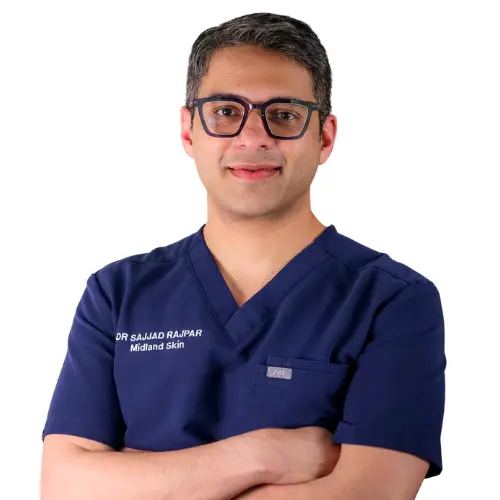
This page has been written and/or medically reviewed by Dr Sajjad Rajpar, Consultant Dermatologist and Medical Director of Midland Skin, Birmingham.
Dr Rajpar is on the GMC Specialist Register in Dermatology and has over 20 years’ experience in clinical dermatology. He provides clinical oversight to ensure the information on this page is accurate, balanced and consistent with current dermatology practice.
Dr Sajjad Rajpar
Date last updated: 1st Oct 2026
Book in with us
Expert, consultant led care in dermatology, skin surgery, eyelid surgery, lasers and aesthetics.
Disclaimer
The content on this website is provided for general information only. It is not, and must not be treated as, medical advice, a diagnosis, or a recommendation for any particular treatment. We make reasonable efforts to keep information accurate and up to date, but medicine and technology change, and content may not reflect the most current evidence, guidance, product information, or individual practice. You should not rely on this website to make decisions about your health or treatment. Always seek personalised advice from an appropriately qualified healthcare professional. Any examples, images, testimonials, and outcome descriptions are illustrative only. Results vary between individuals and no outcome can be guaranteed.

