
I have a spot or bump on the nose – what could it be?
A spot on the nose or bump on the nose is a common reason for seeing a Dermatologist. Here we explore the common causes of a spot on the nose. Most are harmless, but the nose is also one of the commonest sites for skin cancer, so a spot that is new, changing or bleeding should be checked.
Key points
- Most spots on the nose are harmless. Moles, fibrous papules and sebaceous gland hyperplasia are the commonest causes.
- The nose is a high-risk site for basal cell carcinoma, which can be subtle and easily mistaken for a harmless spot.
- A spot that is new, growing, shiny, bleeding or repeatedly scabbing should be checked by a dermatologist.
- Dermoscopy helps distinguish harmless spots from early skin cancer. A biopsy confirms the diagnosis where needed.
- Harmless spots can be removed for cosmetic reasons once the diagnosis is clear.
- Treatment depends on the diagnosis: radiofrequency, scrape removal, cosmetic mole removal or Mohs surgery for BCC.
1. Mole
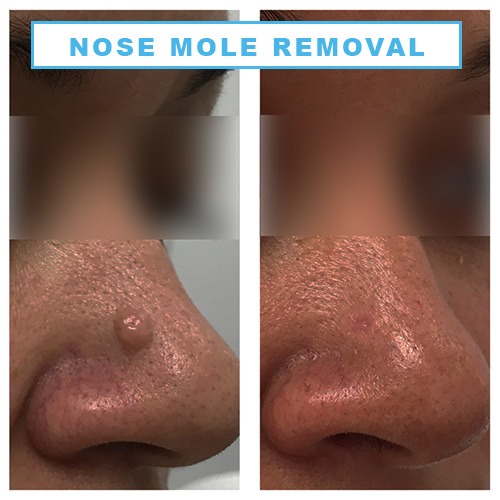
A fleshy mole is common on the nose and can be brown or skin coloured.
A mole on the nose is usually dome-shaped and may have hair growing through it.
A mole on the nose will usually have been there for several years. There is usually little, if any, change in size or appearance over time.
Moles on the nose can be removed by cosmetic mole removal.
2. Fibrous papule of the nose
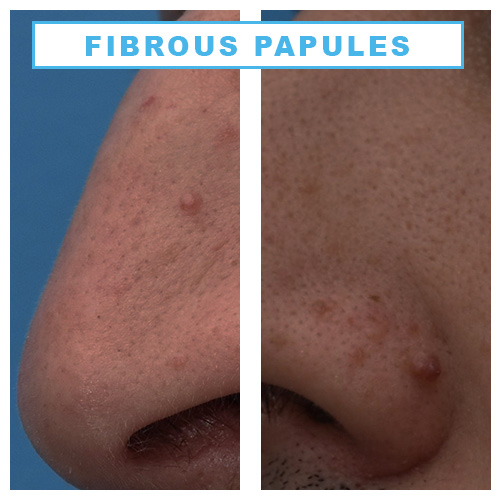
A fibrous papule is another common cause of a spot on the nose that is also dome-shaped. It is usually pink and firm. A fibrous papule can be a tiny bump or measure as wide as 6mm.
It is formed from excessive skin tissue and blood vessels. The blood vessels make it look pink. Even so, a fibrous papule does not usually bleed.
A fibrous papule usually develops in the teenage years or in early adulthood. A fibrous papule can be removed by scrape removal or cauterisation. When a fibrous papule is very large, it may look just like a mole and is sometimes hard to distinguish.
3. Sebaceous gland hyperplasia
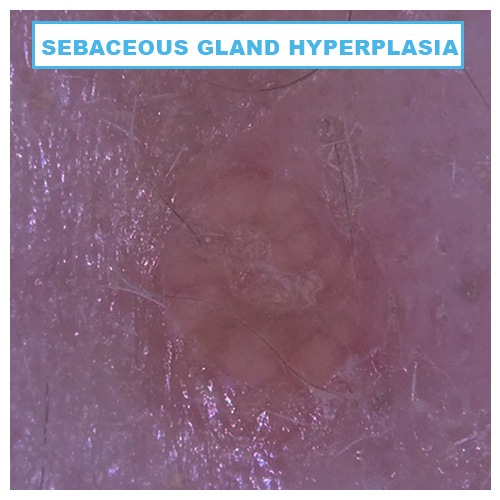
Sebaceous gland hyperplasia is an overgrowth of the sebaceous gland and appears like a yellow spot with a tiny depression in the centre.
There may be fine blood vessels running over it. Sebaceous gland hyperplasia can be removed by radiofrequency.
4. Spider naevus
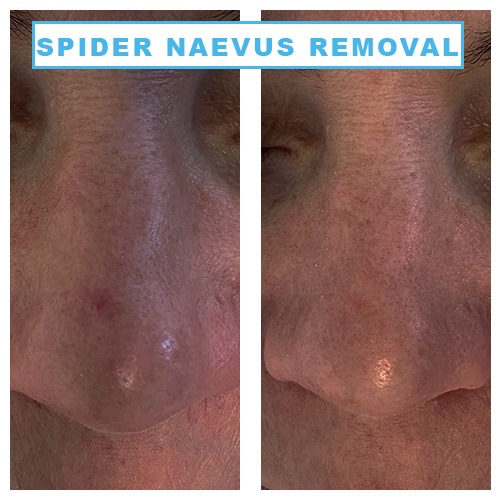
A spider naevus is a skin artery that has become dilated. It looks like a red spot that is about 1 mm wide. There may be a pink blush around it as tiny thread veins around it also form. A spider naevus is treated with radiofrequency.
5. Basal cell carcinoma (BCC)

Basal cell carcinoma (BCC) is a common form of skin cancer that occurs in those who are fair and have spent a lot of time in the sun. It is usually a problem in those over 40 but is increasingly being seen in younger people.
A nodular BCC is usually a pink and shiny spot that grows gradually and eventually starts to scab and bleed. Sometimes it scabs and then looks like it is healing, only to scab again. A superficial BCC looks like a shiny pink patch. Sometimes a raised rolled edge is seen. A morphoeic BCC is very subtle and looks like an expanding scar.
A BCC can be diagnosed by a Dermatologist. A dermatoscope helps pick up very early and subtle BCCs. A biopsy is taken to confirm a diagnosis and the main treatment is Mohs surgery.
6. Actinic keratosis
Actinic keratosis is a form of superficial sun damage. It is usually a thin pink patch that is rough. An actinic keratosis does not usually bleed or scab. A rough patch that thickens, becomes tender or starts to bleed should be checked, as this can occasionally be an early sign of squamous cell carcinoma.
7. Seborrhoeic keratosis
Seborrhoeic keratosis is a very common lesion. It is a harmless warty skin growth that becomes more common with age. It can be thin, tan-coloured and very subtle or more obvious where it is raised and rough.
8. Sunspots
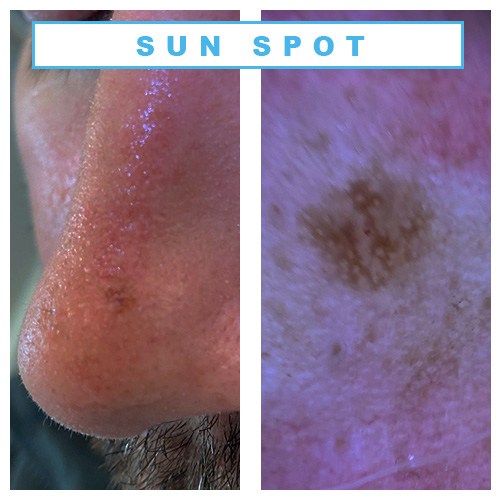
Sunspots, also called solar lentigines, are dark brown flat circular marks on the skin. They occur because of too much sun exposure.
9. Acne spots and pimples on the nose
Acne can affect the nose as well as the rest of the face. Spots may be blackheads (open comedones), skin-coloured bumps (closed comedones), red spots (papules) or pus-filled spots (pustules). In more severe acne, deeper lumps (nodules) and cysts can form.
Acne spots tend to come and go, and several usually appear at once. A single spot that stays in the same place for weeks, or keeps healing and breaking down again, is not typical of acne and should be checked by a dermatologist.
Small clustered bumps around the nose and mouth can also be perioral dermatitis, which is often linked to steroid creams.
Read more about the causes and treatment of acne on our acne page.
When should I see a dermatologist about a spot on the nose?
A dermatology assessment is worthwhile if:
- the spot is new or has appeared in adult life
- it is growing or changing in shape or colour
- it is pink, shiny and slowly enlarging
- it bleeds, scabs, or seems to heal and then breaks down again
- it is rough, thickened or tender
- you are not sure what it is
- you would like it removed and want the diagnosis confirmed first
At Midland Skin a consultant dermatologist examines the spot with a dermatoscope, confirms the diagnosis and discusses removal or treatment where appropriate.
References used for this article
- Nasr I, McGrath EJ, Harwood CA, et al. British Association of Dermatologists guidelines for the management of adults with basal cell carcinoma 2021. Br J Dermatol. 2021;185(5):899–920. doi:10.1111/bjd.20524.
- Eisen DB, Asgari MM, Bennett DD, et al. Guidelines of care for the management of actinic keratosis. J Am Acad Dermatol. 2021;85(4):e209–e233. doi:10.1016/j.jaad.2021.02.082.
About the Author
This page has been written and/or medically reviewed by Dr Sajjad Rajpar, Consultant Dermatologist and Medical Director of Midland Skin, Birmingham.
Dr Rajpar is on the GMC Specialist Register in Dermatology and has over 20 years’ experience in clinical dermatology. He provides clinical oversight to ensure the information on this page is accurate, balanced and consistent with current dermatology practice.
Dr Sajjad Rajpar
Date last updated: 28th Sep 2026
Book in with us
Expert, consultant led care in dermatology, skin surgery, eyelid surgery, lasers and aesthetics.

