
Cryotherapy for keloid scars in Birmingham
Non-surgical treatment that shrinks raised keloids
At Midland Skin we offer contact liquid nitrogen cryotherapy for keloids.

Quick Facts about cryotherapy for keloids

Best for
Raised, bulky keloids
Treatment
Liquid nitrogen cryotherapy
Anaesthetic
None or local anaesthetic
Sessions
Several, 6–8 weeks apart

Recovery
3–6 week healing cycle
Price
See below
What is cryotherapy for keloid scars?
Cryotherapy uses liquid nitrogen to freeze keloid tissue. A swab soaked in liquid nitrogen or plate is held against the keloid until the whole scar is frozen through. Over the following weeks the frozen keloid tissue separates and the keloid shrinks.
Cryotherapy has been used to treat keloids since 1950 and remains a first-line keloid treatment for certain keloids, usually alongside injections and other supportive treatments.
It is most useful for raised, bulky keloids, where injections alone struggle, and it avoids the surgical wound that can trigger a keloid to regrow.
Is cryotherapy suitable for my keloid?
Cryotherapy may be recommended for:
- Ear keloids – including large keloids after piercing, which respond best of all
- Raised, nodular or bulky keloids – where injections alone are unlikely to flatten the scar
- Keloids that have not responded to steroid injections
- Keloids on the face, scalp, neck, chest, shoulders or pubic area – as part of a combined treatment plan
- Children and teenagers with keloids – cryotherapy avoids surgery and radiotherapy
- Keloids that have come back after surgery – or where you want to avoid surgery altogether
Response varies by site. Ear keloids respond best. Pubic keloids often respond well, particularly when cryotherapy is combined with steroid injections. Chest keloids are the most difficult keloids to treat; cryotherapy may still have a place in reducing their bulk and is used together with injections and other treatments.
Small, flat keloids are usually treated with injections rather than cryotherapy. Your consultant will confirm the right approach at your initial scar assessment.
Why we use cryotherapy rather than surgery for many keloids
Keloids form in response to skin injury, and surgery is itself an injury. Keloids removed by surgery alone grow back in 45–100% of cases, and the regrowth is often larger than the original scar. Cryotherapy destroys the keloid tissue without cutting the surrounding skin, is unlikely to make keloids worse, and does not need radiotherapy afterwards. Keloid is part of a multi element treatment approach for keloid treatment.
What happens after cryotherapy?
Each treatment sets off a healing cycle of around three to six weeks, longer for very large keloids.
- Immediately – the frozen keloid turns white, then thaws within minutes. Pain starts straight away, peaks in the first one to two hours and mostly settles within a day or two. Simple painkillers are enough for most people.
- The first week – the keloid swells and blisters, often to twice its size, and leaks clear or blood-stained fluid. You cover it with gauze and tape and change the dressing at least daily.
- Weeks 1 to 3 – the treated tissue dries into a dark scab and the keloid starts to shrink beneath it.
- Weeks 3 to 6 – the scab separates on its own. Do not pick it. Keloids under 1 cm complete the cycle in three to four weeks; large keloids can take 8 to 12 weeks.
- Once healed – the new skin is pink and lighter than the surrounding skin at first, and colour usually returns over the following months. The keloid is smaller and ready for the next session.
What results can I expect?
A single session typically removes a substantial part of a keloid’s bulk. Most keloids need two or three sessions or more, usually repeated every six to eight weeks. Treatment is repeated until the raised part of the keloid has adquately reduced or it is apparent that the keloid is non responsive. Ear keloids respond best, and with repeated cycles many flatten completely; a full course can take several months. Very large keloids are treated in stages rather than all at once.
Once the keloid has been reduced to skin level, any keloid tissue left at the base is treated with injections, including 5-fluorouracil where appropriate and other treatments may also be suggested.
The treated skin is lighter at first. In most people colour returns over months; it can take longer, or remain lighter permanently and makeup or skin camouflage can cover it in the meantime.
Keloids treated with cryotherapy can regrow in the future. Treated areas are checked at each visit and after the course, so any early regrowth is treated promptly rather than left to enlarge.
Treatment pathway
Initial scar assessment
A consultant examines your keloid, photographs it, reviews previous treatments and discusses what you want to achieve.
Suitability and treatment plan
You are advised whether cryotherapy is right for your keloid, on its own or combined with injections, how many sessions to expect, and how pain relief and aftercare will be managed.
Cryotherapy sessions
Treatment is booked as a separate appointment after your assessment. It is carried out at the clinic, with local anaesthetic for larger keloids, and usually repeated every six to eight weeks.
Review and follow-up
Your response is reviewed at every session, and once the keloid is flat you are followed up to check for early regrowth.
On the day: what to expect FAQs
Who will treat me?
Cryotherapy is carried out by a consultant in our scar service. You meet them at your initial scar assessment, where your plan is agreed.
Can I have cryotherapy at my first appointment?
No. Your first appointment is the initial scar assessment, where your keloid is examined and your treatment plan, pain relief and aftercare are agreed. Cryotherapy is then booked as a separate treatment session.
Will it hurt?
Freezing stings, and the area aches for 2-3 days afterwards. Small keloids are usually treated without anaesthetic. Larger keloids are numbed with local anaesthetic first, as are keloids in children and teenagers. Paracetamol, ibuprofen and codeine may be needed afterwards for pain releif.
How long does a session take?
Freezing a small keloid takes a few minutes. Large keloids need repeated applications and local anaesthetic, so the appointment is longer.
What should I wear or bring?
Loose clothing that will not rub the treated area, a list of your medicines, and your usual painkillers to take afterwards.
Can I drive home?
Cryotherapy and local anaesthetic do not affect your ability to drive. However there may be discomfort from treatment which may affect your ability to drive.
After treatment: recovery and aftercare FAQs
How do I look after the treated area?
Cover it with gauze and paper tape, change the dressing at least once a day or whenever it is soaked, and keep it clean and dry between changes. Clean the edges with a cotton bud dipped in water. You can wash normally. Do not scratch the area, pick the scab, or shave over or near it. Continue dressings for the first 3 weeks or so.
How much time off work do I need?
Most people carry on as normal from the next day. After treatment of a large keloid you may want a day or two while the pain and oozing are at their worst.
When can I exercise?
Exercise after. a couple of weeks and soon as you feel comfortable. Avoid swimming and anything that rubs the area until the scab has come away and the area has fully healed.
What are the signs of infection?
Oozing that continues beyond the first week, new pain, or redness spreading into the normal skin around the keloid. Contact us the same day. Infection is uncommon and usually settles with a course of antibiotics.
When is my next session?
Usually eight weeks after treatment.
Book in with us
Ready to get started? Book a consultation with our team at Midland Skin. Friendly, expert advice tailored to you.
Fees
Keloid cryotherapy Show pricing
Book ConsultationInitial scar assessment
For keloid, hypertrophic, surgical, burn, self-harm or injury scars. Up to 25 minutes
Keloid scar cryotherapy treatment
References used for this article
- Tirgan MH, Yin Q, Wolkerstorfer A, Gociman B, Park TH. Comprehensive update on keloid management. Arch Plast Surg 2026;53:15–27. doi:10.1055/a-2698-3574.
- Tirgan MH. KRF Clinical Practice Guidelines in Keloid Disorder: Cryotherapy. Version 1.2018. Keloid Research Foundation, 2018.
- Tirgan MH. KRF Clinical Practice Guidelines in Keloid Disorder: Chest Keloids. Version 1.2019. Keloid Research Foundation, 2019.
- Nast A, Gauglitz G, Lorenz K, et al. S2k guidelines for the therapy of pathological scars (hypertrophic scars and keloids) – Update 2020. J Dtsch Dermatol Ges 2021;19(2):312–327. doi:10.1111/ddg.14279.
- Feng X, Zou X, Jiang S, He X, Deng Y, Xie J. Efficacy and safety of cryotherapy combined with intralesional steroid for keloid and hypertrophic scar: a systematic review and meta-analysis. J Cosmet Dermatol 2026;25(5):e70924. doi:10.1111/jocd.70924.
- Zouboulis CC, Zouridaki E. Cryosurgery as a single agent and in combination with intralesional corticosteroids is effective on young, small keloids and induces characteristic histological and immunohistological changes: a prospective randomized trial. Dermatology 2021;237(3):396–406.
- Cohen AJ, Talasila S, Lazarevic B, et al. Combination cryotherapy and intralesional corticosteroid versus steroid monotherapy in the treatment of keloids. J Cosmet Dermatol 2023;22(3):932–936.
About the Author
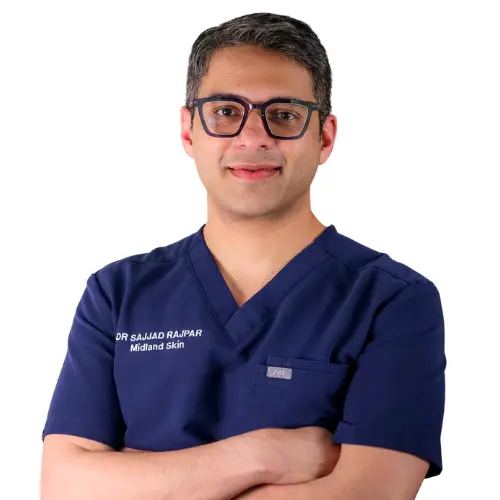
This page has been written and/or medically reviewed by Dr Sajjad Rajpar, Consultant Dermatologist and Medical Director of Midland Skin, Birmingham.
Dr Rajpar is on the GMC Specialist Register in Dermatology and has over 20 years’ experience in clinical dermatology. He provides clinical oversight to ensure the information on this page is accurate, balanced and consistent with current dermatology practice.
Dr Sajjad Rajpar
Date last updated: 10th Nov 2026
Book in with us
Expert, consultant led care in dermatology, skin surgery, eyelid surgery, lasers and aesthetics.
Disclaimer
The content on this website is provided for general information only. It is not, and must not be treated as, medical advice, a diagnosis, or a recommendation for any particular treatment. We make reasonable efforts to keep information accurate and up to date, but medicine and technology change, and content may not reflect the most current evidence, guidance, product information, or individual practice. You should not rely on this website to make decisions about your health or treatment. Always seek personalised advice from an appropriately qualified healthcare professional. Any examples, images, testimonials, and outcome descriptions are illustrative only. Results vary between individuals and no outcome can be guaranteed.

