
Laser-assisted photodynamic therapy (PDT) in Birmingham
Non-surgical treatment for selected basal cell carcinomas, Bowen’s disease and actinic keratoses
At Midland Skin, a Consultant specialising in skin cancer treatment assesses whether laser-assisted PDT is the right treatment for your skin lesion, or whether another option would suit you better.


Quick Facts about laser-assisted PDT

Best for
BCC, Bowen’s, AKs
Treatment
Laser + light-activated gel

Treatment day
2 visits, 3 hrs apart

Sessions
1–2 treatment days

Consultant
Skin cancer consultant

Price
See below
What is laser-assisted photodynamic therapy?
Photodynamic therapy (PDT) uses a light-sensitising gel that is absorbed more strongly by abnormal skin cells than by healthy skin. When the gel is activated with light, it destroys the abnormal cells while largely sparing the surrounding normal skin.
Conventional PDT works best on thin lesions, because the gel only penetrates a short distance into the skin. In laser-assisted PDT, a CO2 laser first removes the surface of the lesion and may create tiny channels in the skin. This helps the gel reach deeper. The gel is then activated in clinic with intense pulsed light (IPL).
PDT involves no cutting and no stitches. The treated area goes through a period of redness, swelling and crusting while it heals.
Who is laser-assisted PDT suitable for?
Laser-assisted PDT may be recommended for:
- Superficial basal cell carcinoma (BCC) – especially where surgery would leave a larger scar than the lesion warrants
- Selected thin nodular BCC – low-risk lesions outside high-risk sites on the face
- Bowen’s disease – squamous cell carcinoma in situ, including larger patches
- Actinic keratoses – including thicker lesions that have not responded to other treatments
- Field cancerisation – areas of sun-damaged skin with multiple precancerous changes
- Multiple lesions – where treating several areas without surgery is an advantage
PDT is not suitable for every skin cancer. It is usually not recommended for:
- BCCs with an aggressive growth pattern, deep nodular BCCs, or BCCs that have come back in high-risk sites
- invasive squamous cell carcinoma or melanoma
- anyone with a light-sensitivity disorder such as porphyria, or an allergy to any ingredient of the gel
If PDT isn’t the right option for you, your dermatologist will explain why and discuss the treatments that are. At Midland Skin these include Mohs surgery, surgical excision, curettage and cautery, cryotherapy and prescription creams.
PDT or surgery: which is right for me?
For basal cell carcinoma, surgery has higher published cure rates than PDT. Mohs surgery has the highest cure rates of all, and it remains the preferred treatment for higher-risk BCCs and BCCs on the face.
PDT trades some of that certainty for other advantages:
- no surgical wound or stitches
- usually a good cosmetic result
- the ability to treat larger areas or several lesions in one session
For low-risk lesions, that can be a reasonable choice. Your dermatologist will discuss the balance between cure rate, healing and cosmetic outcome for your particular lesion before you decide.
Side effects and limitations
Most people feel stinging, burning and heat during and just after the light treatment. This is followed by redness, swelling, oozing and crusting while the skin heals. How long healing takes depends on where you were treated and what was treated (see the aftercare FAQs below).
Most treated areas heal as a flat, slightly paler or pinker patch of skin. For a while, the healed skin may be darker or lighter than the skin around it. This usually fades within about 3 months, although uneven colour is more common after laser-assisted PDT than after conventional PDT. Scarring is more likely on the lower legs and chest.
Other possible effects include infection and, very rarely, a temporary episode of sudden confusion or memory loss.
The cosmetic result can’t be guaranteed. Incomplete clearance and recurrence are possible, as described above.
Treatment pathway for laser-assisted PDT
Initial consultation
Your Consultant Dermatologist examines the lesion, reviews your history and discusses what you hope to achieve.
Diagnosis and treatment plan
For BCC, a biopsy is always needed to confirm the diagnosis and the type of BCC before treatment. If PDT is suitable, your dermatologist will discuss the number of sessions, healing time and alternatives with you. If it isn’t, other treatment options will be discussed.
PDT treatment
Each treatment day has two appointments. At the first, the laser treatment is carried out and the gel is applied under a light-proof dressing. You return 3 hours later for light activation. BCC and Bowen’s disease need two treatment days, about one week apart. Actinic keratoses need one.
Review consultation
Your first review is 3 months after your last treatment, to check that the treated area has cleared. Any further reviews will be as advised by your Consultant Dermatologist.
On the day: what to expect FAQs
Who will carry out my treatment?
Your treatment is carried out by a Consultant who specialises in skin cancer.
How long will my treatment day take?
Each treatment session has two appointments on the same day, 3 hours apart. Each appointment takes about 30 minutes. You don’t need to stay at the clinic in between.
What should I do before my appointment?
- On the morning of your appointment, wash the area to be treated with a mild soap. Don’t apply make-up, creams or ointment to it.
- Tell us before treatment if you are pregnant, are allergic to peanuts or soya, have porphyria or another condition that makes your skin sensitive to light, or take medicines that suppress the immune system or make your skin sensitive to light.
What happens at the first appointment?
For isolated lesions, you may have a local anaesthetic injection to numb the skin. The numbness wears off over a few hours. A CO2 laser then removes the surface of the treated area so that the gel can reach deeper. The laser may also make tiny holes in the lesion to help the gel penetrate. The light-sensitising gel is then applied under a light-proof dressing.
What should I do during the 3-hour wait?
You can leave the clinic, but you must return 3 hours later for your second appointment. Do not remove the dressing or let it get wet, because this makes the treatment less likely to work.
What happens at the second appointment?
The gel is activated with intense pulsed light (IPL), which destroys the abnormal cells.
Will it hurt?
Stinging, burning and heat are common. They are strongest during and just after the light treatment.
What happens at my second treatment session?
If you have a BCC or Bowen’s disease, you will need two treatment sessions, usually about one week apart. Do not apply ointment on the morning of your second treatment. At the second session, any healing tissue may be gently removed with the laser before the treatment is repeated. This means your healing time is counted from your last session, not your first.
Can I drive home?
Usually yes, unless the treated area is near the eye.
After treatment: healing and aftercare FAQs
What will my skin look like afterwards?
- First 24 hours: stinging, burning and heat, strongest during and just after the light treatment. Swelling is common. After facial treatment, the eyelids may swell.
- Days 1–4: in most people, redness, swelling, oozing and crusting settle gradually.
- Weeks 1–2: in some people, reactions last 1–2 weeks or longer, particularly on the legs. Crusts lift off as the skin heals underneath.
- Months 1–3: the healed skin may be darker or lighter than the surrounding skin. This usually fades within about 3 months.
How long will healing take?
In most people, redness, swelling, oozing and crusting settle within 1–4 days. In some people they last 1–2 weeks or longer.
A basal cell carcinoma (BCC) may take longer to heal, because the laser treatment is deeper. This is expected and does not mean the treatment hasn’t worked. Facial lesions can take 4–6 weeks to heal fully, and lesions on the legs 8–12 weeks.
Healing is usually quickest on the face and slowest on the lower legs. It may also take longer if you are older, smoke, have diabetes, have leg swelling or poor circulation, or take medicines that suppress the immune system.
How do I protect the treated area for the first 48 hours?
For 48 hours after each treatment, the treated skin burns easily in daylight, even on a cloudy day. Normal indoor lighting, televisions, phones and computer screens are safe. Sunscreen does not protect against this reaction, and you should not apply it until your skin has healed.
Small or single treated areas
- Keep the dressing we apply in place for 48 hours.
- Keep the dressing dry.
- Keep the area covered with clothing, a hat or a scarf when you are outdoors.
Full face or large treated areas
- Stay indoors for 48 hours, and plan to be at home for these 2 days.
- Indoors, keep away from sunny windows, and close blinds or curtains if the sun is bright.
- If you travel in daylight, wear a wide-brimmed hat and cover your face with a scarf.
- If you must go outdoors, cover your face with a hat and scarf, and keep the trip brief.
Can I breastfeed after treatment?
If you are breastfeeding, stop for 12 hours after each treatment.
How do I care for the wound after 48 hours?
The aim is to keep the wound clean and moist until it has healed. Wounds kept moist heal faster and scar less than wounds left to dry and form a hard scab.
- Remove any dressing and gently wash the area twice a day with a soap substitute and lukewarm water. Pat it dry with a clean towel.
- Apply a thin layer of white soft paraffin ointment 4–6 times a day, and don’t let the wound dry out.
- On the face and body, no dressing is needed after the first 48 hours. You may cover the area if clothing rubs it.
- On the legs, cover the wound with a non-stick dressing, changed daily. Rest with your legs raised whenever you sit, and avoid standing still for long periods. If you are prone to leg swelling, wear a compression stocking if we have advised you to.
- Don’t pick or rub the wound.
When can I exercise, swim or wear make-up?
- Avoid heavy exercise for 48 hours.
- Avoid swimming, saunas, steam rooms and hot tubs until the wound has healed.
- Don’t apply make-up, fragrance or active skincare to the wound until it has fully healed.
How can I manage pain and swelling?
- Take paracetamol if needed, following the packet instructions.
- A cool, clean compress helps with heat and swelling.
- After facial treatment, sleep with your head raised on an extra pillow for the first 2 nights.
How should I protect my skin from the sun afterwards?
- Avoid direct sun on the treated area for 6 weeks.
- Once the wound has healed, apply a broad-spectrum SPF 50 sunscreen every morning, and reapply it every 2 hours when you are outdoors.
- Continue to protect the area from the sun long term. This reduces the risk of uneven pigmentation and of new skin cancers.
When should I contact the clinic?
Please call the clinic on 0121 285 4540 if you notice:
- pain that is getting worse after day 3, rather than better
- increasing redness spreading beyond the treated area, or warmth and tenderness
- thick or smelly discharge, or a fever
- bleeding that doesn’t stop with 15 minutes of firm pressure
- a wound on the leg that is getting larger rather than smaller
Seek urgent medical help, or call 999, if you or someone with you notices sudden confusion or loss of memory. This is a very rare reaction to PDT.
When will I be reviewed?
Your first review appointment is 3 months after your last treatment, to check that the treated area has cleared. If any area has not cleared, we will discuss further treatment with you, and a small sample of skin (biopsy) may be taken. After this, your Consultant Dermatologist will advise how often you need further review appointments.
Between review appointments, contact us if you notice a new spot, a scab that does not heal, or bleeding in or near the treated area.
Why choose Midland Skin?
Our PDT includes a laser step before the gel is applied, to help treat thicker lesions that standard PDT can struggle to reach.
PDT is one of several skin cancer treatments we offer, alongside Mohs surgery, excision and other options. Your skin cancer consultant can recommend what suits your lesion, rather than steering you towards a particular procedure. If PDT doesn’t clear a lesion fully, the next step can be planned within the same clinic.
Fees
Laser-assisted photodynamic therapy (PDT) Show pricing
Book ConsultationInitial dermatology assessment
Up to 25 minutes
Laser-assisted photodynamic therapy (PDT)
PDT under private medical insurance
Midland Skin is recognised by all major UK private medical insurers, including Bupa, AXA Health, Vitality and WPA. Photodynamic therapy is usually availably under private medical insurance.
If you have private medical insurance:
- Contact your insurer to request pre-authorisation for a dermatology consultation. You may need a referral from your GP.
- Your insurer will issue a pre-authorisation number. You will need this when booking your consultation.
- If PDT is recommended at your consultation, we will provide the procedure codes your insurer needs to authorise treatment.
- Contact your insurer for pre-authorisation for PDT. You will need this when booking your treatment.
- Once you have had the treatment, our team will liaise with your insurer directly about the treatment fees.
Book in with us
Ready to get started? Book a consultation with our team at Midland Skin. Friendly, expert advice tailored to you.
References used for this article
- Morton CA, et al. A randomized, multinational, noninferiority, phase III trial to evaluate the safety and efficacy of BF-200 aminolaevulinic acid gel vs. methyl aminolaevulinate cream in the treatment of nonaggressive basal cell carcinoma with photodynamic therapy. Br J Dermatol. 2018;179(2):309–319. doi:10.1111/bjd.16441.
- ClinicalTrials.gov. NCT02144077: Safety and efficacy study for the treatment of non-aggressive basal cell carcinoma with photodynamic therapy. 5-year follow-up results.
- Togsverd-Bo K, et al. Intensified photodynamic therapy of actinic keratoses with fractional CO2 laser: a randomized clinical trial. Br J Dermatol. 2012;166(6):1262–1269. doi:10.1111/j.1365-2133.2012.10893.x.
- Lonsdorf AS, et al. Ablative fractional laser-assisted low-irradiance photodynamic therapy for treatment of actinic keratoses in organ transplant recipients. Acta Derm Venereol. 2022;102:adv00694. doi:10.2340/actadv.v102.1057.
- British Association of Dermatologists. Photodynamic therapy (PDT). Patient information leaflet, December 2022.
- Genouw E, Verheire B, Ongenae K, et al. Laser-assisted photodynamic therapy for superficial basal cell carcinoma and Bowen’s disease: a randomized intrapatient comparison between a continuous and a fractional ablative CO2 laser mode. J Eur Acad Dermatol Venereol. 2018;32(11):1897–1905.
About the Author
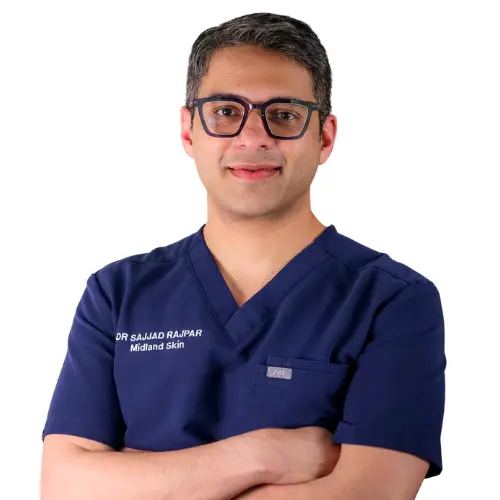
This page has been written and/or medically reviewed by Dr Sajjad Rajpar, Consultant Dermatologist and Medical Director of Midland Skin, Birmingham.
Dr Rajpar is on the GMC Specialist Register in Dermatology and has over 20 years’ experience in clinical dermatology. He provides clinical oversight to ensure the information on this page is accurate, balanced and consistent with current dermatology practice.
Dr Sajjad Rajpar
Date last updated: 11th Nov 2026
Book in with us
Expert, consultant led care in dermatology, skin surgery, eyelid surgery, lasers and aesthetics.
Disclaimer
The content on this website is provided for general information only. It is not, and must not be treated as, medical advice, a diagnosis, or a recommendation for any particular treatment. We make reasonable efforts to keep information accurate and up to date, but medicine and technology change, and content may not reflect the most current evidence, guidance, product information, or individual practice. You should not rely on this website to make decisions about your health or treatment. Always seek personalised advice from an appropriately qualified healthcare professional. Any examples, images, testimonials, and outcome descriptions are illustrative only. Results vary between individuals and no outcome can be guaranteed.

