
Rashes and Itchy Skin
Specialist assessment and treatment for rashes and itchy skin
At Midland Skin we offer specialist assessment and treatment for rashes and itchy skin, for adults and children, for patients in Birmingham, Solihull, Coventry, Wolverhampton, Worcester and the Midlands.


Quick Facts about rashes and itchy skin

Best for
Undiagnosed or persistent rashes

Appointment
Initial dermatology assessment

Treatment
Depends on the diagnosis

Symptoms
Rash, itch, dryness, scaling
Provider
Consultant dermatologist

Price
See below
What are rashes and itchy skin?
“Rash” describes any change in the colour, texture or surface of the skin. Itch may occur with a rash, or on its own with skin that looks entirely normal.
Different diagnoses have different clinical features. Eczema may cause dry, itchy patches. Psoriasis causes very scaly and thick plaques. Fungal infections can cause red, scaly and weepy areas and abnormal nails. Urticaria resembles hives. Lichen planus causes little purple spots.
Many rashes settle on their own or respond to simple treatment. Others persist, keep returning, or do not improve because the underlying diagnosis has not been established.
Rashes and skin conditions we assess and treat
Our consultant dermatologists assess and advise on the full range of general medical dermatology in adults and children, including:
Acne
Acne in individuals of all ages including teenage acne, adult-onset acne, resistant acne, acne during pregnancy, acne associated with perimenopause and menopause.
Rosacea
Rosacea, redness, flushing, rhinophyma.
Eczema and dermatitis
Eczema (atopic eczema), discoid eczema, pompholyx eczema, seborrhoeic dermatitis, allergic contact dermatitis, irritant contact dermatitis, lichen simplex chronicus, asteatotic eczema, perioral dermatitis, steroid withdrawal
Psoriasis and related conditions
Psoriasis — including plaque, guttate, scalp, flexural and nail psoriasis — and palmoplantar pustulosis
Lichen planus and lichenoid conditions
Lichen planus, lichen planus pigmentosus, lichen planopilaris, lichen sclerosus, lichen nitidus, lichenoid drug eruptions
Urticaria and drug reactions
Acute and chronic spontaneous urticaria, chronic inducible urticaria (including dermographism, cholinergic and cold urticaria), angioedema, suspected drug reactions, drug rashes and drug eruptions, fixed drug eruption
Blistering and immunobullous conditions
Bullous pemphigoid, dermatitis herpetiformis, linear IgA disease
Skin infections and infestations
Fungal infections of the skin, scalp and nails (tinea corporis, tinea cruris, tinea pedis, tinea capitis, onychomycosis), pityriasis versicolor, candida, impetigo, folliculitis, shingles, viral rashes, scabies, molluscum contagiosum, warts
Itchy skin conditions
Prurigo nodularis, nodular prurigo, chronic pruritus without a rash, brachioradial pruritus, notalgia paraesthetica, aquagenic pruritus, dry skin and winter itch
Inflammatory and autoimmune skin disease
Granuloma annulare, cutaneous lupus and discoid lupus, morphoea, cutaneous sarcoidosis, erythema nodosum, erythema multiforme
Pigmentation conditions
Vitiligo, melasma, post-inflammatory hyperpigmentation, ashy dermatosis
Other rashes
Pityriasis rosea, pityriasis lichenoides, pityriasis rubra pilaris, keratosis pilaris, hidradenitis suppurativa
Rashes in children
Childhood eczema, cradle cap and infantile seborrhoeic dermatitis, nappy rash, viral exanthems, hand foot and mouth disease, molluscum contagiosum, tinea capitis, scabies, urticaria, pityriasis alba, juvenile plantar dermatosis, keratosis pilaris
If your condition is not listed, we are still likely to be able to help. These are the conditions we see most often, not the limit of what we assess.
When should I see a dermatologist for a rash or itchy skin?
A dermatology assessment is particularly useful when:
- The diagnosis is unclear – you have been told it is “just a rash”, or different explanations have been offered
- It is persistent – the rash has lasted weeks or months without settling
- It keeps coming back – flares recur once treatment stops
- Treatment has not worked – creams from your GP or the pharmacy have not helped
- It is spreading or changing – in appearance, extent or the areas affected
- The itch is severe – disturbing sleep, concentration or daily life
- There is itch without a rash – where the skin looks normal but feels intensely itchy
- It affects your child – where the diagnosis or the treatment plan needs to be right

Christine Cartwright

Why getting the diagnosis right matters
Very different conditions can produce a similar-looking rash, and the treatments for them are not interchangeable.
A steroid cream that helps eczema can make a fungal infection considerably worse and change its appearance, making it harder to identify afterwards. An antifungal cream will do nothing for psoriasis. Urticaria that is treated as eczema will not improve. And a rash caused by a medication will keep returning until the medication is identified.
This is why the assessment matters more than the prescription. Establishing what the rash actually is determines whether treatment works, how long it needs to continue, and whether anything further needs investigating.
Treatment pathway
Initial dermatology assessment
You meet with a dermatologist who examines the skin and reviews your symptoms, how the rash began, treatments you have already tried, your medications and any relevant medical history.
Care plan
A diagnosis and treatment plan is discussed with you. This may include prescription treatment, skincare changes or investigations where the diagnosis needs confirming.
Review consultation
A review consultation is required to assess your response to treatment and decide whether treatment should be continued, changed or stopped. Your dermatologist will also discuss ongoing management where appropriate.
Itch without a rash
Itch can occur with skin that looks completely normal. This is surprisingly common and is approached differently from an itchy rash.
Where the skin is otherwise normal, the itch may be arising from a cause elsewhere in the body. Iron deficiency, thyroid disease, liver and kidney problems, and certain blood disorders can all cause generalised itch, sometimes before anything else is apparent. Some medications also cause itch. In other cases the itch is a variation of urticaria, or relates to dry skin or nerve sensitivity.
Blood tests are usually appropriate here, and can be arranged at Midland Skin. Identifying a treatable underlying cause changes the management entirely, and persistent unexplained itch is worth investigating rather than tolerating.
Rashes and itchy skin in children
Our dermatologists assess children of any age, from babies through to teenagers.
Children’s skin conditions are not simply smaller versions of adult ones. Rashes can look different in children, treatment choices and strengths differ, and parents are often understandably cautious about treatments such as steroid creams. Getting a clear diagnosis and a plan you feel confident using at home makes a substantial difference.
We are happy to see children with undiagnosed rashes, persistent itch, or conditions that have not settled with treatment already tried.
How are rashes and itchy skin treated at Midland Skin?
Treatment depends entirely on the diagnosis, so it is decided after assessment rather than before it.
Establishing the diagnosis
Most rashes are diagnosed by examining the skin and taking a careful history. Where the diagnosis needs confirming, we can carry out at Midland Skin:
- skin swabs, where infection is suspected
- skin scrapings and nail clippings, to confirm or exclude fungal infection
- a skin biopsy, taken under local anaesthetic in clinic
- blood tests, particularly for itch without a rash
Patch testing for suspected contact allergy is not performed on site, but can be arranged elsewhere where it is needed.
Treatment
Once the diagnosis is established, treatment is individualised. Depending on the condition, this may involve:
- an appropriate emollient and skincare routine
- topical treatments, including steroid and non-steroid anti-inflammatory creams
- antifungal or antibacterial treatment where infection is present
- antihistamines, particularly for urticaria
- oral medication for more widespread or resistant conditions
- referral for phototherapy or specialist systemic treatment where appropriate
There is no guarantee that a particular treatment will be prescribed. What is offered depends on what the assessment finds.
What to expect from treatment
Some rashes clear completely and do not return. Others, including eczema, psoriasis and chronic urticaria, are long-term conditions that are controlled rather than cured, and may need ongoing or intermittent treatment.
Recurrence does not mean treatment has failed. It may reflect renewed exposure to a trigger, or simply the natural course of the condition.
Where a rash does not respond as expected, that is useful information in itself. It may mean the treatment needs changing, or that the diagnosis needs reconsidering. This is one of the main reasons the review consultation is required.
Your dermatology appointments: FAQs
Who will assess me?
You meet with a consultant dermatologist who examines the skin and reviews your symptoms, how the rash began, treatments you have already tried and your relevant medical history.
Should I stop my creams before my appointment?
There is no need to stop your treatments unless you have been told otherwise. It does help if the rash is visible when you attend, so please avoid applying make-up or heavy cover-up over the affected area on the day.
What is useful to bring?
Please bring the creams and treatments you have already tried, including anything bought over the counter, and a list of your current medications with the dates you started them. Photographs are very helpful if the rash comes and goes, or looks different from how it does today.
Will I need tests?
Not always. Many rashes are diagnosed by examination alone. Where the diagnosis needs confirming, a swab, skin scraping, nail clipping, blood test or skin biopsy may be arranged, usually at Midland Skin.
Will I receive a prescription at my first appointment?
A treatment plan is discussed with you at your assessment, and this often includes prescription treatment. What is prescribed depends on the diagnosis reached.
Can you see my child?
Yes. Our dermatologists assess children of any age, from babies to teenagers.
Why is a review consultation required?
A review consultation is required to assess your response to treatment and decide whether treatment should be continued, changed or stopped. It is also the point at which the diagnosis is reconsidered if the rash has not behaved as expected.
Book in with us
Ready to get started? Book a consultation with our team at Midland Skin. Friendly, expert advice tailored to you.
Fees
Rashes Show pricing
Book ConsultationInitial dermatology assessment
Up to 25 minutes
Initial extended dermatology assessment
For eczema, psoriasis, complex or long-standing problems & second opinions. Up to 35 minutes
Review consultation
Standard, up to 20 minutes
Extended review consultation
If more time is required, up to 30 minutes
Blood tests
Biopsy of skin
Debra Harris
References used for this article
- Millington GWM, Collins A, Lovell CR, et al. British Association of Dermatologists’ guidelines for the investigation and management of generalised pruritus in adults without an underlying dermatosis, 2018. Br J Dermatol. 2018;178(1):34–60. doi:10.1111/bjd.16117.
- Roh YS, Choi J, Sutaria N, Kwatra SG. Itch: Epidemiology, clinical presentation, and diagnostic workup. J Am Acad Dermatol. 2022;86(1):1–14. doi:10.1016/j.jaad.2021.07.076.
About the Author
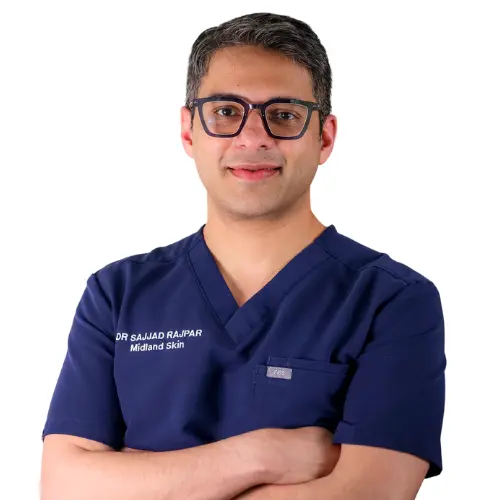
This page has been written and/or medically reviewed by Dr Sajjad Rajpar, Consultant Dermatologist and Medical Director of Midland Skin, Birmingham.
Dr Rajpar is on the GMC Specialist Register in Dermatology and has over 20 years’ experience in clinical dermatology. He provides clinical oversight to ensure the information on this page is accurate, balanced and consistent with current dermatology practice.
Dr Sajjad Rajpar
Date last updated: 26th Sep 2026
Book in with us
Expert, consultant led care in dermatology, skin surgery, eyelid surgery, lasers and aesthetics.
Disclaimer
The content on this website is provided for general information only. It is not, and must not be treated as, medical advice, a diagnosis, or a recommendation for any particular treatment. We make reasonable efforts to keep information accurate and up to date, but medicine and technology change, and content may not reflect the most current evidence, guidance, product information, or individual practice. You should not rely on this website to make decisions about your health or treatment. Always seek personalised advice from an appropriately qualified healthcare professional. Any examples, images, testimonials, and outcome descriptions are illustrative only. Results vary between individuals and no outcome can be guaranteed.

