
Acne scar treatment in Birmingham
Individual and combined treatments for different types of acne scarring
At Midland Skin, we offer acne scar treatment for patients from Birmingham, Solihull, Coventry, Wolverhampton, Worcester and across the Midlands.


Quick Facts about acne scar treatment

Best for
Mixed acne scarring

Treatment
Individual or combined treatment
Anaesthetic
Cream and/or local anaesthetic

Duration
Varies by treatment

Recovery
Usually around one week
Sessions
Usually 3–5
Acne scar treatment at Midland Skin
Acne scarring often requires a staged, combination approach. At Midland Skin, we tailor each acne scar treatment session to your individual scar pattern, skin type and treatment response.
Most people have more than one type of acne scar. Treatment therefore needs to consider the depth, shape and distribution of the scars, together with any tethering, volume loss, redness or pigmentation.
Active acne normally needs to be controlled before procedural scar treatment begins. If you also have active acne, a separate acne consultation is required to assess and treat it.
Types of acne scars
Acne scars appear in several patterns, depending on how the skin heals after inflammation. The three main types are:
- Ice-pick scars – narrow, deep holes that extend into the dermis, resembling tiny punctures made with a fine needle.
- Rolling scars – caused by fibrous bands beneath the skin that pull it down unevenly, producing a wave-like or undulating surface.
- Boxcar scars – round or oval depressions with sharp edges, giving the skin a pitted or cratered appearance.
This classification is, however, a significant oversimplification. Most people have overlapping scar types with varying depths and underlying tissue loss.
There is often field damage, meaning that scarring extends beyond the visible indentations seen on the surface. Many patients also experience volume loss from thinning of the dermis or subcutaneous fat, making the skin appear hollowed or uneven.
In addition to these structural changes, scars may also show differences in colour and tone:
- Hyperpigmentation – increased pigmentation leaving dark marks.
- Hypopigmentation – loss of pigment producing lighter areas.
- Erythema – persistent redness caused by dilated surface blood vessels.
Redness and pigmentation require a different approach from structural scarring. Improving the colour of a scar does not correct its depth, tethering or edges.
Individual and combined acne scar treatment sessions
Each acne scar treatment offered at Midland Skin can be carried out as an individual procedure. Where several components of scarring need to be addressed, two or more relevant treatments may instead be combined within a single acne scar treatment session.
A common combination is subcision, TCA CROSS and fractional laser resurfacing. Subcision releases tethered rolling scars, TCA CROSS treats deeper ice-pick and narrow boxcar scars, and fractional laser resurfacing treats broader textural change and helps the treated scars blend with the surrounding skin.
Not every patient needs all three treatments. The components included in each combined session are selected according to the scar pattern, depth and distribution, skin type, previous treatment response and acceptable recovery.
Different combinations may be used at different stages of a treatment course. Only treatments that are required and considered safe are provided during any individual or combined session.

Kamil Osman

Who is acne scar treatment suitable for?
Not everyone benefits equally from acne scar treatment. While these procedures can make a visible difference for many people, they require time, patience and realistic expectations.
Specialist assessment may be worthwhile if:
- You have persistent ice-pick, rolling or boxcar acne scars.
- Several different scar types occur within the same area.
- Scars are tethered, deep or have sharply defined edges.
- Redness, pigmentation or volume loss makes the scarring more noticeable.
- Previous treatment has produced limited or uneven improvement.
- You want to understand which individual or combined treatments may be appropriate.
- You understand that improvement rather than completely smooth skin is the realistic goal.
- You can commit to staged treatment, recovery, aftercare and sun protection.
Darker skin types can often be treated, but the risk of post-inflammatory pigmentation may affect the choice of treatment, treatment settings and whether a test area is advisable.
When acne scar treatment may not be suitable
Treatment may not be suitable, or may need to be delayed, if any of the following apply:
- Unrealistic expectations – if you are hoping for completely smooth or flawless skin. Improvement, not perfection, is the realistic goal.
- A desire for rapid results – collagen remodelling takes time, and visible improvement develops gradually over several months.
- Body dysmorphic disorder or significant body-image concerns – treatment can worsen distress in people struggling with their appearance. Appropriate psychological or medical support should be engaged before an aesthetic procedure is considered.
- Active acne or an unstable skin condition – treating active inflammation may increase the risk of infection, further scarring or poor healing.
- Uncontrolled medical conditions or relevant medication – some illnesses and medications can increase bleeding, affect healing or make the skin more sensitive to treatment.
- Inability to follow aftercare instructions – successful healing requires appropriate wound care, sun protection and attendance for advised reviews.
A careful consultation determines whether treatment is suitable and when it should begin. In some cases, we recommend starting with medical acne treatment, treating redness or pigmentation first, or using a small test area before proceeding.
If the treatment you initially had in mind is unsuitable, your dermatologist will explain whether another approach is more appropriate or whether the likely benefit does not justify treatment.
Acne scar treatments offered at Midland Skin
Subcision
Subcision releases fibrotic strands that are anchoring rolling or tethered scars. A fine needle or cannula is passed beneath the skin to release these bands.
Local anaesthetic injections are usually required. Bruising and swelling are common, and repeat sessions may be needed.
Subcision treats the tethering beneath a scar but does not resurface the overlying skin. It may therefore be performed alone or combined with TCA CROSS, fractional laser resurfacing or other appropriate treatments.
TCA CROSS
TCA CROSS places high-strength trichloroacetic acid precisely into selected ice-pick and narrow boxcar scars to stimulate new collagen.
The treatment helps scars contract and rebuild from their base. Several treatments may be required, and temporary crusting or pigmentation change can occur.
TCA CROSS may be performed as an individual treatment or as one component of a combined acne scar treatment session.
Fractional laser resurfacing
Fractional laser resurfacing stimulates collagen remodelling through precise microscopic columns of treatment. It can reduce the apparent depth of scars, contract scars and improve broader areas of textural damage.
Available technologies may include:
- Fractional CO₂ treatments such as DeepFX and ActiveFX.
- ProFractional Er:YAG.
- UltraClear 2910 nm.
- Halo hybrid laser.
- Selected 1064 nm fractional nano-laser treatments.
The choice of technology, treatment depth and settings depends on the scar pattern, skin type, pigmentation risk, previous response and acceptable recovery.
Fractional resurfacing may be used by itself or combined with subcision, TCA CROSS, focal scar treatment or other appropriate procedures.
Spot laser resurfacing and laser coring
A small ablative CO₂ or Er:YAG laser tip is used to smooth the sharp vertical edges of selected boxcar scars or remodel individual deep scars.
This helps the scars blend more naturally with the surrounding skin while limiting the area of recovery. It may be carried out before broader fractional resurfacing.
Scar excision
Selected deep scars may be removed using punch or elliptical excision.
This replaces the acne scar with a planned surgical scar and is therefore reserved for scars where the likely trade-off is worthwhile. It is not suitable for every scar or anatomical location.
Hyaluronic-acid fillers and biostimulators
When scars are associated with volume loss, hyaluronic-acid fillers may be used to restore support and contour beneath selected depressed scars. The effect is immediate but temporary, and maintenance may be required.
Biostimulators, including PDLLA and PLLA, encourage gradual collagen production. Polynucleotide-based treatments may also be used as an adjunct in selected treatment plans, delivered by injection or transdermally where appropriate.
These treatments do not replace subcision where scars remain tethered or resurfacing where sharp edges and surface texture are the main concerns.
Acne-scar pigmentation treatment
Acne pigmentation treatment may include topical treatment and selected laser-toning treatments.
Improving pigmentation can make scarring less noticeable but does not alter the underlying scar structure.
Acne-scar redness treatment
Persistent scar redness may be treated using a vascular laser.
A course of treatment may be required, and reduction rather than complete clearance is the realistic aim. Treating redness does not correct the depth or shape of a scar.
Book in with us
Ready to get started? Book a consultation with our team at Midland Skin. Friendly, expert advice tailored to you.
What results can I expect?
Gradual improvement is expected with each session in the majority of suitable patients. The degree of improvement depends on scar type, skin response, previous treatment and individual healing capacity.
Published studies of fractional CO₂ laser commonly report improvement of approximately 20–60%. These figures relate specifically to fractional CO₂ laser studies and cannot predict the overall response of an individual patient undergoing a personalised combination-treatment plan.
Visible improvement is common, but complete resolution of acne scarring is not achievable. As with any medical treatment, no guarantee can be given about the outcome or degree of improvement.
An average of 3–5 sessions is usually required, commonly at intervals of around three months. Treatment may continue beyond this while worthwhile improvement is still being achieved safely.
Not every scar will respond equally. There is a small but real possibility of little improvement, no improvement or worsening.
Visible improvement can continue for up to a year after treatment as collagen remodelling progresses.
What UK NICE guidance says about acne scar treatment
NICE guideline NG198 recommends that severe acne scarring which remains one year after the acne has cleared should be assessed within a consultant dermatologist-led team with expertise in scarring management.
Within this setting, NICE identifies CO₂ laser treatment, either alone or after punch elevation, and glycolic-acid peel as treatment options.
Treatment pathway
Initial acne scar assessment
A consultant dermatologist examines your skin and assesses the types, depths and distribution of scarring, together with tethering, volume loss, pigmentation, redness and active acne. Your skin type, medical history, previous treatments, healing response and treatment goals are also considered. Clinical photographs are taken as part of the assessment.
Suitability and treatment plan
The dermatologist explains which parts of the scarring are most likely to respond and recommends an individual treatment plan. The plan explains whether treatment should be performed as an individual procedure or as a combined acne scar treatment session. The likely benefits, limitations, risks, recovery, number of sessions and fees are discussed before treatment is arranged.
Individual or combined acne scar treatment session
Treatment takes place at a separate appointment once the plan has been agreed and consent completed. Where laser treatment is proposed, Midland Skin’s two-week cooling-off period applies. Topical anaesthetic cream, injected local anaesthetic or both may be used. The session may involve one treatment or a combination such as subcision, TCA CROSS and fractional laser resurfacing, depending on the agreed plan.
Review and further treatment
Your healing and response are assessed before further treatment is planned. The next session may repeat the same combination, use different components or focus on another aspect of the scarring. If improvement has plateaued or further treatment would carry more risk than likely benefit, we will recommend stopping.
Downtime, risks and aftercare
Recovery depends on which treatments are performed and the intensity of treatment. A combined session may produce several effects, such as bruising from subcision together with crusting and redness from TCA CROSS or fractional laser.
- Subcision: swelling, tenderness and bruising may remain visible for several days and sometimes longer.
- TCA CROSS and focal laser treatment: treated scars may whiten initially and then form small dark crusts, usually lasting around 5–10 days.
- Fractional laser resurfacing: heat, swelling, redness and fine crusting are expected. Redness may persist after the surface has healed.
- Vascular laser and injectable treatment: temporary redness, swelling or bruising may occur, depending on the treatment.
A typical week after fractional laser resurfacing
- Days 1–2: heat, swelling and tightness tend to peak.
- Days 3–6: fine crusting develops. Keep the skin moisturised and do not pick.
- Around days 7–10: the surface is usually healed, although redness can persist for several weeks and occasionally longer.
Antiviral cover is used when indicated. SPF 50 and strict sun avoidance are essential for at least eight weeks. Healing varies according to age, skin type, treatment depth and energy used.
Important risks
Risks vary according to the treatments included but can include:
- Pain, heat or tenderness.
- Redness and swelling.
- Bruising or bleeding.
- Crusting or peeling.
- Acne flare.
- Bacterial infection or cold-sore reactivation.
- Post-inflammatory hyperpigmentation.
- Loss of pigment.
- Prolonged redness.
- Incomplete or uneven improvement.
- Scarring or worsening of existing scarring.
Your individual risks and aftercare are explained before treatment.
Nikki Ainsworth
Practical questions about acne scar treatment
Before treatment and on the day
Why does an acne scar assessment need to be face to face?
Acne scars cannot be assessed comprehensively from photographs or video alone. Their apparent depth and severity can change considerably with lighting, camera angle and image quality.
During a face-to-face assessment, the specialist examines your skin under different lighting, with animation and with gently stretching and feeling the skin. This helps determine which scars are tethered, how deep their edges extend, whether there is underlying volume loss and how much wider field damage is present. The assessment also considers active acne, redness, pigmentation, skin type and factors that may affect healing or treatment risk.
This examination helps determine which treatments are suitable.
Because the clinician accepting responsibility for an invasive or higher-risk procedure must be satisfied that it is appropriate and can be performed safely, photographs can support the assessment but cannot replace an in-person examination.
Why do I need an acne scar assessment when I already know which treatment I want?
We welcome patients who have researched their options or have a particular treatment in mind. Your concerns, preferences and goals form an important part of the assessment.
The clinician who agrees to perform your treatment becomes professionally responsible and accountable for your care. Before accepting you for a procedure, they must be personally satisfied that the diagnosis is sufficiently clear, the requested treatment is appropriate, the likely benefit justifies the risks and they can provide the treatment safely.
This requires an appropriate assessment of your scarring, skin type, health, previous treatment and healing history. The clinician must also consider material risks, reasonable alternatives, any necessary preparation or monitoring, and the option of no treatment.
Booking an assessment for a named treatment means that your suitability for it will be considered; it does not guarantee that it will be recommended or provided. The clinician may support your preferred option, recommend an individual or combined approach, suggest an alternative, advise further preparation or recommend no treatment. You are free to accept or decline any recommendation, with no obligation to proceed.
Is the assessment fee deducted from the treatment or procedure fee?
No. The assessment fee is separate and is not refunded or deducted from any later treatment or procedure fee.
The fee pays for the clinician’s time and professional services in reviewing your history, examining your skin, assessing suitability, applying clinical judgement, discussing your options and preparing an appropriate treatment plan. This work is undertaken whether or not treatment is recommended or you decide to proceed.
Keeping the assessment fee separate from the treatment fee also ensures that neither the clinical recommendation nor your decision is financially tied to having a procedure. The clinician can advise against treatment when appropriate, and you can decide not to proceed without feeling that you need to undergo treatment to recover or make use of the assessment fee.
Will treatment be carried out at my initial assessment?
Treatment should not be assumed at the initial assessment. Acne scarring requires careful assessment and a planned approach, with treatment booked separately once suitability, recovery, risks and fees have been discussed, and a minimum cooling period of 2 weeks has elapsed.
Who will assess and treat me?
Your assessment and treatment plan are provided by a consultant specialising in acne scar treatment. The clinician performing each part of your treatment will be identified when your procedure is planned.
What anaesthetic is used, and will treatment hurt?
Topical anaesthetic cream is commonly used before resurfacing treatments. Subcision, scar excision and some focal procedures require injected local anaesthetic. You may still feel heat, pressure, pulling or brief sharp sensations depending on the treatments being performed.
How long will the appointment take?
The duration depends on the number of areas and treatments included. Your expected appointment time will be confirmed when the treatment is booked.
Can I drive home?
You may prefer to arrange transport after an extensive combined facial treatment, and you should not drive if swelling affects your vision or you do not feel safe to do so.
After treatment
What will my skin look like immediately afterwards?
Redness, swelling, pinpoint bleeding, frosting, bruising or small crusts may be visible, depending on the treatments performed. The expected appearance will be explained when your session is planned.
When can I wash my face and wear makeup?
Follow the written instructions supplied for your treatment. Gentle cleansing may be allowed on the same day or the following day, but makeup must not be applied over broken, weeping or incompletely healed skin.
When can I return to work?
This depends on the treatment and how comfortable you are with visible redness, swelling, bruising or crusting. Fractional resurfacing commonly requires around one week or longer away from public-facing work.
When can I exercise?
Strenuous exercise, swimming, saunas and activities that cause significant heat or sweating should be avoided during the early healing period. Your treatment-specific instructions will explain when these activities can be restarted.
What should I do if I am concerned about healing?
Contact Midland Skin if you experience increasing pain, spreading redness, unexpected blistering, discharge, fever or another change not covered by your aftercare instructions. Do not wait for a routine review if you are concerned.
Fees for Acne Scarring
Initial Assessment & Reviews Show pricing
Book ConsultationInitial acne scar assessment
A separate acne assessment is required for those who also have active acne. Up to 25 minutes
Review consultation
Standard, up to 20 minutes
Acne scar treatments (per session) Show pricing
Book ConsultationCombined acne scar treatment session
Combination of cannula subcision ± TCA Cross ± Fractional laser
Subcision – Cannula (one cheek or temple)
Subcision – Cannula (both cheeks or both temples)
Taylor liberator subcision
TCA Cross (1-9 lesions)
TCA Cross (10-19 lesions)
Fractional laser resurfacing – acne scarring
Filler per ml
Halo laser – face
Book in with us
Ready to get started? Book a consultation with our team at Midland Skin. Friendly, expert advice tailored to you.
References used for this article
- Liu F, Zhou Q, Tao M, Shu L, Cao Y. Efficacy and safety of CO₂ fractional laser versus Er:YAG fractional laser in the treatment of atrophic acne scar: a meta-analysis and systematic review. Journal of Cosmetic Dermatology. 2024;23(9):2768–2778.
- Thuy LNDT, Trang VTT, Tran NN, Doan TPT. Comparing the use of 80% trichloroacetic acid and 50% trichloroacetic acid for the treatment of ice-pick acne scars. Dermatologic Surgery. 2024;50(9):847–850.
- National Institute for Health and Care Excellence. Acne vulgaris: management (NG198). Published 2021; last updated 2026.
- Ptaszek B, Czernecka M, Podsiadło S. The use of a fractional laser in acne scar treatment: a systematic review. Life. 2025;15(6):915.
- Shi VJ, Ma MS, Koza E, et al. Subcision with and without suction for acne scars: a split-faced, rater-blinded randomised controlled trial. Archives of Dermatological Research. 2024;316(7):344.
About the Author
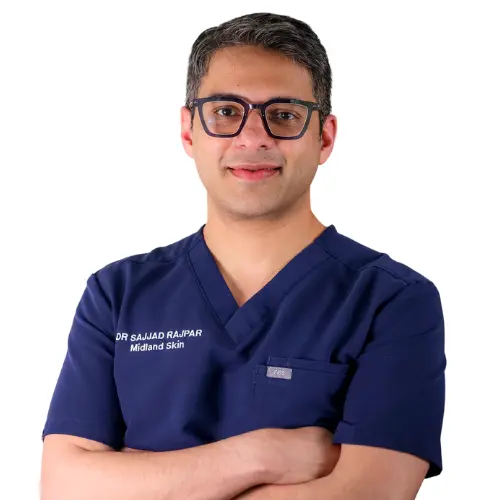
This page has been written and/or medically reviewed by Dr Sajjad Rajpar, Consultant Dermatologist and Medical Director of Midland Skin, Birmingham.
Dr Rajpar is on the GMC Specialist Register in Dermatology and has over 20 years’ experience in clinical dermatology. He provides clinical oversight to ensure the information on this page is accurate, balanced and consistent with current dermatology practice.
Dr Sajjad Rajpar
Date last updated: 28th Sep 2026
Book in with us
Expert, consultant led care in dermatology, skin surgery, eyelid surgery, lasers and aesthetics.
Disclaimer
The content on this website is provided for general information only. It is not, and must not be treated as, medical advice, a diagnosis, or a recommendation for any particular treatment. We make reasonable efforts to keep information accurate and up to date, but medicine and technology change, and content may not reflect the most current evidence, guidance, product information, or individual practice. You should not rely on this website to make decisions about your health or treatment. Always seek personalised advice from an appropriately qualified healthcare professional. Any examples, images, testimonials, and outcome descriptions are illustrative only. Results vary between individuals and no outcome can be guaranteed.

