
Acne treatment in Birmingham
Consultant dermatologist-led assessment and treatment for all types of acne and acne scarring
At Midland Skin we offer specialist acne treatment for patients in Birmingham, Solihull, Coventry, Wolverhampton, Worcester and the Midlands.


Quick Facts about acne treatment

Best for
All ages & types of acne

Appointment
Initial acne assessment
Treatment
Skincare, prescription & procedures

Also treats
Acne scarring

Provider
Consultant dermatologist

Price
See below
Acne treatment at Midland Skin
Acne is common but complex, and the medical team at Midland Skin has extensive experience treating it. Our consultant dermatologists treat the full range of acne — from mild but stubborn acne through to severe, resistant and complex cases — including hormonal acne, acne that has returned after isotretinoin, chronic adult acne, maskne, and acne in sensitive skin or during pregnancy, perimenopause and menopause.
We also treat the after-effects of acne, including acne scarring, persistent red marks and pigmentation.
Your care begins with an initial acne assessment with a consultant dermatologist. This first visit is exploratory: your dermatologist examines your skin, confirms the diagnosis and talks through the treatment options best suited to your acne. You can then take time to consider your options before deciding what you would like to pursue.
An assessment also helps identify whether you have folliculitis, fungal acne, rosacea, perioral dermatitis or another overlapping condition that needs a different line of treatment.
Who should see a consultant dermatologist for acne?
Many people manage mild acne with pharmacy products or GP treatment. A consultant dermatologist assessment is particularly worthwhile when:
- your acne is persistent, severe or starting to scar
- it has not improved with pharmacy or GP treatments
- acne keeps coming back, including after a course of isotretinoin
- you have painful nodules or cysts
- acne is affecting your confidence or quality of life
- you may benefit from specialist-only treatment such as isotretinoin
- you would like to explore non drug based treatments for acne
- you are unsure whether it is acne, rosacea, perioral dermatitis or fungal acne
- you also want to treat acne scarring or marks
What happens at an initial acne assessment?
Your initial acne assessment is with a Consultant Dermatologist, who examines your skin to establish the type and severity of your acne and whether there is any scarring, red marks or pigmentation, and reviews how long you have had it, any pattern to flares, the treatments you have already tried, your current skincare and any relevant medication or health conditions.
Where the appearance is not typical, conditions that can mimic acne are considered (see below).
A care plan is then discussed with you. This may include skincare changes, prescription creams or tablets, or in-clinic treatment where appropriate; no particular medication can be promised before assessment, and blood tests are only arranged where they are genuinely needed.
Getting the diagnosis right
Several common facial conditions can look like acne but need different treatment. A specialist assessment confirms what you are dealing with before treatment begins.
- Rosacea can cause spots and redness but is treated differently, and some acne treatments can make it worse.
- Perioral dermatitis causes clustered small bumps around the mouth or nose and is often linked to steroid creams.
- Fungal acne (Malassezia folliculitis) looks like small, uniform spots but does not respond to standard acne antibiotics.
- Folliculitis, from bacteria or ingrown hairs, can also mimic acne.
Treating the correct condition from the start avoids wasted time on treatments that were never going to work.

Scarlett Greenwood

The acne treatments we offer at Midland Skin
There is no single best treatment for acne. The right approach depends on the type and severity of your acne, your skin, your general health and what you have already tried — so treatment is individualised and recommended after your assessment. Options we offer include:
- Topical prescription treatments with proven active ingredients — including topical retinoids, benzoyl peroxide, clascoterone, salicylic acid, clindamycin, azelaic acid, AHAs and nicotinamide
- Bespoke prescription creams made up for your skin
- Antibiotics — short-term, used alongside topical treatment rather than on their own
- Spironolactone — a hormonal treatment used in some female patients
- Roaccutane (isotretinoin) — for severe, scarring or resistant acne, and a specialist-only medicine
- Intralesional steroid injection for acne cysts
- Hyfrecation of comedones
- Chemical peels
- AviClear — a drug-free acne laser. Midland Skin was the first dermatology clinic in the Midlands to offer it.
- Forever Clear BBL laser treatment
- Laser Genesis
Treatments we offer for acne scarring
If you have both active acne and scarring, we usually aim to get the acne under good control first, as treating scars while acne is still active tends to give poorer results and new spots can undo the work. Acne scarring is also assessed separately from active acne by members of the team who specialise in this, as the two need different care plans.
Once active acne is controlled, we can treat the marks and scars it leaves behind. The right treatment depends on the type of scarring:
- Laser to reduce redness
- Laser to reduce pigmentation
- Laser resurfacing for indented scarring
- Hybrid laser (Halo)
- Subcision
- TCA CROSS
- Sofwave
- Filler injection
- Filler-subcision
- Punch or elliptical excision of a scar
- Keloid scar treatment
What is acne?
Acne can be a very different problem for different people. For some it is the odd spot; for others it causes persistent, large inflamed pustules and nodules that can scar the skin. We help people of all ages with the whole spectrum of acne.
What types of acne are there?
Acne may be comedonal, with blackheads (open comedones) and skin-coloured bumps (closed comedones). It may be inflammatory, with red spots (papules) and pus-filled spots (pustules). Severe acne can form large lumps (nodules) and cysts. Greasy skin may or may not be present.
What causes acne?
There are three main factors:
- Cells lining the hair follicles become “sticky”, clogging the follicles.
- Sebum produced by the sebaceous glands then builds up behind the blockage.
- Overgrowth of Cutibacterium acnes (formerly Propionibacterium acnes), a skin bacterium that thrives on sebum and drives inflamed spots.
Who gets acne?
Acne is common. It usually starts in the teenage years but is increasingly common in adults — around 1 in 5 adults aged 25 to 39 are affected, and adult acne is more common in women.
Why does acne need treatment?
Research consistently shows acne lowers self-confidence and quality of life, and that treatment measurably improves it. Treating acne early also helps prevent permanent scarring.
Control rather than cure
Acne is a chronic condition, so treatment manages it rather than curing it outright — but in most people it can be brought under very good control. A plan is usually started once you decide how to proceed, then built up and adjusted over several reviews until your acne is settled.
Results take time — many treatments take 6 to 12 weeks, sometimes longer, to show a clear benefit — so patience and consistency matter. Once your skin has settled, a maintenance plan helps keep it that way.
Treatment pathway
Initial acne assessment
Your first visit is exploratory. A consultant dermatologist examines your skin, confirms the diagnosis and reviews your history and previous treatments.
Your treatment options
Your dermatologist explains the options suited to your acne. You can take time to consider them and decide what you would like to pursue — there is no pressure to commit on the day.
Treatment and reviews
You start your chosen treatment, which is then adjusted over follow-up reviews until your acne is well controlled.
Your acne appointments: FAQs
Who will assess me?
A consultant dermatologist on the GMC specialist register, who assesses your acne and plans your treatment.
Will I get a prescription at my first appointment?
Your initial assessment is mainly exploratory. Your dermatologist talks through the options suited to your acne and you can take time to decide which to pursue. In many instances, some treatment can often be started at this first visit.
I have acne and scarring — can both be treated at once?
Acne scarring is assessed separately from active acne, because the two need different treatment plans. If you have both, we usually get the acne well controlled first — treating scars while acne is still active tends to give poorer results, and new breakouts can undo the improvement. Once your skin is settled, we can plan scarring assessment with members of the team specialising in this, and subsequent treatment.
Do I need to stop my skincare before my appointment?
No. Attend with your skin as it normally is and ensure you have listed all your medications and skincare in your registration form. Come without makeup so your skin can be assessed.
Will I need any tests?
Sometimes. Blood tests may be needed for certain oral treatments, and hormone tests are occasionally arranged if a hormonal cause is suspected.
Why are review appointments important?
Acne treatment is rarely one and done. Reviews let your dermatologist fine-tune your plan until your acne is well controlled. Review appointments are also necessary for monitoring your treatment, and providing you with continued prescriptions.
Why choose Midland Skin?
- Consultant-led care — every patient is assessed by a consultant dermatologist
- Accurate diagnosis — acne overlaps with other conditions, and a specialist can identify these and treat coexisting problems such as rosacea.
- The full spectrum of treatment in one place — prescription skincare through to hormonal treatment, isotretinoin, in-clinic procedures and acne scarring treatments.
- Access to specialist-only treatment — some acne medicines, including isotretinoin, can only be prescribed by a specialist.
- Experience with complex acne — hormonal, resistant and complex acne, and acne that has returned after previous treatment.
Book in with us
Ready to get started? Book a consultation with our team at Midland Skin. Friendly, expert advice tailored to you.
Fees for acne assessment
Acne assessment Show pricing
Book ConsultationInitial acne assessment
Up to 25 minutes
Review consultation
Standard, up to 20 minutes
Joshua Burrows
References used for this article
- Reynolds RV, Yeung H, Cheng CE, et al. Guidelines of care for the management of acne vulgaris. J Am Acad Dermatol. 2024;90(5):1006.e1–1006.e30. doi:10.1016/j.jaad.2023.12.017.
- Kutlu Ö, Karadağ AS, Wollina U. Adult acne versus adolescent acne: a narrative review with a focus on epidemiology to treatment. An Bras Dermatol. 2023;98(1):75–83. doi:10.1016/j.abd.2022.01.006.
About the Author
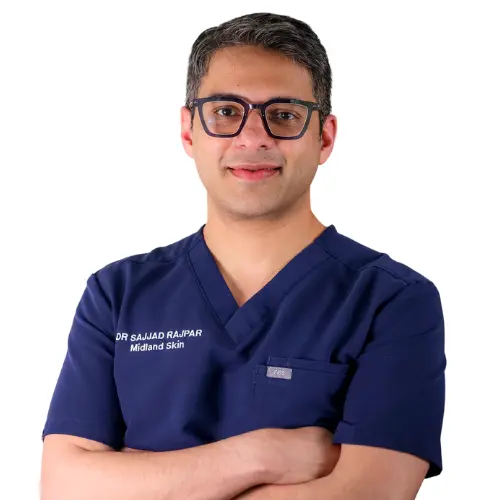
This page has been written and/or medically reviewed by Dr Sajjad Rajpar, Consultant Dermatologist and Medical Director of Midland Skin, Birmingham.
Dr Rajpar is on the GMC Specialist Register in Dermatology and has over 20 years’ experience in clinical dermatology. He provides clinical oversight to ensure the information on this page is accurate, balanced and consistent with current dermatology practice.
Dr Sajjad Rajpar
Date last updated: 26th Sep 2026
Book in with us
Expert, consultant led care in dermatology, skin surgery, eyelid surgery, lasers and aesthetics.
Disclaimer
The content on this website is provided for general information only. It is not, and must not be treated as, medical advice, a diagnosis, or a recommendation for any particular treatment. We make reasonable efforts to keep information accurate and up to date, but medicine and technology change, and content may not reflect the most current evidence, guidance, product information, or individual practice. You should not rely on this website to make decisions about your health or treatment. Always seek personalised advice from an appropriately qualified healthcare professional. Any examples, images, testimonials, and outcome descriptions are illustrative only. Results vary between individuals and no outcome can be guaranteed.

